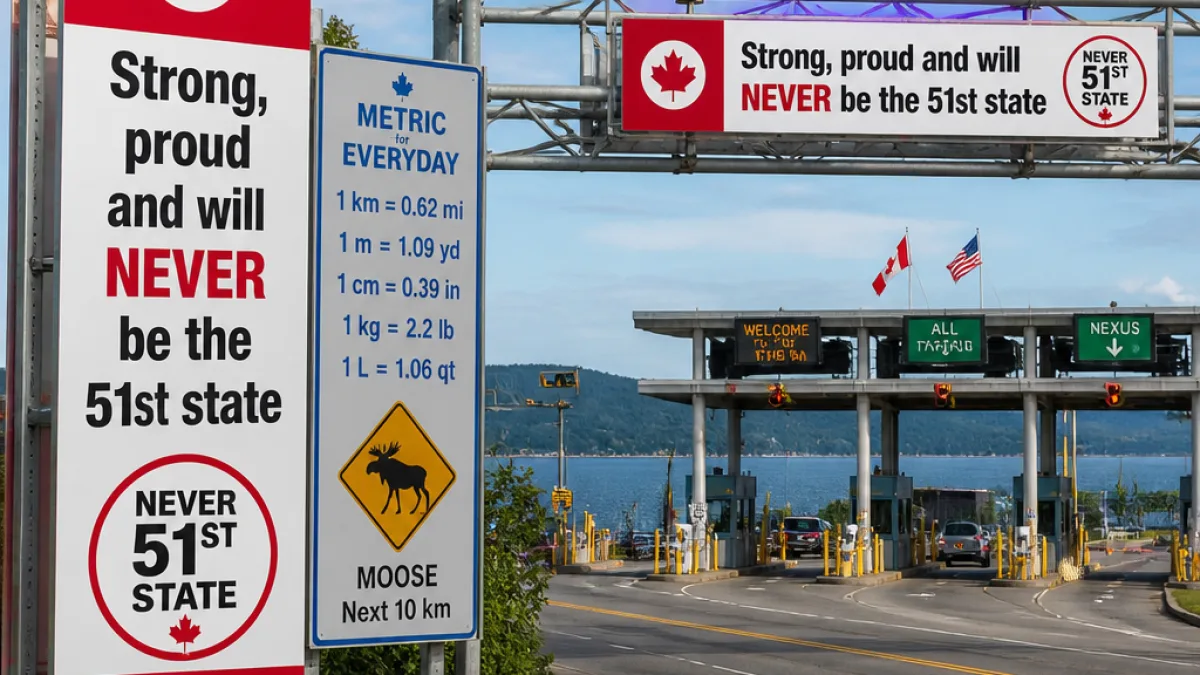
British Columbia will erect new signs at American border crossings that declare Canada will "NEVER be the 51st state," Premier David Eby announced Tuesday as Ottawa’s counter‑tariffs took effect in response to U.S. levies.
Symbolic pushback at the frontier
The signs, unveiled at a Victoria news conference on Sept. 8, are designed as a visible expression of provincial resistance to what Mr. Eby described as an "unhinged" U.S. president and an escalating trade conflict that threatens jobs on both sides of the border. One example reads: "Strong, proud and will NEVER be the 51st state. Sorry!" Other panels include metric conversion information, a moose warning and a logo showing the phrase "Never 51st State" with a line through it.
“All I can say is that the president is clearly unhinged,” Mr. Eby said, pointing to recent videos posted by U.S. President Donald Trump.
The premier criticised social‑media posts that, in one instance, portray Mr. Trump as a hockey player assaulting a figure identified in media coverage as Prime Minister Mark Carney. He called such memes "bizarre" and "disturbing," saying they do not befit the leader of the world’s largest economy.
What the signs say — and why
Mr. Eby framed the signage as part of a broader message: Canadians are kind and compassionate, but that should not be mistaken for weakness. He used the moment to urge British Columbians to support homegrown business as Ottawa and Washington impose tariffs and counter‑tariffs.
| Sign text | Intended message |
|---|---|
| "Strong, proud and will NEVER be the 51st state. Sorry!" | Affirmation of Canadian sovereignty and provincial defiance |
| Metric conversion data / moose warning / "Never 51st State" symbol | Playful cultural reminders to U.S. travellers and a symbolic pushback |
| "Kindness ≠ Weakness" | Message that Canadian values should not be exploited |
Practical limits and policy trade‑offs
While the signs are a clear symbolic measure, Mr. Eby acknowledged the province’s limited fiscal room to cushion businesses against the fallout. B.C. is forecast to run what the government describes as a historic $13‑billion deficit this year, curtailing the provincial ability to introduce large new assistance programs.
As a result, the premier said British Columbia will advise Ottawa on federal supports for sectors that are expected to be hit hardest, including forestry. He also dismissed calls to roll back recent expansions of the Provincial Sales Tax to some services — a move critics say will raise prices at a time the government is urging residents to buy local.
- Province will install signs at U.S. border crossings to make a public stand.
- B.C. will advise Ottawa on federal aid measures for affected sectors such as forestry.
- Province has limited direct fiscal options due to a projected $13‑billion deficit and will not roll back PST expansion.
Local stakes for industry and communities
Forestry and other export‑dependent industries in B.C. were singled out as vulnerable to the tit‑for‑tat levies. Mr. Eby warned there is "no getting around the fact that people will lose their jobs, and businesses will close on both sides of the border," acknowledging the human cost behind the political rhetoric.
He also emphasised the need for diversification of trading partners, arguing a more global set of markets would provide predictability and stability if relations with the United States remain volatile.
Mix of symbolism and outreach
The new signs are a symbolic element of a broader provincial response that mixes public messaging with policy advice to Ottawa and appeals to consumers to support domestic suppliers. Critics have argued that symbolism without substantial provincial financial relief will offer little protection to workers who face layoffs or businesses threatened by sudden tariff changes.
At the news conference, the atmosphere alternated between levity and seriousness — an entertainer known as OGR‑Scintilla provided warm‑up before Mr. Eby spoke — but the premier’s message ended on a sober note: British Columbians should prepare for difficult months ahead while leaders seek options to mitigate economic harm.
As the tariff dispute plays out, border communities and export industries will be closely watching what measures Ottawa, Washington and provincial governments put in place to soften the blow and preserve trade ties that are integral to the West Coast economy.