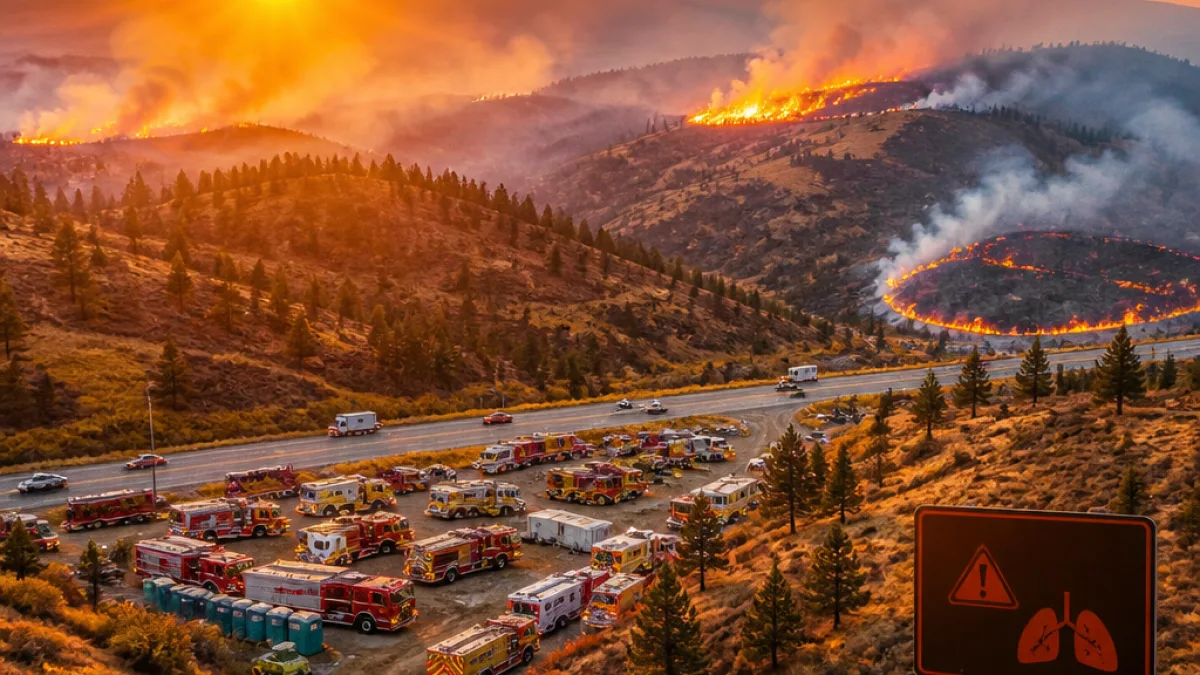
Merritt, B.C. — British Columbia’s wildfire situation showed signs of stabilizing Tuesday as the BC Wildfire Service removed one blaze from its list of wildfires of note, leaving three large incidents still of highest concern across the province.
Improved conditions let crews fight more directly
Following a weekend that saw roughly 11,000 lightning strikes spark dozens of new fires, the agency says shorter days and rising humidity have allowed crews to mount more direct suppression efforts.
“Shorter days and higher humidity levels have allowed crews to directly attack the fires more often,” said Teoh in a video update posted by the service.
That shift has contributed to a decline in the total number of active wildfires. The tally had climbed past 180 in the immediate aftermath of the lightning event; it now sits at about 160 active fires, the service reported.
Three fires remain of particular concern
The BC Wildfire Service currently lists three incidents as fires of note:
- Ainslie Creek — prompting an evacuation alert covering roughly 280 properties in the Nicola Valley and an evacuation order affecting 61 properties along Highway 5 southwest of Merritt;
- Pear Lake — associated flooding risk from the blaze has left parts of the Village of Clinton still under evacuation alert, even though much of the community’s alert has been rescinded;
- Bald Range — the large south Okanagan fire that earlier forced the evacuation of about 20,000 residents and destroyed roughly 150 structures; its growth has slowed but it remains a major incident spanning the area west of Summerland.
Provincial crews and aircraft remain strategically positioned to respond to new starts, officials said, because hot and dry conditions are expected to return later in the week and lightning remains a forecast threat.
Air quality: improvements in some areas, warnings remain elsewhere
Smoke conditions have eased in several zones. Environment Canada lifted a yellow‑level air quality warning that had stretched from the Fraser Canyon through Penticton and Kamloops to the Chilcotin, though a warning remains in place for the eastern Fraser Valley.
The Metro Vancouver regional district cautioned residents that fine particulate matter levels are still elevated in parts of the Lower Mainland due to wildfire smoke drifting from interior blazes.
| Area | Status |
|---|---|
| Nicola Valley (Ainslie Creek) | Evacuation alert ~280 properties; order for 61 properties on Hwy 5 |
| Village of Clinton (Pear Lake) | Evacuation alert mostly rescinded, some properties remain at risk from flooding |
| South Okanagan (Bald Range) | Major fire, growth slowed; earlier evacuation of ~20,000 residents |
What residents should know and do
Officials urged residents in affected zones to remain prepared. Practical steps include keeping vehicles fuelled, having a grab‑and‑go kit ready, and monitoring local evacuation orders and alerts via municipal and provincial channels.
- Check current evacuation status at local government websites or EmergencyInfoBC.
- Follow public health guidance on masks and limiting outdoor activity when smoke is heavy.
- Be ready to move if an evacuation order is issued — orders require immediate departure, while alerts mean residents should be prepared to leave.
Emergency management agencies said crews are prioritizing resources where the threat to life and property is greatest and reshaping responses as weather and fire behaviour evolve. Aircraft, heavy equipment and ground crews remain active in key zones.
While the recent dampening in fire activity is welcome, officials cautioned that a return to hotter, drier conditions could reverse progress quickly. Communities across interior and southern B.C. should therefore continue to monitor wildfire bulletins and air‑quality updates closely.
This report is based on information released by the BC Wildfire Service, Environment Canada and regional public safety officials.