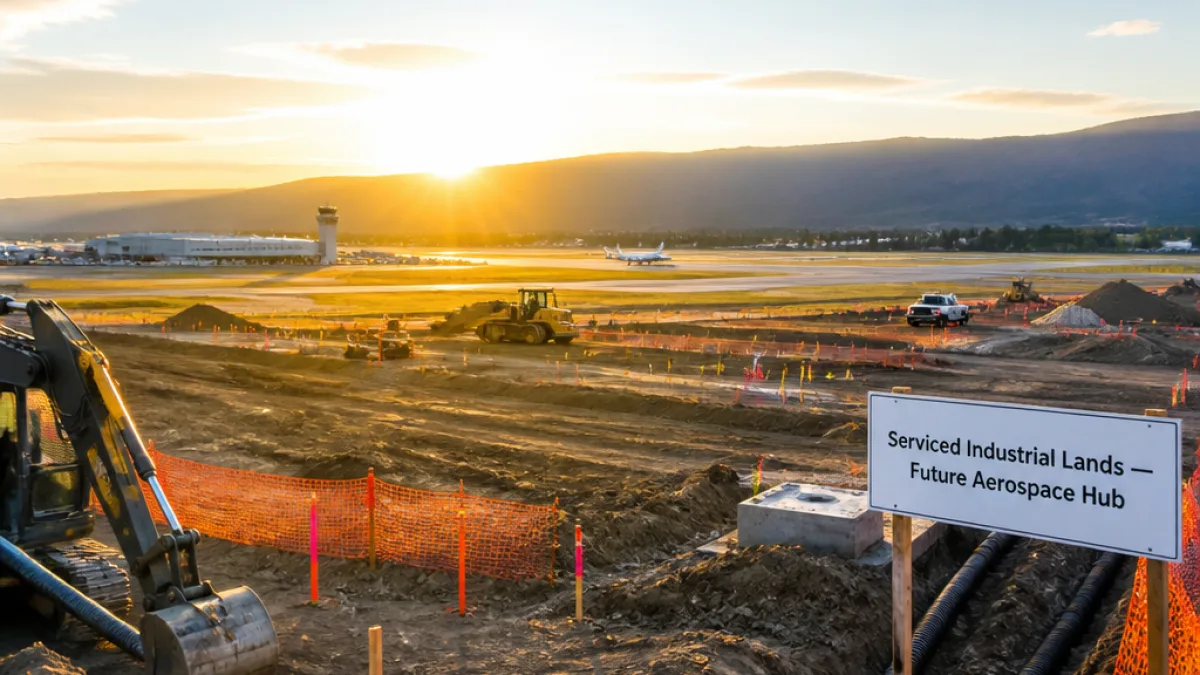
The federal government has committed $22.4 million to infrastructure work that will free up 165 acres of industrial and commercial land on the east side of Kelowna International Airport (YLW), a move municipal and industry leaders say will accelerate aerospace and related economic growth in the Central Okanagan.
Funding and purpose
Kelowna MP Stephen Fuhr announced the contribution from the Build Communities Strong fund to support a $58.8-million development intended to service the east lands with essential utilities. The money will be used for construction of water, sewer, electrical and communications infrastructure to prepare parcels for immediate industrial use.
The airport authority says the serviced parcels are being prepared for companies that have already expressed firm interest. Three aerospace and aviation-related organisations — FireSwarm Solutions, Wildcat Helicopters and De Havilland Canada — have signed letters of intent and toured the site with local dignitaries.
“The Kelowna International Airport is already a major economic engine for our region. This investment will unlock valuable airport lands, attract new investment and aerospace companies, and create skilled Canadian jobs,”
Fuhr said in the announcement that the investment will help strengthen the local economy while creating new opportunities for Canada's aerospace industry in the Okanagan.
Local planning and timelines
Phillip Elchitz, director of airport operations and innovation, told media the airport has a clear plan for parcel layout and expects to move quickly from planning to construction. He said there is a good sense of where several tenants will be located and that work on the first phase is slated to begin in the spring, with completion of that phase expected by 2028.
Airport representatives emphasised that the funding is aimed at unlocking land rather than subsidising tenant operations. The newly serviced parcels are meant to attract aerospace manufacturers and service companies that need ready access to runway infrastructure and regional markets.
Industry interest and operational advantages
De Havilland Canada — one of the parties expressing intent — said the Okanagan's climate and operational environment present advantages for some aircraft work. Representatives noted challenges that extreme weather in other parts of Canada, such as Calgary, can present for flying and testing aircraft during winter months.
Sherry Brydson, co‑chair of De Havilland Canada’s board, described the Okanagan as a desirable location for finishing work on aircraft. Neil Sweeney, vice‑president of corporate affairs at De Havilland Canada, highlighted operational difficulties testing certain aircraft in winter, including water bomber testing, and pointed to the value of a southern B.C. location that can mitigate some weather constraints.
Economic and community implications
Local officials say the project could create skilled jobs and broaden Kelowna’s industrial base beyond its traditional strengths in technology, tourism and agriculture. The airport has for years been touted as a regional economic engine; moving to open these east lands is one of the more significant steps to intensify industrial and aerospace activity directly adjacent to airport infrastructure.
Details remain to be finalised on the pace of parcel sales or long‑term leases, environmental and community impact assessments, and the number and types of jobs that the development will generate. Airport officials have said they are working toward agreements with the interested firms and expect construction to commence quickly once approvals and contracts are in place.
- Federal contribution: $22.4 million from Build Communities Strong fund
- Total project cost: $58.8 million for infrastructure servicing
- Area to be serviced: 165 acres on YLW east lands
- Companies with letters of intent: FireSwarm Solutions, Wildcat Helicopters, De Havilland Canada
- Construction timeline: first phase begins in spring, with work through 2028
| Item | Figure |
|---|---|
| Federal funding | $22.4M |
| Total project cost | $58.8M |
| Land to be serviced | 165 acres |
| Planned completion (phase 1) | By 2028 |
As Kelowna continues to grapple with growth pressures, housing needs and transportation demands, the airport expansion introduces both economic opportunity and local planning questions. How the city, regional district and airport authority balance industrial expansion with community priorities such as housing affordability, traffic impacts and environmental stewardship will be closely watched by residents and stakeholders in the months ahead.