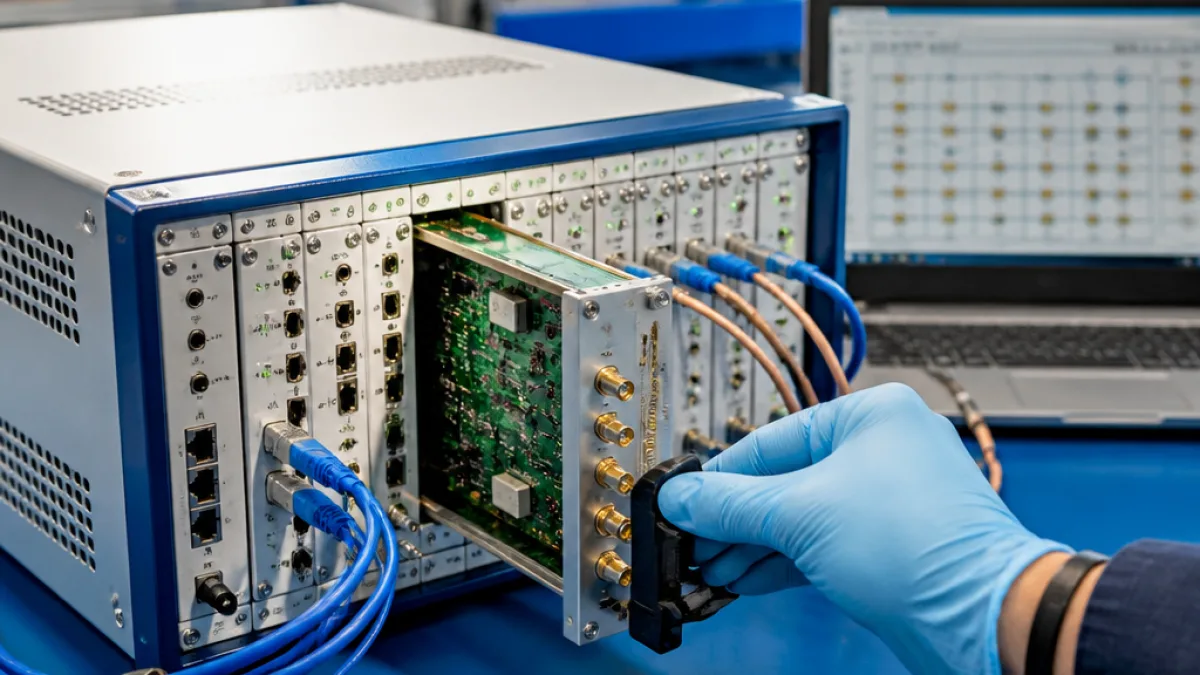
Pickering Interfaces has introduced a new modular Ethernet‑controlled LXI matrix module designed to let test engineers expand systems as requirements evolve and make servicing simpler, the company announced.
Modular approach aims to reduce downtime and programming complexity
The 65‑217 plug‑in module is built for the company’s 65‑200 scalable LXI chassis platform. Up to six modules can be fitted into a single 65‑200 chassis to create one continuous matrix, rather than operating multiple 64x8 elements separately. That approach is intended to reduce programming complexity because the control software manages the path identification offsets between modules.
Key technical points include:
- Each plug‑in provides a 64x8, 1‑pole matrix.
- Systems can be expanded to a maximum 384x8 configuration in a 19‑inch, 2U chassis by combining up to six modules.
- Modules are front‑loaded for installation and replacement without removing the chassis from a test rack, simplifying maintenance.
Steve Edwards, the company’s Head of Product Management, said the product gives users a practical way to start with the matrix size they need and expand later. The company is also offering versions with and without front‑panel Y‑axis access, and supports switched Y‑axis loop‑through connections for matrix expansion across multiple chassis.
"The 65‑217 gives users a practical way to start with the matrix size they need today and expand it later," the company said.
Designed for demanding test environments
The 65‑217 supports RF crosstalk measurements on unterminated signal paths, a requirement specified in some aerospace and automotive test applications. The module can switch up to 300 VDC or 250 VAC and 2 A, with a maximum power rating listed as 60 W or 62.5.
To help manage component life and reduce unplanned downtime, Pickering Interfaces has included relay cycle counting to plan preventive maintenance and balance usage across signal paths. Built‑in diagnostic features include BIRST (Built‑In Relay Self‑Test) and compatibility with optional external eBIRST self‑test tools to identify failed or worn relays. Each plug‑in also mounts spare relays to simplify servicing.
Flexibility and instrument access
The product’s design also offers flexibility in how instruments access the matrix. A dual Y‑axis analog bus allows multiple external instruments to access different portions of the matrix, and the system can be divided into two independent matrices if required. Switched Y‑axis points permit disconnection of unused sections to help maximise bandwidth.
| Modules installed | Resulting matrix size |
|---|---|
| 1 | 64x8 |
| 6 (maximum) | 384x8 |
Front‑loaded plug‑in modules are a notable physical design choice: they allow service personnel to add or replace modules without extracting the chassis from a rack. The manufacturer says this reduces downtime and simplifies expansion planning for labs and production test environments.
Pickering Interfaces’ announcement highlights the product’s suitability for sectors with stringent testing protocols, such as aerospace and automotive, where unterminated crosstalk measurements can be a specific requirement. The modular architecture and integrated diagnostics are aimed at customers who need scalable, maintainable test matrices in a compact 19‑inch, 2U form factor.
As Pickering remains home to companies serving test and measurement markets, the new 65‑217 plug‑in aligns with ongoing demand for flexible, scalable test hardware that reduces rack‑level complexity and supports preventative maintenance strategies.