
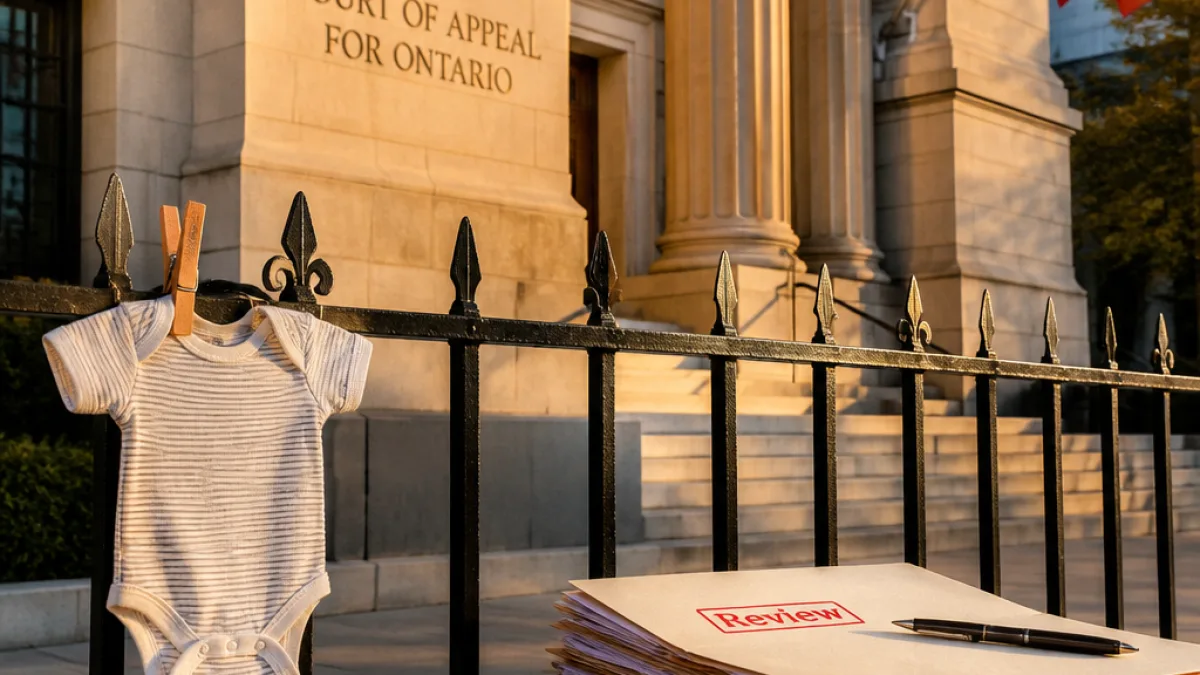
An Ontario woman who was convicted of manslaughter more than two decades ago is asking the province’s top court to set aside her conviction after new medical reviews raised serious doubts about the evidence that led to her conviction.
Background of the case
Jennifer Gaskin was convicted in 2002 in the death of her 2 1/2‑month‑old son, Joeseph. At trial, two medical experts testified that the baby had died as a result of shaken baby syndrome, a finding that formed the basis for the manslaughter verdict.
The infant had been born prematurely and spent the first two months of his life in hospital, court records show. Years after the conviction, the province conducted a broad review of shaken‑baby cases dating from the mid‑1980s through the mid‑2000s, and that review returned significant questions about the reliability of the medical evidence used in many of those cases.
Fresh expert reviews and the appeal
Gaskin’s legal team subsequently retained three medical experts to re‑examine the prosecution file. According to court documents filed ahead of the appeal hearing, those experts concluded they could not exclude the possibility of an inflicted injury, but they also found Joeseph could have died from sudden infant death syndrome (SIDS).
“The original expert evidence supporting her conviction has been ‘wholly undermined and placed in grave doubt,’” the Crown said in submissions ahead of the appeal hearing, and it urged that the new findings be admitted as fresh evidence and that Gaskin be acquitted.
What the Crown is asking the court to do
In an unusual turn, the Crown has told the court the newly obtained expert opinions should be treated as fresh evidence and that, on the basis of that evidence, Gaskin’s conviction ought to be quashed. The Crown’s position underscores how far standards of medical interpretation in child‑death cases have shifted since the era in which Gaskin was tried.
Local and systemic implications
The case sits at the intersection of evolving medical science and criminal law. For families, it raises the prospect that longstanding convictions based on now‑disputed forensic opinions could be revisited. For prosecutors and defence lawyers, it underscores the ongoing challenge of ensuring expert medical testimony meets current scientific understanding.
Possible implications include:
- Re‑examination of other convictions that relied on older shaken‑baby testimony;
- Questions about how courts should treat retrospective expert opinions in appeals and post‑conviction reviews;
- Pressure on coroners’ and medical panels to re‑assess historical infant‑death determinations in light of contemporary science.
Timeline
| Year | Event |
|---|---|
| 2002 | Jennifer Gaskin convicted of manslaughter in the death of her 2 1/2‑month‑old son, Joeseph. |
| Mid‑1980s to mid‑2000s | Province later reviewed shaken‑baby cases from this period, raising concerns about medical evidence used. |
| Post‑2002 (years later) | Gaskin’s defence retained three experts who found SIDS could not be ruled out. |
| 2026 | Ontario’s top court set to hear the appeal where the Crown seeks to admit the new evidence and acquit Gaskin. |
What’s next
The appeal hearing at the province’s top court will determine whether the new medical opinions are admissible as fresh evidence and whether they are sufficient to overturn a 2002 manslaughter conviction. If the court accepts the new evidence and grants the Crown’s request, Gaskin could be acquitted. If not, the conviction may stand pending any further legal options.
The case will be watched closely by legal advocates, medical experts and families affected by similar prosecutions. It adds to a growing catalogue of cases that spotlight how advances in medical knowledge can alter the legal significance of expert testimony given years earlier.
Coverage of the hearing will continue as the province’s court calendar updates and more documents become public.















