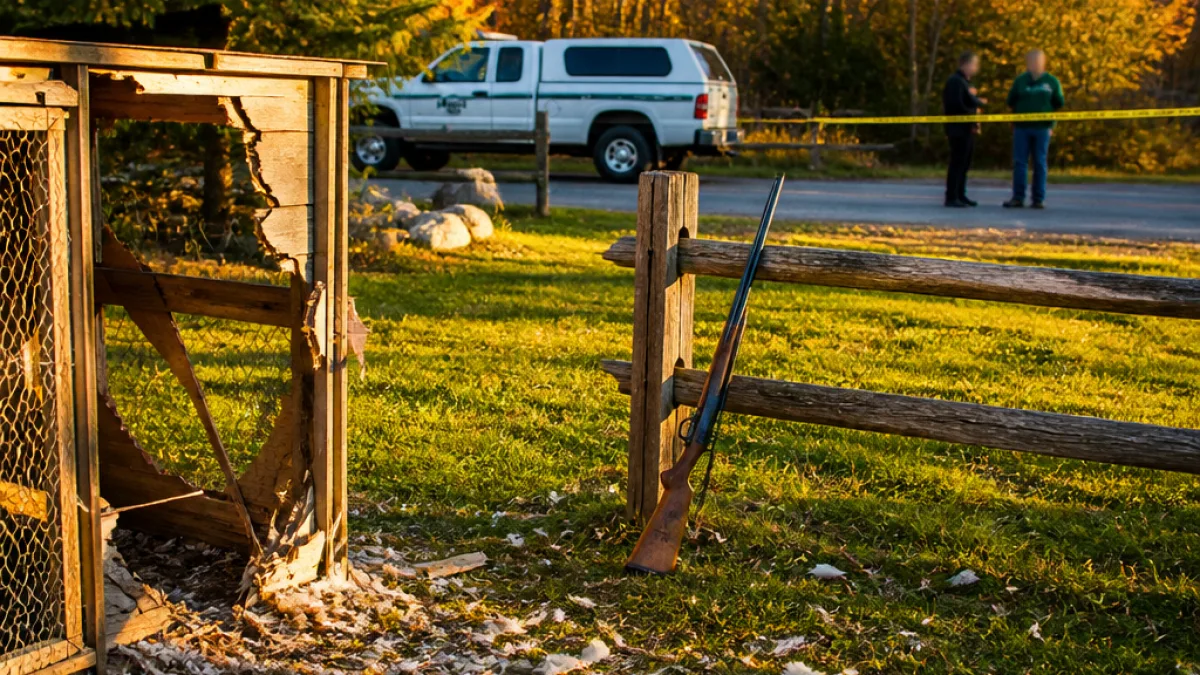
A Granby man in Connecticut has been charged after shooting and killing a bear in his backyard, an episode that has reopened debate over a 2023 state law that constrains when firearms may be used against black bears and sets out a multi-step process before lethal action is allowed.
What happened
Authorities say Michael Gero shot and killed a bear on Friday after calling the incident into the state. Gero, who has previously confronted bears on his property, told reporters in 2024 that he chased a bear that had attacked one of his goats, striking the animal until it retreated into the woods.
The Department of Energy and Environmental Protection (DEEP) has cited Gero for illegally killing the bear. Under the 2023 Connecticut law, a bear can only be killed when humans or pets are in immediate danger. The law also requires that non-lethal mitigation be attempted first, that the landowner meet with a DEEP biologist, and that DEEP issue a Bear Agricultural Damage Permit before an animal may be taken.
Local officials and community reaction
Granby Town Manager Mike Walsh said he sympathizes with both the man and the animal and described the situation as difficult. He told reporters that while there might have been other ways to handle the event, the circumstances make it hard not to be sympathetic to the position the homeowner faced.
“Reviewing the law I think is needed and also more training on DEEP’s part to communities that may be in the situation,”
Walsh urged a review of the legislation and called on DEEP to step up community outreach and training so residents understand the consequences and the process to follow when bears are causing damage.
Legal requirements under the 2023 law
The statute narrows immediate recourse for residents confronted by bears and sets out a tiered approach before lethal measures can be authorised. According to public reports on the case, the steps required by law include:
- Attempting non-lethal methods to deter or remove the bear;
- Meeting with a DEEP biologist to review the situation;
- Obtaining a Bear Agricultural Damage Permit from DEEP prior to taking lethal action.
Notably, the law's definition of "pets" does not automatically include certain animals that residents commonly keep for agricultural purposes; goats and chickens fall into a grey area in public discussion of the statute.
| Item | Reported detail |
|---|---|
| Charged individual | Michael Gero |
| Alleged justification | Bear attacking chickens and suspected to have killed goats the prior month |
| Relevant authority | Connecticut Department of Energy and Environmental Protection (DEEP) |
| Court date | Oct. 8 (case scheduled) |
Public response and next steps
The incident has prompted vigorous public reaction online. A social media post about the case drew more than 2,200 comments, many expressing support for the homeowner and questioning whether the law adequately protects people who keep small livestock or poultry.
Gero’s family has said they plan to meet with an attorney. The matter is scheduled to be heard in court on Oct. 8. DEEP has been contacted for comment but, at the time of reporting, had not provided a full response to media enquiries.
Why it matters in Quebec and beyond
While this episode took place in Granby, Connecticut, it speaks to broader tensions in rural and semi-rural communities across Eastern Canada and the northeastern United States, where expanding wildlife populations and changing land use bring residents into more frequent contact with species such as black bears. Laws designed to protect wildlife can clash with the immediate needs of property owners and farmers facing recurring damage or threats to animals.
Local officials in Granby, Conn., are calling for greater clarity and outreach from DEEP; whether that will prompt legislative or regulatory changes remains to be seen. For nearby communities that raise small livestock or keep poultry, the case underscores the importance of understanding the legal framework and the limited circumstances under which lethal force is permitted.
As the case proceeds to court, it will likely be watched by residents and officials who want a clearer balance between humane wildlife conservation and the practical safety concerns of householders and small-scale agricultural operators.