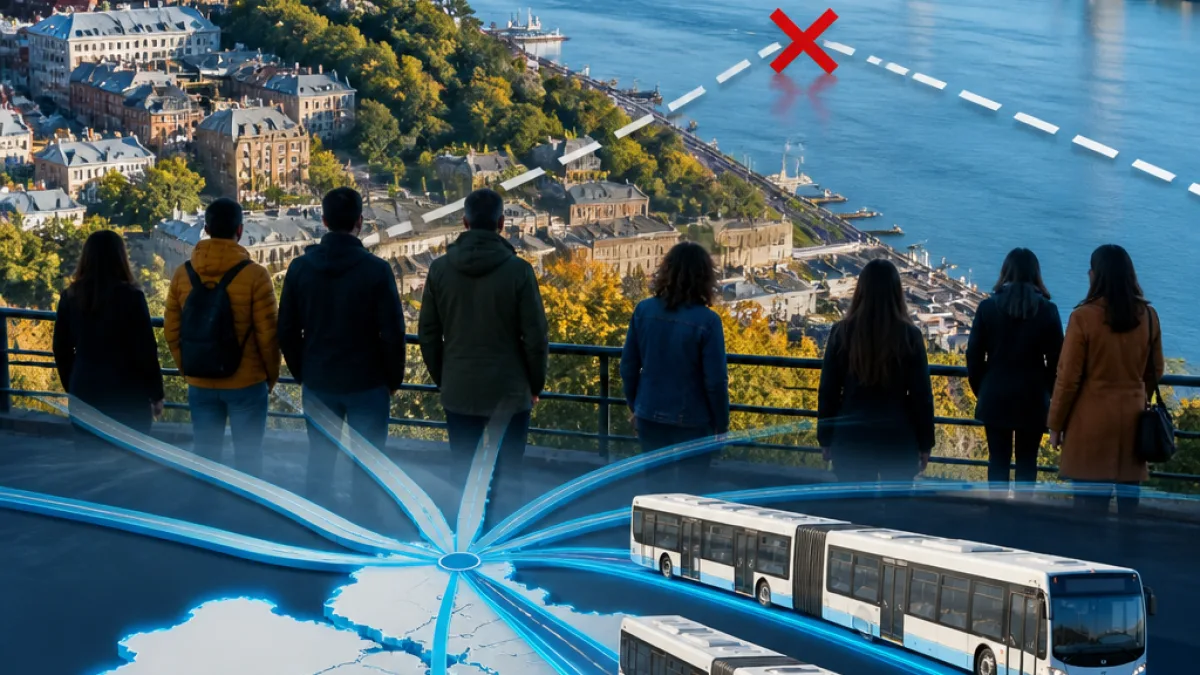
Party says tunnel or bridge will not begin within four years; transit investments to be emphasised
The Parti Québécois has told voters in the Quebec City region it will not begin construction on a long-discussed third link between Quebec City and Lévis during its first mandate, arguing that such work is unrealistic within a four-year horizon. The party instead proposes a short-term focus on strengthening public transit to ease congestion across the Capitale-Nationale area.
Speaking at a presentation of party priorities for the region, leader Paul St‑Pierre Plamondon said promises to build a tunnel or other new connection in the near term amount to misinformation. He framed his party's approach as pragmatic, prioritizing measures that can deliver relief faster and at lower immediate risk.
"Any other party that tells you they're going to build a tunnel or a link on Île d'Orléans is shamelessly lying to the public,"
The PQ document for the region advocates increasing the frequency and number of buses operating in and around Quebec City. The party says bolstering bus service would reduce congestion and provide more reliable alternatives to private cars while long-term solutions are studied.
The announcement drew swift criticism from other provincial rivals. Éric Duhaime, leader of the Conservative Party of Quebec, accused the PQ leader of betraying prior commitments and seized on the issue as a campaign wedge. Duhaime has promoted a plan that would include a two-lane bridge connecting Île d'Orléans and Bellechasse, a proposal at odds with the PQ's stance.
Local stakes and short-term versus long-term planning
For residents of Quebec City and Lévis, the debate revolves around immediate commuting needs and the future shape of regional mobility. The existing links across the St. Lawrence are essential arteries for workers, students and commercial traffic. A third crossing has been discussed for years as a way to relieve chronic congestion, but it remains controversial because of cost, environmental and land-use implications.
By declining to commit to starting construction in a first term, the PQ signals it will prioritise measures that can be implemented quickly. Enhanced bus service — if planned and funded effectively — could provide more frequent options on major corridors and support modal shift away from single-occupant vehicles. That approach appeals to urban voters concerned about service reliability, but it is likely to frustrate constituencies and stakeholders that want a concrete timeline for a new crossing.
Political opponents framed the PQ move differently. Duhaime, who emphasises rapid infrastructure creation, cast the announcement as a retreat from earlier commitments and warned it would carry political costs. The exchange at times referenced the Coalition Avenir Québec (CAQ) as well, with the PQ leader accusing the governing party of misleading the public on the feasibility of a third link.
| Party | Stance on third link | Near-term priority for Quebec City region |
|---|---|---|
| Parti Québécois | Will not begin construction in first term; views immediate construction as unrealistic | Increase bus frequency and number of buses to reduce congestion |
| Conservative Party | Advocates a new connection — Duhaime proposes a two-lane bridge to Île d'Orléans/Bellechasse | Build infrastructure to create crossings |
What residents should expect next
Residents and municipal leaders will be watching for the PQ's specifics on transit funding, routes and timelines. Delivering meaningful increases in bus frequency requires investments in vehicles, drivers, bus priority measures and operating budgets — items that can become central bargaining points in negotiations with municipalities and transit agencies.
- Short-term: PQ proposes more frequent and numerous bus services to address congestion.
- Medium-term: the party suggests studying longer-term solutions rather than launching construction immediately.
- Political impact: the decision sharpens contrasts with the Conservatives and invites scrutiny from voters focused on infrastructure promises.
As the campaign unfolds, Quebec City residents will evaluate whether a focus on improved transit is a pragmatic step or an insufficient substitute for a new crossing — a question that will shape debates at council chambers and on the doorstep in the months ahead.