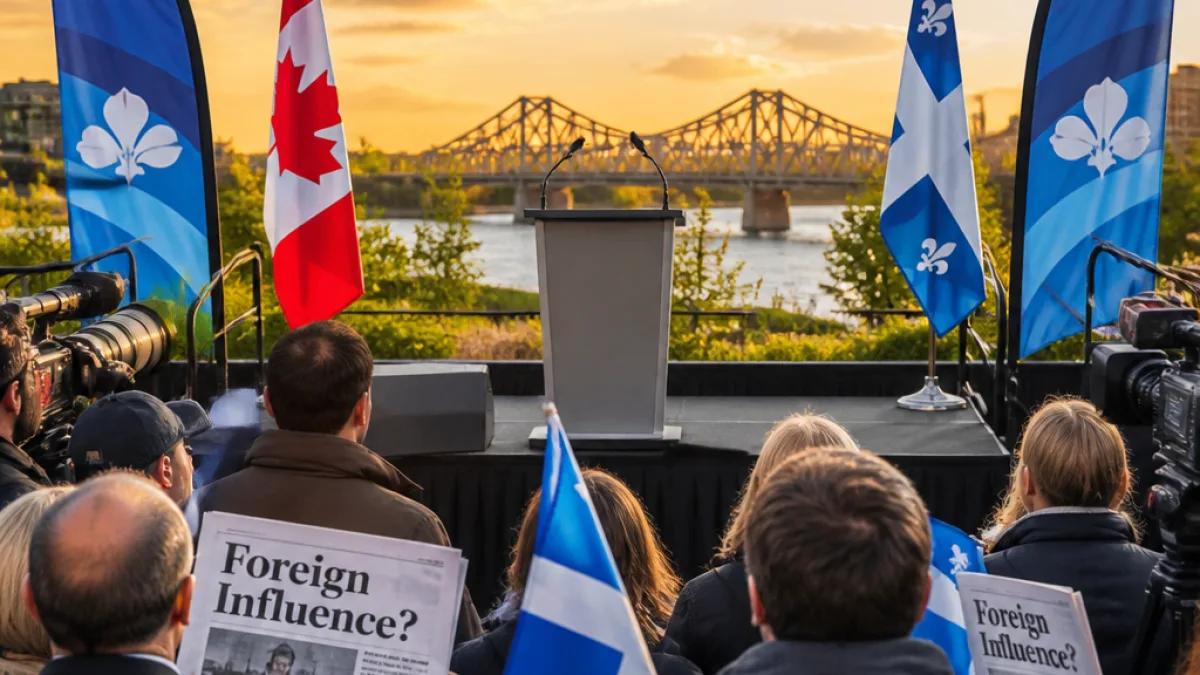
Claims that American actors may be manoeuvring to influence the outcome of Quebec’s election dominated the provincial campaign trail Saturday, a day before advance polling begins for the Oct. 5 vote.
Coalition Avenir Québec leader Christine Fréchette raised the alarm while campaigning in Gatineau, saying she has grown concerned by material she said came to her party’s attention and by essays from a U.S.-based think tank that call for measures to undermine the Canadian federation.
“I mostly want to raise awareness among Quebecers to the situation that could occur. For now, there hasn’t been interference, it hasn’t happened. But nonetheless, it looks like there could be attempts from American interests to destabilize Canada, to destabilize Quebec,”
Fréchette said her party contacted the Canadian Security Intelligence Service after learning about the materials, and that the federal intelligence agency arranged a meeting last Wednesday. She linked her concerns to the Parti Québécois’s pledge to hold a referendum in its first mandate, arguing a referendum could play into “the American’s hands.”
The comments follow reporting by Quebecor media citing two unnamed sources who said American officials had reached out to Quebec over tariff negotiations. That article also highlighted a February essay by the Washington-based Defense Analyses and Research Corporation (DARC) — described by Fréchette as promoting destabilizing measures.
Rivals push back
Opposition leaders responded with scepticism. Parti Québécois leader Paul St-Pierre Plamondon has insisted his party would not seek a referendum while U.S. President Donald Trump remains in office. During campaigning in Saint-Augustin-de-Desmaures, St-Pierre Plamondon appeared to downplay the CAQ leader’s scenario, saying the party’s position reduces the specific threat Fréchette described.
Federal Foreign Affairs Minister Anita Anand also weighed in, saying Friday she has not seen evidence of foreign interference in the provincial vote but that the allegations are being taken seriously.
The exchange has added an international dimension to what was already a tightly contested campaign, drawing attention from voters and media as advance polls open across the province.
What is known and what isn’t
At the core of the controversy are a combination of media reports, a think-tank essay and unnamed sources. Fréchette has been careful to say she has not seen proof of interference in the current election, but argues the ideas she has read and the outreach reported by Quebecor raise credible concerns.
Opponents and some commentators have characterised her warnings as speculative and politically timed, given the potential electoral fallout from talk of foreign meddling.
That tension — between precautionary alert and political accusation — is now part of the late-stage campaign narrative. For voters, the debate raises practical questions about the integrity of democratic processes and about what provincial and federal institutions can do to identify and respond to foreign influence.
- CAQ: Fréchette expressed concern about possible American attempts to destabilize Canada by supporting sovereigntist interests.
- Parti Québécois: Paul St-Pierre Plamondon says PQ would not hold a referendum while Trump is in office.
- Federal government: Anita Anand says no evidence seen yet of interference but the matter is being taken seriously.
Below is a brief summary of public positions aired so far:
| Actor | Position |
|---|---|
| Christine Fréchette (CAQ) | Raised alarm over possible U.S. attempts to destabilize Quebec/Canada; contacted CSIS |
| Paul St-Pierre Plamondon (PQ) | Committed to not holding a referendum while Trump is in office |
| Anita Anand (Federal) | No proof seen of interference to date; allegations taken seriously |
Local impact and the road ahead
With advance polling beginning Sunday, the debate could affect turnout and the tenor of the final days of the campaign. Voters alarmed by the suggestion of foreign meddling may press parties for more detail on what was shared with intelligence services and what specific steps are being taken to guard the vote.
Officials at Elections Quebec and at federal security agencies have limited their public comments, pointing to ongoing inquiries and stressing the importance of evidence-based assessments. For campaign managers, the episode presents a communications challenge: reassure the public without amplifying unverified claims.
As Quebecers head to the polls, the question of foreign influence — and of how parties and institutions respond to it — will remain a live political issue. For now, leaders on the provincial stage offer different readings of the facts, and federal agencies say they are watching closely.
This story will likely evolve as intelligence agencies, journalists and political actors provide more detail. Advance polling opens Sunday ahead of the Oct. 5 election.