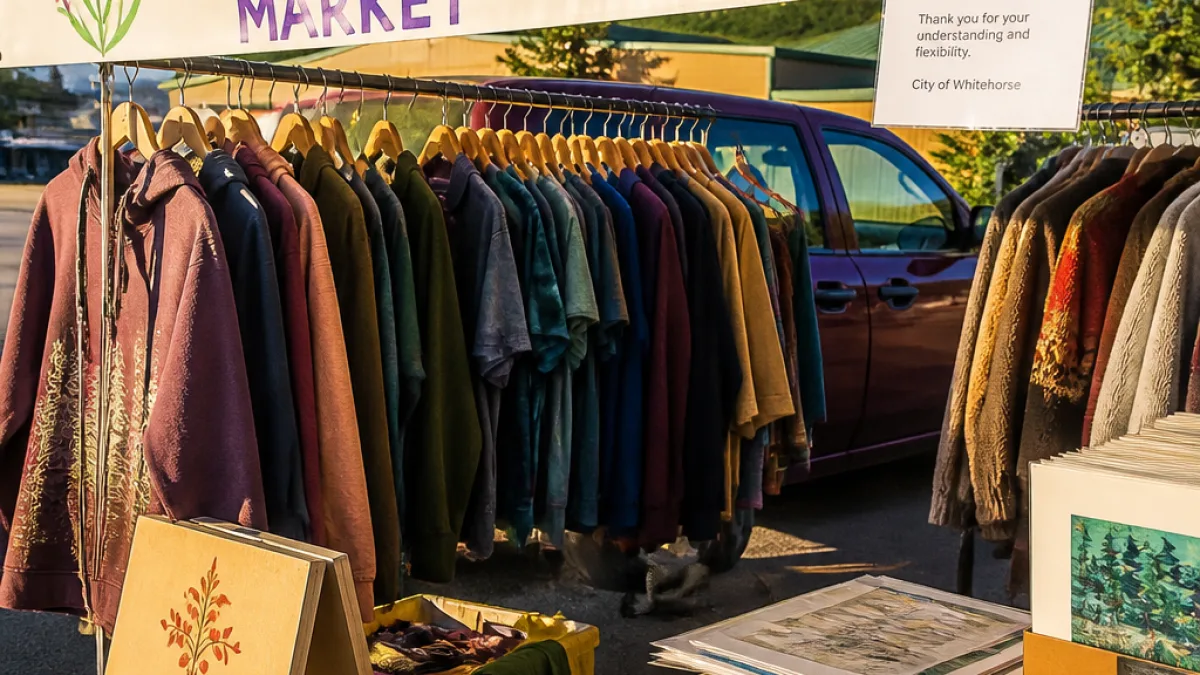
A Whitehorse clothing business that has sold at the Fireweed Community Market for three years says it may be forced to close after the market board told the company its products do not meet vendor rules.
Dispute centres on who creates the artwork
Sunshine and Wild Co., a sustainable clothing company co-owned by Annika Phillips and Emillie Denis, was informed this spring that it may no longer be allowed to participate in the Fireweed Community Market pending a board review of its products.
The board’s concern, according to a letter sent in April, is that the artwork printed on many of Sunshine and Wild’s garments is rendered into final, print-ready digital files by a local artist, Charlotte Heffelfinger. The Fireweed Market board says that process means the artwork is not the original work of Sunshine and Wild and therefore falls afoul of the market’s rule that vendors may not sell items whose primary value-add is commissioned.
Sunshine and Wild’s co-owners say they collaborate closely with Heffelfinger but maintain that the bulk of the creative work — concept, design direction and hours of brainstorming — is their own. They say the partnership with a professional artist is part of bringing their designs to market, not outsourcing the creative essence of their products.
“So the vendor registering has to be the one who’s adding the value,”
The Fireweed Community Market Society board president, Attinerjit Sidhu, told the News the board questions Sunshine and Wild’s assertion that most of the creative work is done by Phillips and Denis. Sidhu said the market’s regulations require the vendor registering to add “substantial value” to the final product and that if a vendor provides a concept but the hired artist produces the finished work, the board must consider who should be recognised as the artist.
Possible consequences for a local business and the market
Phillips and Denis told the News that losing the ability to sell at Fireweed could be the last straw for their business, which they say may be forced to close next year if they cannot continue vending at the community market. The market has been a retail and community-access point for local makers; a prohibition could therefore have immediate financial consequences for Sunshine and Wild.
- Company: Sunshine and Wild Co. — sustainable clothing, Whitehorse-based
- Vending history: Participated at Fireweed Community Market for three years
- Board action: Letter sent in April advising the company may not comply with rules; further review pending
- Main issue: Whether artwork printed on products is commissioned work rather than vendor-created, per market rules
Rules, interpretation and local creative partnerships
The dispute highlights a tension that can arise in small creative economies: the line between collaboration and commissioned work. Many small makers and clothing producers partner with illustrators, printers or digital artists to translate ideas into production-ready files. The Fireweed board relies on its vendor rules to protect a market identity focused on maker-created goods, while vendors say the rules must recognise common production practices.
The April letter cited by Sunshine and Wild is the formal step that set this review in motion. The board has argued the market rules “do not permit vendors whose primary value-add is commissioned.” Phillips and Denis contest the board’s reading of their working relationship with Heffelfinger and insist their role in developing concepts, colour palettes and design direction constitutes substantial creative input.
| Item | Detail |
|---|---|
| Vendor | Sunshine and Wild Co. (Annika Phillips, Emillie Denis) |
| Artist partner | Charlotte Heffelfinger |
| Market | Fireweed Community Market |
| Key date | April — board letter advising possible non-compliance |
| Time at market | Three years |
What’s next
Both sides now face a decision: the market board will continue its review of whether Sunshine and Wild complies with Fireweed’s vendor regulations, and the company must consider its options if the board rules against it. The outcome could affect not only Sunshine and Wild but also how the market interprets creative partnerships going forward — a subject of interest to many makers in Whitehorse who rely on outside freelancers and artists to bring products to market.
This case underscores the practical challenges of applying vendor rules to collaborative creative work in a small northern economy, and it raises questions about how community markets balance authenticity, rule enforcement and the livelihoods of local entrepreneurs.