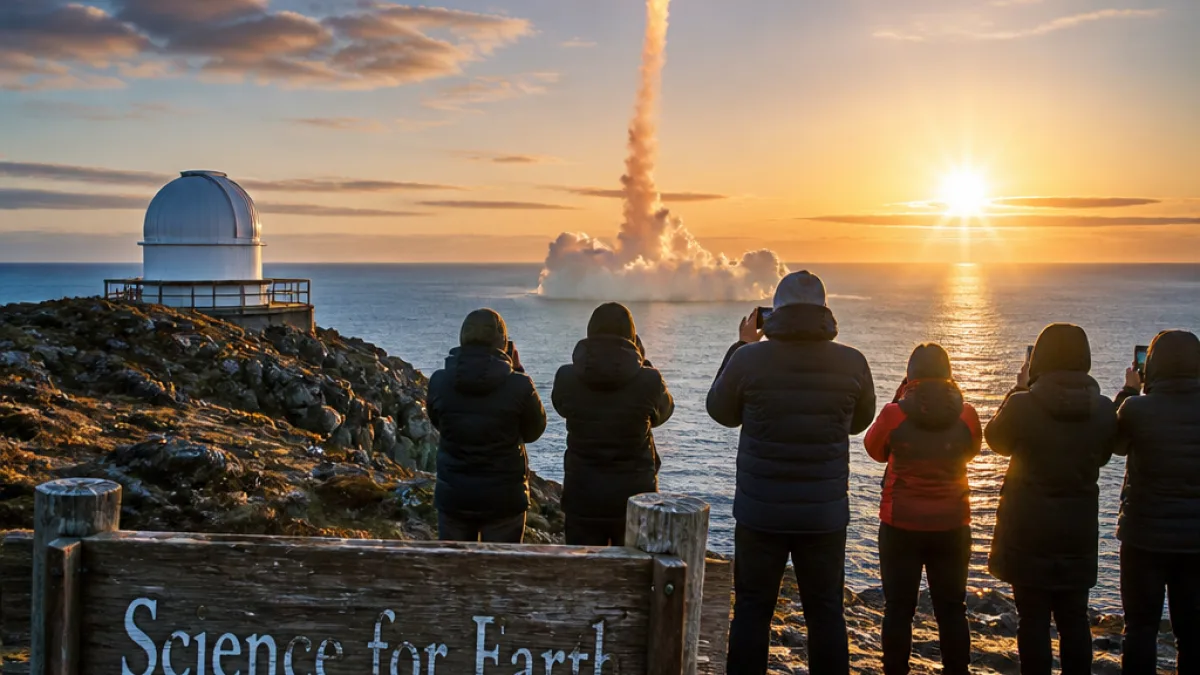
Aug. 30 marked the departure of the Nancy Grace Roman Space Telescope, launched aboard a Falcon Heavy rocket and committed to a direct transit toward the Sun–Earth Lagrange Point 2, some 1.5 million kilometres from Earth. The telescope is expected to reach its station in roughly 100 days, power up and begin observations.
Big telescope, bigger questions
The Roman telescope represents a major step in wide-field space astronomy, designed to survey vast swaths of the sky with sensitivity that complements existing observatories. Along with the potential to discover distant objects and study cosmic structures, commentators have highlighted its capacity to search for signatures of life beyond Earth.
“New Nancy Grace Roman Space Telescope could help find life somewhere out there, but that doesn't excuse what's happening on Earth.”
The line captures a recurring theme in public debate: scientific achievement and cosmic curiosity co-exist with pressing terrestrial concerns. Observers argue the launch is cause for celebration while urging that it not distract from problems such as climate change, inequality and resource management — issues that demand immediate attention and political will.
What the mission will do
The Roman telescope is chiefly a wide-field survey instrument. Its observations will complement those of existing telescopes by mapping large portions of the sky quickly and in detail. Among its scientific aims are:
- Surveying the distribution of galaxies to study dark energy and cosmic expansion.
- Detecting exoplanets through micro-lensing and other techniques that may reveal planets too faint or distant for current methods.
- Cataloguing faint and transient objects to support follow-up with ground- and space-based observatories.
Those capabilities give the Roman telescope a real, if indirect, role in the search for life beyond Earth: by identifying interesting exoplanetary systems and providing statistical context for where habitable worlds might be found.
Timeline at a glance
| Event | Date / Figure |
|---|---|
| Launch | Aug. 30 (Falcon Heavy) |
| Destination | Sun–Earth L2 (1.5 million km) |
| Transit time | Approximately 100 days |
| Initial operations | Power-up and commissioning after arrival (timeline ongoing) |
Why L2?
Lagrange Point 2 sits on the far side of Earth from the Sun and offers a stable gravitational environment for space telescopes. An observatory at L2 can maintain a clear, relatively constant thermal and lighting environment, simplifying instrument cooling and allowing uninterrupted views of deep space. Several prominent space telescopes have used or will use this vantage for sensitive observations.
Local perspective and implications
For readers in Newfoundland and Labrador, the Roman telescope's launch is part of a broader narrative: our province has deep connections to the sea, weather and light — elements that pull at the same human curiosity that sends instruments into space. Scientific milestones abroad can inspire local students, educators and communities to engage with science, technology, engineering and math (STEM) fields.
At the same time, commentators caution that enthusiasm for distant discovery should not become an excuse to neglect local and global challenges. Investments in science and exploration often yield long-term benefits, but they also require public debate about priorities.
Watching the skies and minding the ground
The Roman telescope's voyage is a reminder of human inventiveness and the long view of scientific inquiry. But as the quoted commentary bluntly puts it, the search for answers among the stars does not absolve us of responsibilities at home.
As the spacecraft powers up and begins its work in the months ahead, expect fresh data that will shape our understanding of galaxies, dark energy and potentially habitable worlds. Simultaneously, the launch revives the question of how scientific accomplishment should be balanced with urgent social and environmental policy — a debate that remains as earthly as the rocks and seas of Newfoundland and Labrador.