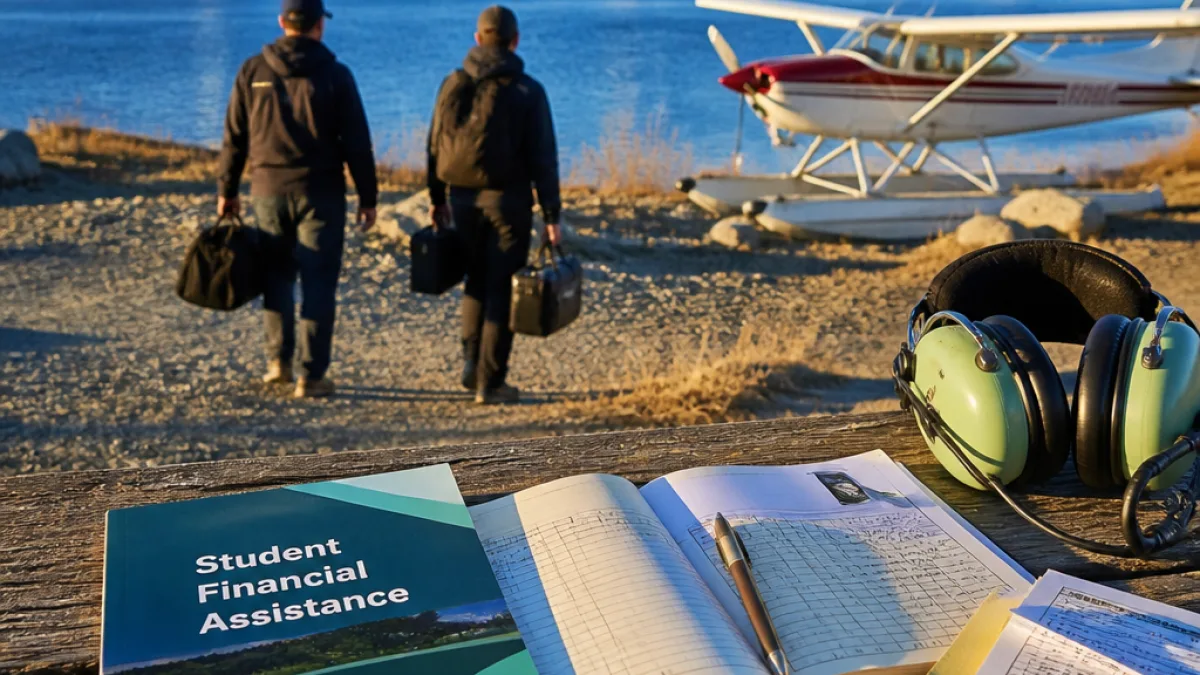
Yellowknife — The Government of the Northwest Territories has broadened student financial assistance to help aspiring northern pilots overcome a major up‑front cost: payment for private pilot licence training. Effective in August, the Department of Education, Culture and Employment updated its regulations so up to two semesters of coursework toward a private pilot licence can be covered — provided the training is part of a documented pathway to a commercial pilot licence.
Removing an early financial hurdle
The change recognises that the private pilot licence is a required stepping stone to commercial pilot training and that the initial hours and instruction have long posed a financial barrier for students. The territorial government said that, historically, prospective pilots in the N.W.T. have had to pay between $20,000 and $26,000 out of pocket to obtain the necessary initial flight hours before they could access traditional grants or loans.
By allowing the cost of up to two semesters of private‑licence coursework to be funded without deducting from a student’s later allocation for commercial pilot training, the territory aims to reduce the out‑of‑pocket burden at the start of training.
Why the change matters in the North
The move addresses several northern realities. There are no post‑secondary aviation schools physically based in the N.W.T.; students must leave the territory for training, adding travel and living costs to tuition and flight hours. That combination has pushed many prospective pilots to postpone training or relocate permanently to pursue aviation careers.
Expanding financial aid for the private licence is intended to make the pathway more accessible to northern residents who wish to return and work as commercial pilots — a profession important to connectivity, medevac, resource development and community supply in remote regions.
What the new rule covers
- Coverage applies to up to two semesters of coursework that lead to a private pilot licence.
- Eligible coursework must form a documented pathway toward a commercial pilot licence.
- Funding for those semesters will not be deducted from the student’s later allocation for commercial licence training.
Officials framed the change as a way to remove a specific barrier: the private licence cost that must be met before students can progress to commercial training supported by existing programs.
"A private licence is often a financial barrier for students to pursue flying as a career," the government said in a statement.
Practical implications and next steps for students
Students considering a career in aviation should contact the Department of Education, Culture and Employment or their student aid office to confirm eligibility and to learn what documentation is required to demonstrate the private‑to‑commercial pathway. Those already enrolled in private‑licence courses should seek clarification on whether their current or completed semesters qualify under the revised regulations.
Because training providers are located outside the territory, applicants should also budget for travel and living expenses that are not covered by this specific change unless other assistance applies.
Local context and workforce considerations
The north depends on a skilled pool of pilots for passenger travel, cargo, emergency services and access to remote communities. Improving access to pilot training for residents could help retain talent in the N.W.T. and support continuity of aviation services that northern communities rely upon.
| Item | Detail |
|---|---|
| Effective date | August (territorial update) |
| Coverage | Up to two semesters of private pilot coursework |
| Condition | Must be part of a documented pathway to commercial pilot licence |
| Typical prior out‑of‑pocket cost | $20,000–$26,000 (before this change) |
Local aviators and aviation training providers outside the territory will now be watching how the policy affects enrolment and whether it leads to more northern residents entering commercial pilot programs. For a territory with vast distances and limited road access, retaining locally trained pilots has both economic and community resilience benefits.
Those seeking more information should consult the Department of Education, Culture and Employment’s student financial assistance office for application details and eligibility criteria.