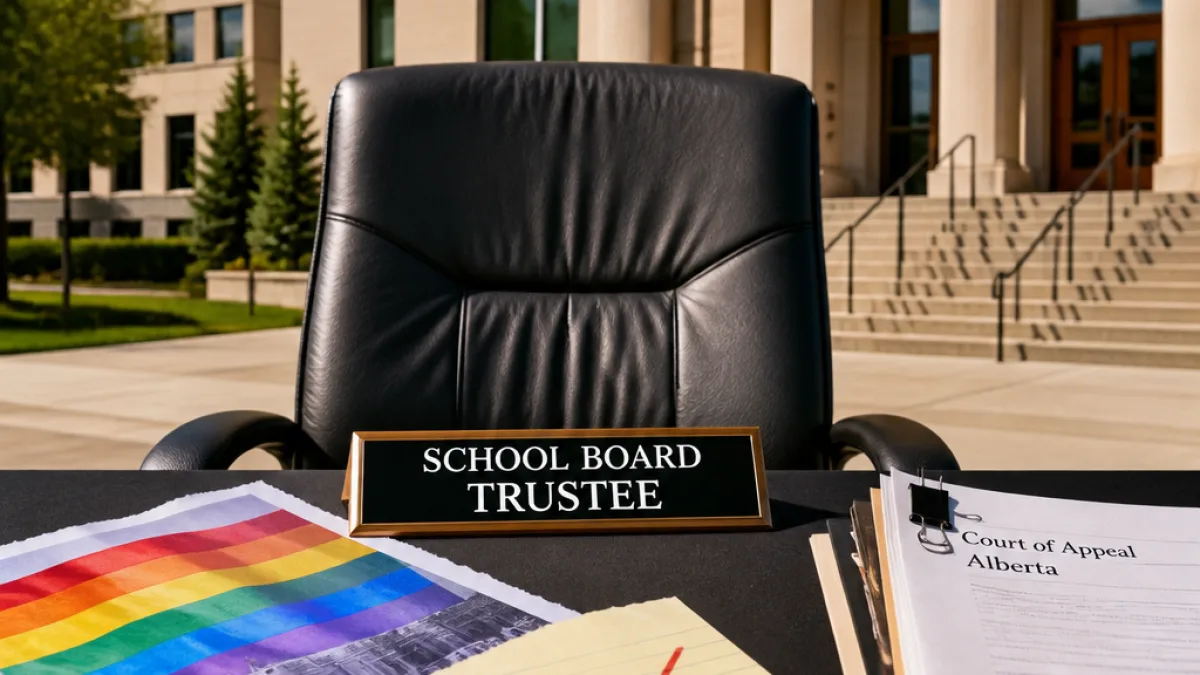
The Alberta Court of Appeal has concluded that the disqualification and the majority of disciplinary measures imposed on a former trustee of Red Deer Catholic Regional Schools were reasonable, while finding that the board overreached when it ordered the ex-trustee to provide a “sincere” apology.
Background and board response
In August 2023, then-trustee Monique LaGrange shared a social media image juxtaposing children carrying rainbow Pride flags with a historical photograph of children holding Nazi flags, captioned to equate the two. The school division’s board determined the post breached board policy and its code of conduct.
Following the board’s finding, LaGrange was removed from committees, forbidden from officially representing the division, required to complete sensitivity training and ordered to write an apology. When she failed to comply with some of those restrictions, a further complaint prompted the board to disqualify her, a decision that led to her resignation and subsequent legal challenges.
Judicial review and appeal
LaGrange first applied for judicial review in the Court of King’s Bench; those applications were dismissed. She then appealed to the Alberta Court of Appeal, seeking declarations that the board’s decisions were unreasonable and procedurally unfair and that she had not breached the earlier sanctions.
On Sept. 2 the Court of Appeal released its written decision concluding the board’s decision to disqualify LaGrange and most of the sanctions were within bounds. However, the court agreed with LaGrange that the apology requirement should not stand.
Apology requirement struck down
The appellate decision followed an earlier judicial review court’s finding that ordering a sincere apology is problematic because sincerity cannot be measured against an objective standard. The Court of Appeal went further, holding the entire requirement to issue an apology must be removed on administrative law grounds.
“The first judicial review court struck the apology sanction in part, holding that the requirement for the apology to be ‘sincere’ was unreasonable because sincerity was ‘not measurable by any objective standard’ and it is not ‘feasible … to prescribe an individual’s personally held feelings,'”
The written judgment also noted LaGrange had already acknowledged that members of the school division found the social media post offensive at the time of the board’s initial hearing.
Sanctions and outcome
The Court of Appeal’s ruling leaves in place most measures the board imposed after finding a code-of-conduct breach, while removing the apology mandate. That distinction matters for how school boards can discipline trustees going forward and for the limits of corrective orders that touch on inner beliefs or expressions of sentiment.
| Sanction | Court outcome |
|---|---|
| Removal from committees | Upheld |
| Prohibition from representing the division | Upheld |
| Mandatory sensitivity training | Upheld |
| Order to write an apology described as “sincere” | Struck |
| Disqualification from board | Upheld |
Local implications
For Red Deer families, staff and trustees, the ruling clarifies two points: school boards have authority to impose a range of sanctions for code-of-conduct breaches, but they cannot lawfully compel expressions of personal feeling where those expressions cannot be gauged by objective criteria.
The decision is likely to shape how the Red Deer Catholic Regional Schools board and other Alberta trustees craft discipline and remedial orders after misconduct findings. Boards will still be able to strip duties, restrict representation and require training, but must be cautious about imposing requirements that amount to compelled affirmations of mindset or sincerity.
- Board discipline largely upheld; disqualification remains effective.
- Apology requirement removed as legally impermissible.
- Ruling reinforces limits on boards ordering subjective personal expressions.
As this matter involves internal board governance and court review, the ruling will be watched by school divisions and municipal stakeholders across Alberta as they balance codes of conduct, trustee accountability and freedom of expression in public office.