
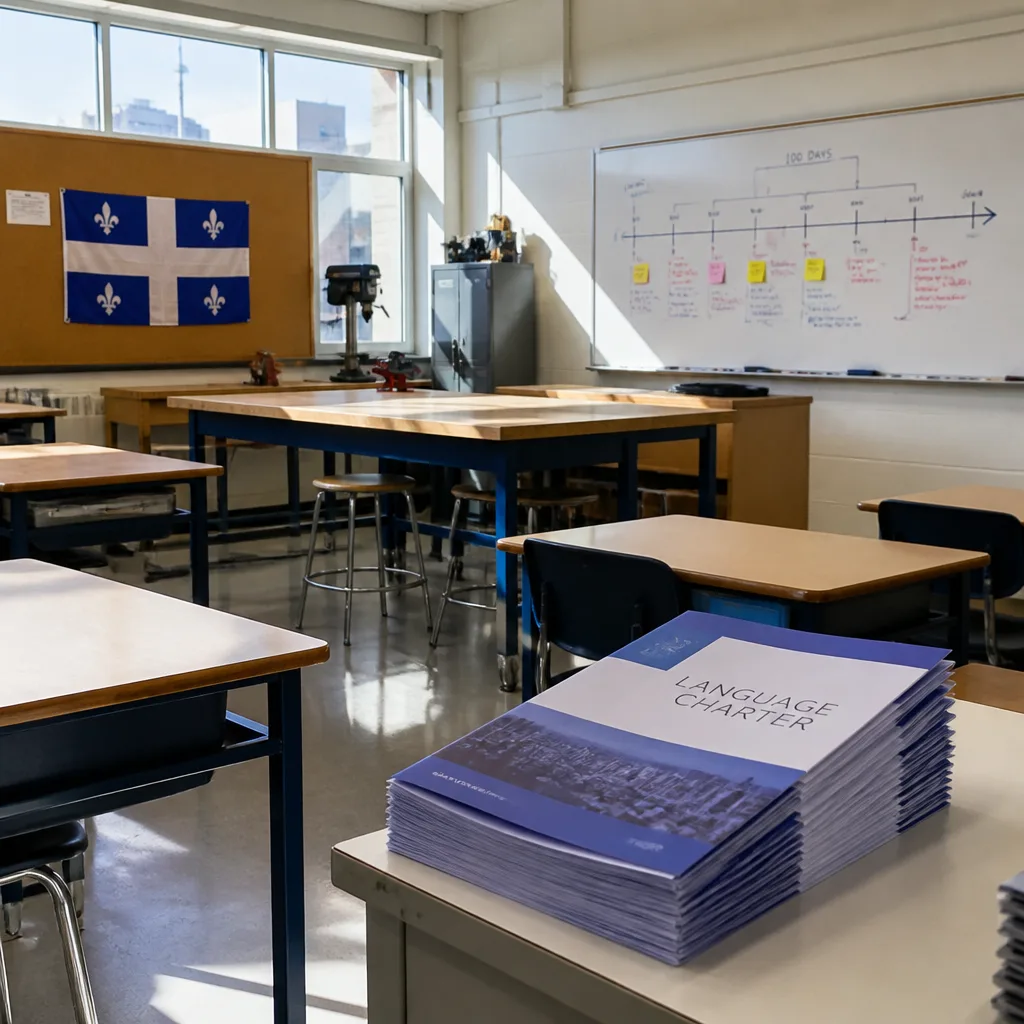
Quebec’s governing party is pledging to extend the province’s Charter of the French Language to adult and vocational education centres if it secures a third mandate, a move that could reshape who can study in English in the province.
What the CAQ is proposing
Christine Fréchette, leader of the Coalition Avenir Québec (CAQ), said during the campaign that her government would introduce legislation within its first 100 days to bind adult education and vocational training centres to the province’s language charter, commonly known as Bill 101. The announcement reiterates a pledge she made earlier while seeking the party leadership.
“French must remain the language of education, culture, and work in Quebec; this is essential,”
The CAQ previously tabled a bill in June that would have broadened the charter to these institutions, but the measure was not adopted before the dissolution of the National Assembly. At that time, government officials said the proposed changes would protect the rights of Quebec’s longstanding English-speaking community while restricting access to English instruction for students not considered part of that community.
Who could be affected
Officials have estimated that as many as 27,000 students could be affected by the proposed expansion, with most of those learners being newcomers residing primarily in the Montreal area. The figure was provided by Jean‑François Roberge, the outgoing minister responsible for the French language, during earlier briefing on the proposal.
| Category | Detail |
|---|---|
| Institutions targeted | Adult education centres and vocational schools |
| Estimated students affected | 27,000 (mainly newcomers in Montreal region) |
| Legal tool signalled | Renewal of the notwithstanding clause for Bill 96 |
- Scope: Expansion would bring adult and vocational programmes under the Charter of the French Language.
- Timing: CAQ promises action within 100 days of a third-term victory.
- Legal approach: Party leader has signalled intent to renew use of the notwithstanding clause related to Bill 96.
Legal and community implications
The party states the intent to respect the rights of the province’s historical English-speaking community, but the change would remove English-language access for students who are not members of that community, according to previous government briefings. The question of who qualifies as a member of the “historical” English-speaking community and how that is determined has been central to debates about language policy and access to schooling in Quebec.
Renewing use of the notwithstanding clause — a provision that allows provincial legislation to operate notwithstanding certain protections in the Canadian Charter of Rights and Freedoms — signals the government may be prepared to shield the proposed law from federal constitutional challenges. The CAQ has already employed the clause in connection with Bill 96, the more recent language statute.
Advocates for francophone language protection argue the measures are necessary to ensure the primacy of French in public life and the labour market. Critics warn that restricting English-language routes to training and adult education could limit newcomer integration paths, workforce readiness and access to services for those who require instruction in English.
Next steps
The CAQ’s campaign promise means the fate of the proposal will now hinge on the outcome of the election and the composition of the next National Assembly. If the party is returned to power and proceeds with legislation, affected institutions, communities and legal observers are likely to scrutinize the bill’s definitions, exemptions and implementation timelines.
For students, teachers and families, the immediate concern will be how any change would affect program availability, language of instruction and eligibility criteria for English-language learning opportunities at the adult and vocational level.