
U.S. President Donald Trump on Sunday demanded that Canadian companies conducting business with the United States relocate their headquarters and production to the U.S., and said doing so would spare them from recently announced American tariffs. The comments came after trade negotiations between the two countries broke down, and as both Ottawa and Washington have already imposed retaliatory duties.
Tariff threat and timing
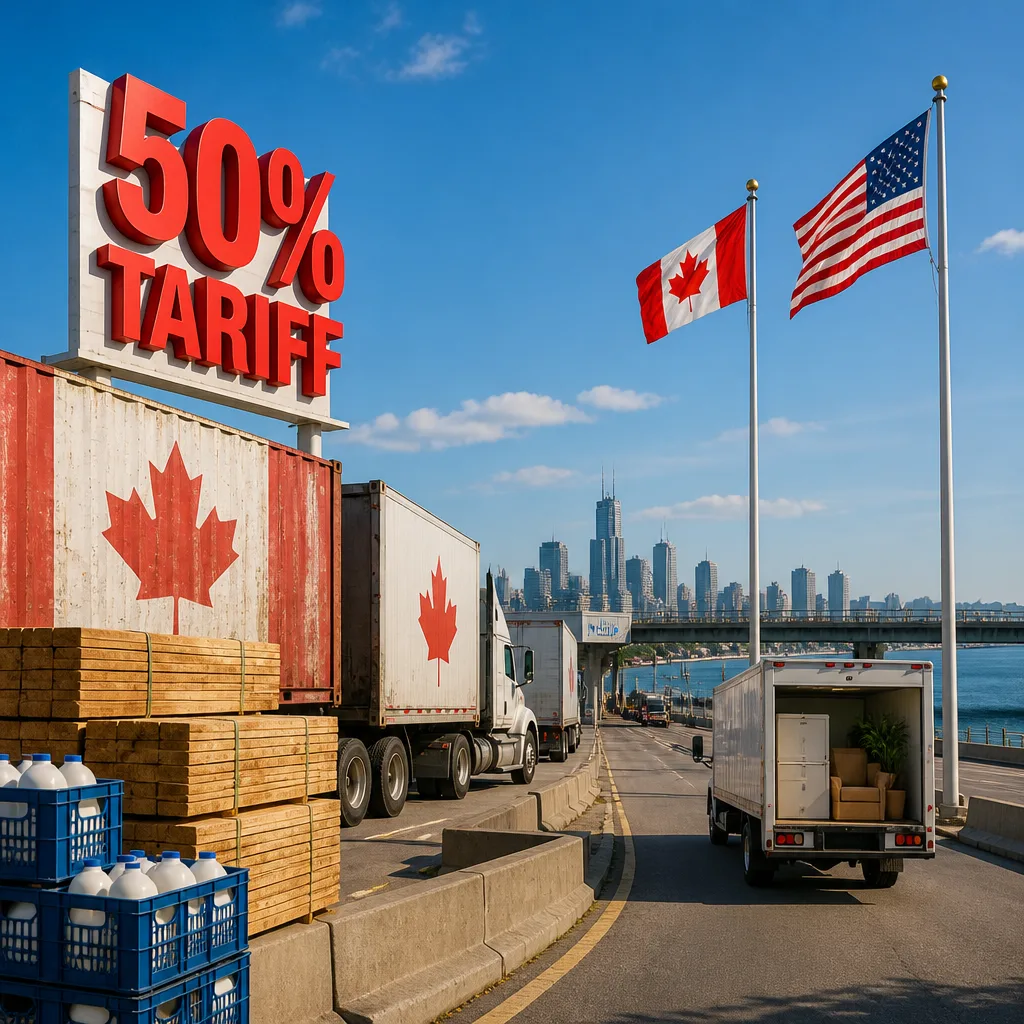
Trump said the U.S. levied duties of up to 50 per cent on some Canadian products and indicated those measures will begin in 2027. The tariffs target a range of goods, with media reports and administration announcements identifying categories that include dairy and lumber.
“Let all Canadian Companies that are doing business with America move to the United States, immediately. Many of them are Companies that moved out years ago due to stupid U.S. Leadership. When you move back, there are no TARIFFS!”
The president also posted that Canada was among “one of the Worst Abusers,” saying he did not want Canadian cars, parts or other goods — comments that underscore an intensifying trade dispute between two of the world’s most integrated economies.
Canadian response and existing measures
Ottawa has not been passive. The federal government has already announced and imposed reciprocal tariffs on a range of American exports, notably including U.S. steel and aluminium, as well as other products. Those measures came after bilateral talks failed to resolve outstanding issues, and both sides have signalled readiness for an extended confrontation.
The U.S. trade representative counts roughly US$900 billion in annual cross‑border economic activity between Canada and the United States. The sheer scale of the relationship — covering raw materials, intermediate parts, finished goods and services — raises the stakes for businesses and supply chains on both sides of the border.
- Tariff level: up to 50 per cent on certain Canadian goods.
- Start date: duties set to begin in 2027.
- Canadian retaliation: duties on U.S. steel, aluminium and other exports.
Business and policy consequences
The president’s call for reshoring — moving headquarters and production back to the United States — is designed to make avoidance of tariffs contingent on corporate relocation. That pressure could catalyse tough choices for corporate boards and supply‑chain managers: weigh the cost of moving against the cost of sustained tariffs, disruption and potential market loss.
Any large‑scale migration of Canadian head offices or plants would be difficult and expensive. Multinational firms typically cite workforce skills, proximity to suppliers and customers, regulatory environments and tax structures when choosing locations. The administration’s message introduces a political variable into those calculations, but the practical hurdles to moving entire operations remain significant.
What to watch next
Key indicators for Canadian business and policymakers in the coming weeks include:
- Whether Washington finalizes and publishes specific tariff schedules and affected product lines;
- Ottawa’s next steps in reciprocal measures or legal challenges at the World Trade Organization or other fora; and
- Corporate responses from industries most exposed to the tariffs — notably dairy, lumber and automotive supply chains that rely on cross‑border inputs.
| Measure | Target | Timing |
|---|---|---|
| U.S. tariffs | Dairy, lumber and other Canadian goods | Announced; set to begin in 2027 |
| Canadian reciprocal duties | U.S. steel, aluminium and other exports | Already imposed |
The dispute comes at a particularly sensitive time for industries that depend on integrated North American supply chains. For Canadian firms, the decision whether to stay and absorb higher costs, pursue exemptions, litigate or consider relocation will depend on sectoral exposure and the practical feasibility of moving operations.
For policymakers, the episode raises questions about how to protect competitive industries and jobs while keeping lines of negotiation open with the United States — Canada’s largest trading partner and a source of deep, long‑standing economic ties.
The immediate economic effect will hinge on the precise products targeted and the response from businesses. But with nearly US$900 billion in annual cross‑border commerce at stake, the dispute promises to reverberate through boardrooms, factory floors and trade ministries on both sides of the border.