Agreement links Nuuk to Qikiqtarjuaq and Grays Bay projects
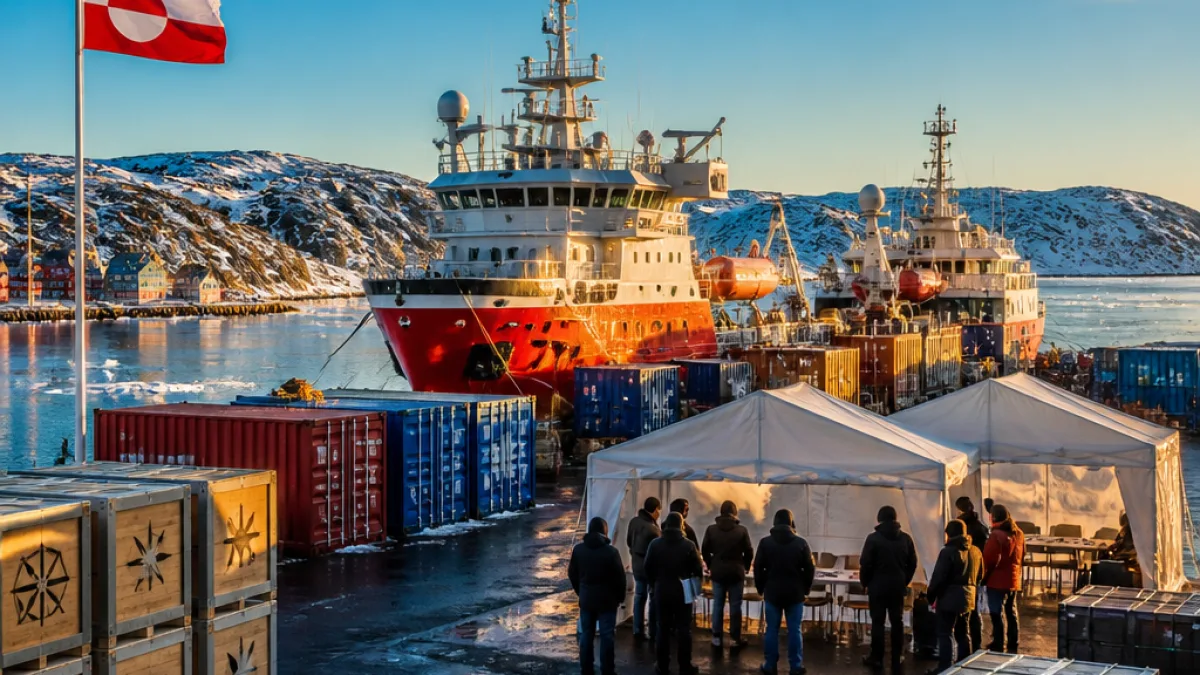
The Port of Nuuk and proponents of two proposed deepwater ports in Nunavut have formalized a partnership intended to strengthen Arctic maritime resilience, emergency response and supply chains in the region.
On Monday, the Port of Nuuk—operated by Sikuki Nuuk Harbour A/S—signed a Memorandum of Understanding (MOU) with Qikiqtaaluk AEDC, the proponent of the Qikiqtarjuaq Deep Sea Port Project, and West Kitikmeot Resources Corp., the proponent of the Grays Bay Road and Port Project. The announcement coincides with a trade mission to Nuuk by Nunavut Tunngavik Inc., the organization that represents the Inuit of Nunavut.
The MOU frames practical cooperation between existing Greenland maritime infrastructure and proposed Nunavut developments. According to the release, the parties will share expertise and explore joint work in:
- Maritime resilience—adapting port operations to Arctic conditions;
- Coordinated emergency response—improving readiness for incidents at sea or along the coastline;
- Vessel support and supply chains—enhancing logistics for shipping in the North;
- Infrastructure and environmental protection—sharing lessons on development and safeguarding fragile marine environments.
The statement highlights the historical and cultural ties that bind Greenland and Nunavut, noting shared Inuit culture, language and community relationships. It also situates the agreement within broader Canada–Kingdom of Denmark (Greenland) relations, where Arctic security and economic opportunity are growing priorities—particularly as the significance of the Northwest Passage and surrounding waters increases.
Who is involved
| Party | Role |
|---|---|
| Sikuki Nuuk Harbour A/S | Owner and operator of the Port of Nuuk |
| Qikiqtaaluk AEDC | Proponent and developer of the Qikiqtarjuaq Deep Sea Port Project (Nunavut) |
| West Kitikmeot Resources Corp. | Proponent and developer of the Grays Bay Road and Port Project (Nunavut) |
The MOU creates a framework for knowledge-sharing between Greenland’s established commercial port and two priority port developments proposed for Nunavut. It is described as an initial step, with early work focused on practical port cooperation and shared emergency-response capabilities.
Economic and strategic context
Nunavut’s long-term economic plans have included proposals for deepwater ports that could support resource projects, community supply and growing Arctic marine traffic. The Qikiqtarjuaq and Grays Bay proposals are among the territory’s priorities for improving maritime infrastructure. The MOU links those projects to Nuuk’s existing facilities and operational experience.
Officials framed the cooperation as both practical and symbolic: practical because it aims to build operational capacity for search and rescue and vessel support in a region with limited infrastructure; symbolic because it reinforces a cross-Greenland–Nunavut dialogue rooted in Inuit connections and shared northern priorities.
The announcement was issued as part of a trade mission to Nuuk led by Nunavut Tunngavik Inc., which the release says is focused on identifying deeper economic and strategic partnerships between the two Arctic jurisdictions.
Next steps and limitations
The MOU is a non-binding agreement that outlines areas for cooperation and information exchange. The release says initial work will concentrate on coordinated emergency-response plans, vessel-support capability and shared knowledge on port development and operations. Details on timelines, funding, or specific joint initiatives were not included in the announcement.
As proponents move from planning to project development, the MOU could help align operational procedures and emergency systems across the region—an outcome that would be relevant to communities, shipping operators and government agencies concerned with Arctic transport and safety.
For residents and stakeholders in Nunavut, the agreement underscores growing international interest and local engagement in northern infrastructure. The partnership links two established cultural and maritime neighbours as they consider how best to manage increased activity in Arctic waters while protecting fragile environments and supporting local economies.
Media inquiries for the announcement were directed to West Kitikmeot Resources Corp., where the company provided contact information for its environment manager along with the public release.