After weeks of short‑lived but recurring power interruptions in the territorial capital, a new generator arrived in Iqaluit on Aug. 20 and was moved to the Qulliq Energy Corporation (QEC) power plant overnight.
Special convoy moves heavy equipment through city streets
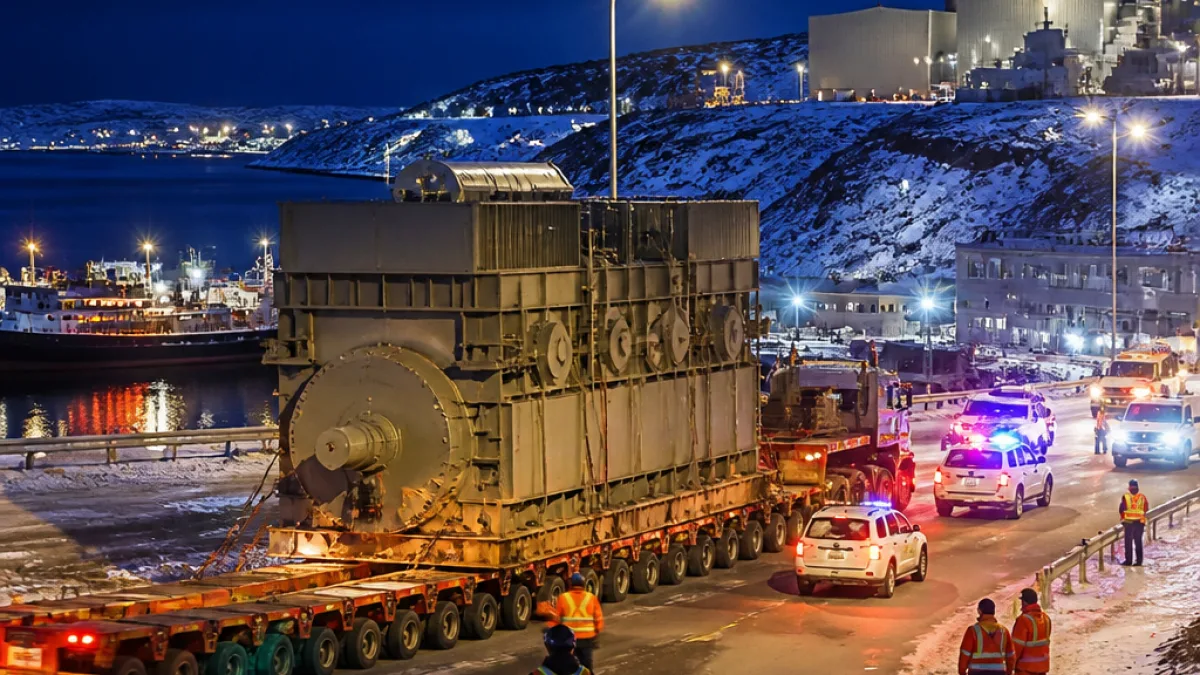
The unit was transported from the deep‑sea port toward the plant located between Hospital Hill and the Plateau. The move began late evening on Aug. 20 and continued into the early hours of Aug. 21. QEC said the transport crossed the four‑corners intersection just after midnight, escorted by a caravan of at least eight vehicles, including three RCMP cruisers and a QEC utility vehicle.
QEC employees guided the generator on a wire‑controlled flatbed loader, inching the heavy equipment through town. At the same time, the utility removed an older generator from the plant and moved it back to the port for disposal.
Frequent outages prompted the emergency replacement
Residents experienced a spate of outages between Aug. 6 and Aug. 19. QEC reported there were seven outages during that period, with interruptions ranging from a few minutes to just over an hour. At least one incident affected the entire city, while others were limited to individual neighbourhoods.
In addition to those unplanned interruptions, a planned outage on Aug. 22 was scheduled from 8 a.m. to noon for work affecting Nikku Lane, Palaugaa Drive adjacent to Creek Side and White Row, and Nipisa Street between Queen Elizabeth Way and Kuugalaaq Street. Several businesses and offices also fell inside the planned outage zone, including The Snack, the Survival Store, CBC, the Nunavut Employees Union building and the NorthwesTel office.
| Period | Reported outages | Duration range |
|---|---|---|
| Aug. 6–19, 2026 | 7 | A few minutes to just over an hour |
| Aug. 22, 2026 | Planned outage | 8 a.m.–noon (local zones) |
QEC names aging equipment and strain as causes
QEC has acknowledged that the territory’s capital is being affected by an aging power plant and units that are not performing optimally. The utility said it is bringing in specialised consultants to assess the underperforming units and determine the necessary steps to restore reliable service.
“Two other generation units are not performing optimally. We are bringing in specialized consultants to assess these units and determine the necessary actions,”
The corporation also said it is installing equipment designed to isolate smaller sections of the system when a fault occurs, so that fewer customers are affected by a single problem and repairs can be completed more quickly.
Local impacts and precautions
Short outages may seem minor, but in Iqaluit they can affect essential services, businesses and the day‑to‑day routines of residents who rely on electric heat, communications and refrigeration. The movement of the new generator is an immediate step to improve redundancy at the plant and reduce the likelihood of city‑wide interruptions.
- What changed: New generator placed at QEC power plant on Aug. 20–21.
- Why it matters: It adds generation capacity and backup while consultants assess other units.
- Short‑term impact: Planned and emergency outages may continue while work is done to isolate faults and repair aging equipment.
For residents, QEC’s plans to segment the grid during faults should mean that future incidents affect smaller areas rather than the entire city — provided the upgrades and repairs proceed as intended.
What to watch for next
QEC has signalled two concurrent lines of work: the immediate insertion of a replacement generator to stabilise supply and a technical review by external consultants of other generation units. The results of that assessment will be key to longer‑term reliability. Meanwhile, customers should expect occasional planned outages as upgrades and maintenance proceed.
As this work moves forward, local residents and businesses will be watching for follow‑up communications from QEC about timelines for repairs and any additional planned outages. Reliable power is central to northern life; in a place where distances are great and supply chains are thin, equipment failures ripple quickly through daily routines.
Reporting from Iqaluit.