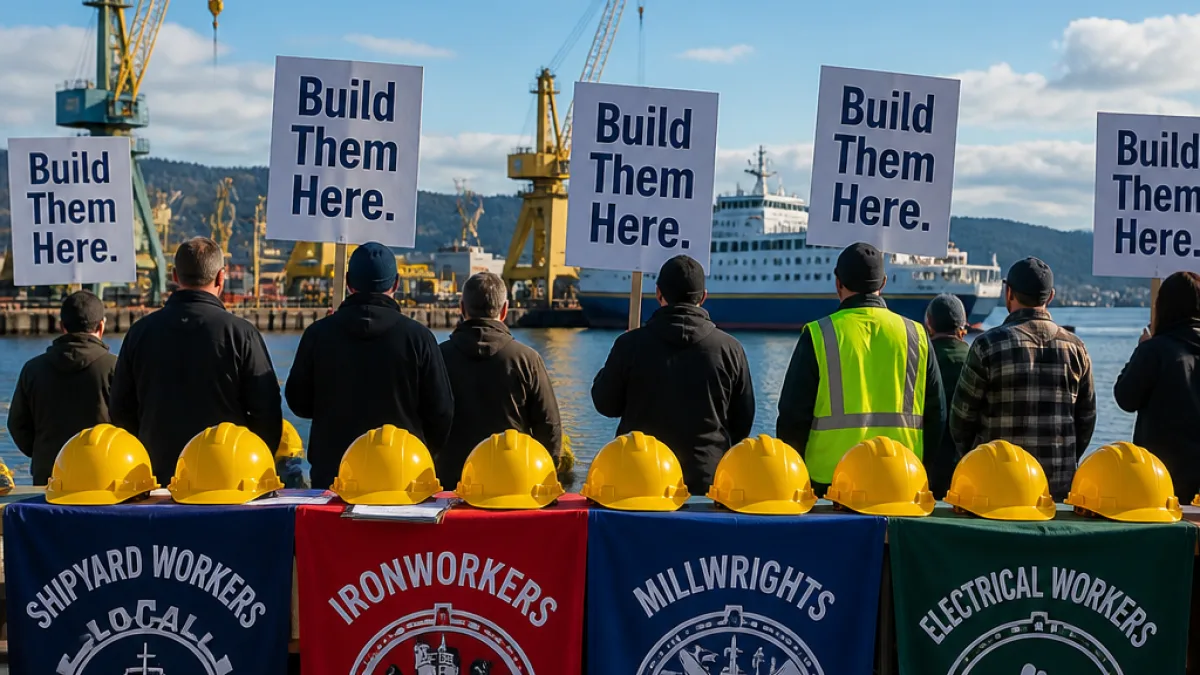
A coalition of 17 unions and industry groups representing more than 7,000 workers in B.C.'s marine and related sectors has launched a campaign calling on BC Ferries to commit to building future vessels in the province.
Pressure after contract sent overseas
The announcement, made at a news conference in Delta, comes after BC Ferries last year selected a Chinese state-owned shipyard — China Merchants Industry Weihai Shipyards — to build four major vessels. Those ships were expected to enter service beginning in 2029, with subsequent vessels arriving at roughly six-month intervals.
The coalition, which calls its initiative the Build Them Here campaign, says the decision to outsource large passenger-vessel construction has undermined capacity and opportunity for the provincial shipbuilding sector. Organizers argue that preserving and expanding local shipbuilding work is central to sustaining thousands of jobs across coastal communities.
Job security, supply chains and geopolitics
Speakers at the Delta event cited two broad concerns: the economic impacts on local workers and firms, and the vulnerability of supply chains when major capital projects are sourced from abroad. The coalition also pointed to recent trade tensions between Canada and the United States as a reason to prioritise domestic procurement.
"The need to buy Canadian and build Canadian has grown even more critical in the last 10 days," said Brynn Bourke, executive director of B.C. Building Trades, referring to the Canada-U.S. trade war.
Union representatives said building vessels locally would reduce the risk of delays for parts and repairs and help maintain critical skills in the province.
BC Ferries and government responses
BC Ferries has told media that it "actively sought" Canadian participation in the procurement process for the four-vessel contract and that two Canadian yards were pre-qualified. According to the corporation, neither of those pre-qualified Canadian yards submitted a final bid.
BC Ferries has also said that while there are economic gains to boosting Canada's shipbuilding industry, expanding capacity for large passenger vessels would require coordinated investment from government and industry.
The provincial transportation ministry has highlighted programs aimed at supporting growth in the shipbuilding sector but did not immediately commit to the coalition's request that future ferries — after the four already contracted — be built in B.C.
Industry capacity and cost considerations
Premier David Eby previously told media officials that BC Ferries' decision to award the recent contract overseas was influenced by cost considerations, noting that constructing the four vessels in Canada would have been significantly more expensive — the premier estimated at least $1 billion more.
Industry players such as Seaspan, which operates a major North Vancouver shipyard, have said B.C. yards face challenges competing with countries that have lower employment standards and different cost structures. Seaspan has also said it did not submit a bid for the contract, citing what it described as unrealistic price expectations for domestic shipbuilding.
What the coalition wants
The Build Them Here campaign is asking BC Ferries and the provincial government to make a clear, public commitment that future ferries will be constructed in British Columbia whenever feasible. Organizers say such a pledge would:
- Support jobs across coastal communities and supply chains
- Reduce vulnerability to international trade disputes and shipping delays
- Provide a market signal that could attract investment to expand domestic shipbuilding capacity
Practical hurdles remain
BC Ferries' explanation that domestic yards did not submit final proposals underscores a practical hurdle: capacity alone does not guarantee bids if expected costs and timelines are not aligned with the corporation's procurement requirements. The corporation has warned that without government and industry investment to build capacity, the additional cost of local construction would likely be passed on to ferry customers.
| Event | Timing |
|---|---|
| BC Ferries awards contract to China Merchants Industry Weihai Shipyards | June 2025 |
| Expected service entry of first vessel | 2029 |
| Planned intervals between subsequent vessel deliveries | ~6 months |
For coastal communities that rely on marine sector employment and related suppliers, the debate is not just about a single contract but about long-term industrial strategy. The coalition argues that a concrete commitment from BC Ferries could spur provincial and federal investment to help close the cost gap and ensure future contracts attract domestic bidders.
The issue is likely to surface in upcoming discussions about provincial procurement policy and economic recovery plans. For now, union leaders are calling on BC Ferries and the province to set a clear course that prioritizes B.C. yards for future ferry construction when it is practical to do so.
Coverage will continue as the Build Them Here campaign evolves and as government and BC Ferries officials respond to the coalition's demands.