Bold public art joins safety push in Richmond
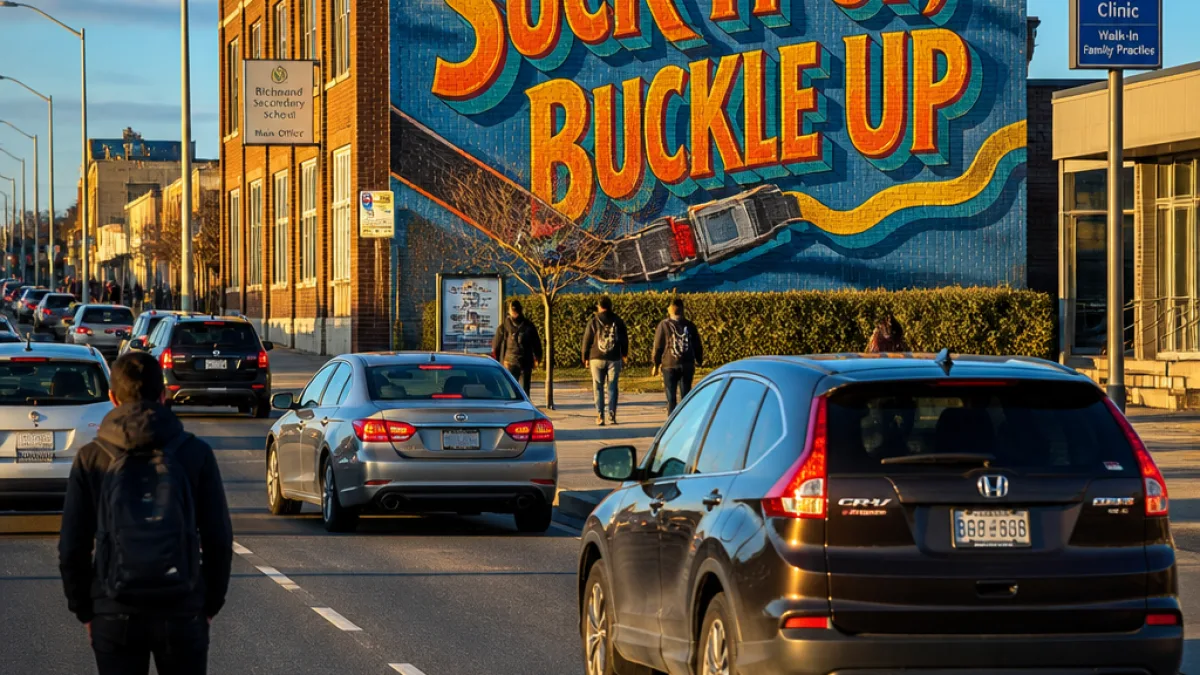
A new mural on Richmond’s south side has been unveiled as a visual anchor for a community-driven push to increase seatbelt use in the city.
The artwork, installed at 1501 Hull Street, was created in partnership with Drive Smart Virginia and local fabricator Hamilton Glass and is part of the organisation’s “Suck It Up, Buckle Up” campaign. Hundreds of vehicles pass the location each day, giving the message prominence along a busy corridor.
- Richmond seatbelt rate: 81%
- National average: 91%
- Local concern: 65% of vehicle occupants who die on Richmond roadways were unbuckled
Community input shaped the approach
The campaign grew out of a partnership launched last fall between Drive Smart Virginia and the Insurance Institute for Highway Safety. According to Kristin Pettway, executive director of Drive Smart Virginia, the organisation sought community feedback through virtual and in-person meetings and consultations with schools to determine what messaging might move people to buckle up more consistently.
“We need to focus on why seat belts save lives. We want to make it home to our loved ones,”
Pettway said the group was surprised by the city’s seatbelt numbers, which mirror the statewide average but fall short of the national rate. The organisation emphasised that many of the fatalities recorded on city roads involved occupants who were not wearing seatbelts and that some of those crashes could have been survivable.
From schools to medical centres: a multi-pronged effort
Alongside the mural, Drive Smart Virginia carried out outreach events and partnered with Virginia Commonwealth University to install signage in schools and medical centres as part of the spring-through-summer campaign. The strategy combines public art, targeted signage and community events to reinforce a simple safety behaviour.
Drive Smart Virginia framed the public art as a conversation starter: placing a large, visible reminder on a busy street aims to reach drivers repeatedly and normalize buckling up as a routine, non-negotiable action.
Where the numbers stand
Pettway cited two figures as central to the campaign’s urgency: the national seatbelt usage rate of 91 per cent, and Richmond’s rate of 81 per cent. The city’s proportion of unbuckled fatalities — 65 per cent of vehicle occupants who die on Richmond roadways were not wearing seatbelts — was highlighted as a key motivator for action.
| Measure | Rate |
|---|---|
| Richmond seatbelt use | 81% |
| U.S. national average | 91% |
| Share of vehicle occupants killed while unbuckled (Richmond) | 65% |
Campaign organisers said the effort began in the spring and ran through the summer, combining creative outreach with data-driven goals. The mural represents one tangible product of the public consultations and partnerships that informed the campaign.
Local resonance and limits of the message
Public-messaging campaigns that use art and signage aim to reach a broad audience, but measuring long-term behaviour change is complex. The campaign’s leaders emphasised education and repeated exposure as keys to improving the city’s seatbelt rate.
For Richmond residents, the mural is a reminder that simple protective habits — in this case, buckling a seatbelt — can change the outcome in crashes that might otherwise be survivable. As the Drive Smart Virginia campaign illustrates, organisers are increasingly turning to community voices and visible public art to address safety gaps where hard data shows a need for improvement.