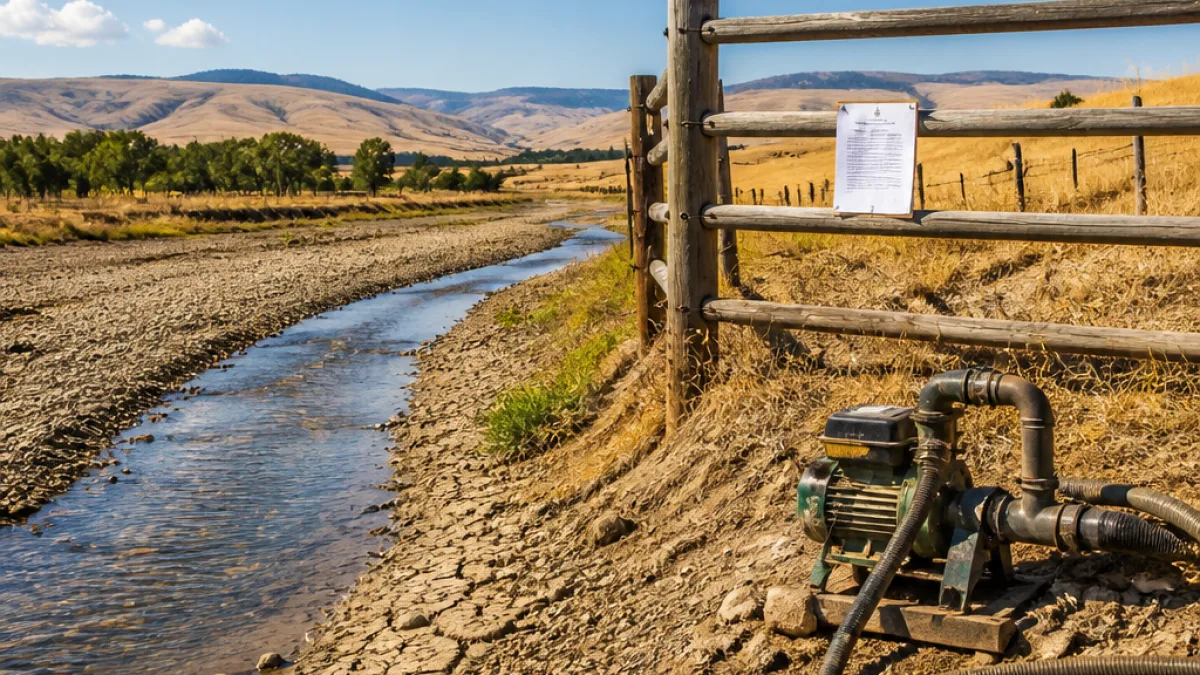
The B.C. government has issued a water-restriction order for the Bessette Creek watershed in the southern Interior, directing 131 water licence holders to stop drawing water for irrigation and other uses as drought conditions threaten chinook salmon.
What the order covers
Under the directive, licence holders in the affected watershed are required to cease water use for a range of activities, including irrigation, harvesting, greenhouse operations, nurseries and well-drilling. The restriction took effect on Friday.
| Activity | Status under order |
|---|---|
| Irrigation | Prohibited |
| Harvesting | Prohibited |
| Greenhouses and nurseries | Prohibited |
| Well-drilling | Prohibited |
Support and reaction from local producers
The Ministry of Agriculture and Food has been named as the provincial contact for claims related to crop failures or declines in income arising from the order. The ministry said it will help affected operators make claims.
Kevin Boon, general manager of the B.C. Cattlemen’s Association, said producers had been working with the provincial ministry throughout the summer and saw limits on water use coming. He described the timing as late enough in the season that many ranchers had already scheduled and received sufficient water to get through critical needs.
“The thing for us is it’s late enough in the season that it had allowed them to schedule, so they were getting enough water to get by,”
Boon added that, while the order is restrictive, it was not the catastrophic scenario seen in some previous years. He spoke directly with Water and Land Minister Randene Neill on Friday and said the minister commended ranchers for their co-operation.
Longer-term concerns: storage and watershed balance
Boon emphasised the value of on-farm and local water storage as a tool to manage seasonal shortages. He pointed to provincial statistics from 2015 indicating roughly 1,500 storage dams in B.C., with about two-thirds managed or owned by ranchers.
“If we don’t store it, we can’t manage it,” Boon said, noting the principle that capturing spring flows can help regulate supply through the summer months and create a more stable balance in the watershed. That argument underscores a long-running conversation across the Interior about infrastructure, agricultural resilience and ecological needs.
Why chinook salmon matter here
The immediate reason for the order, according to provincial officials, is protection of chinook salmon. Low flows and warm water during drought years can increase stress on salmon runs, reduce available spawning habitat and concentrate pollutants. With chinook populations of cultural and ecological importance in B.C., the province moved to restrict extractions that could worsen stream conditions.
What local residents and licence holders should know
- Licence holders named in the order must stop the specified water uses immediately.
- The Ministry of Agriculture and Food is the contact point for claims about crop or income losses resulting from the restriction.
- Ranchers and other producers were reportedly engaged in discussions with the ministry through the summer and in many cases anticipated limits on water use.
Officials did not specify how long the restriction will remain in place. The provincial approach in such circumstances typically depends on changes in streamflow, precipitation and temperature over the coming weeks.
The order adds to a string of drought-related measures across British Columbia in recent years as changing precipitation patterns and warmer summers have increased competition between agricultural water users and environmental flow needs. For communities and producers in the Bessette Creek watershed, the directive is an immediate constraint — and a reminder of the growing importance of water storage and watershed management in a warming climate.
Further details about the order and instructions for licence holders are available from the ministry. Affected producers have begun coordinating with provincial staff to document impacts and explore support options.