
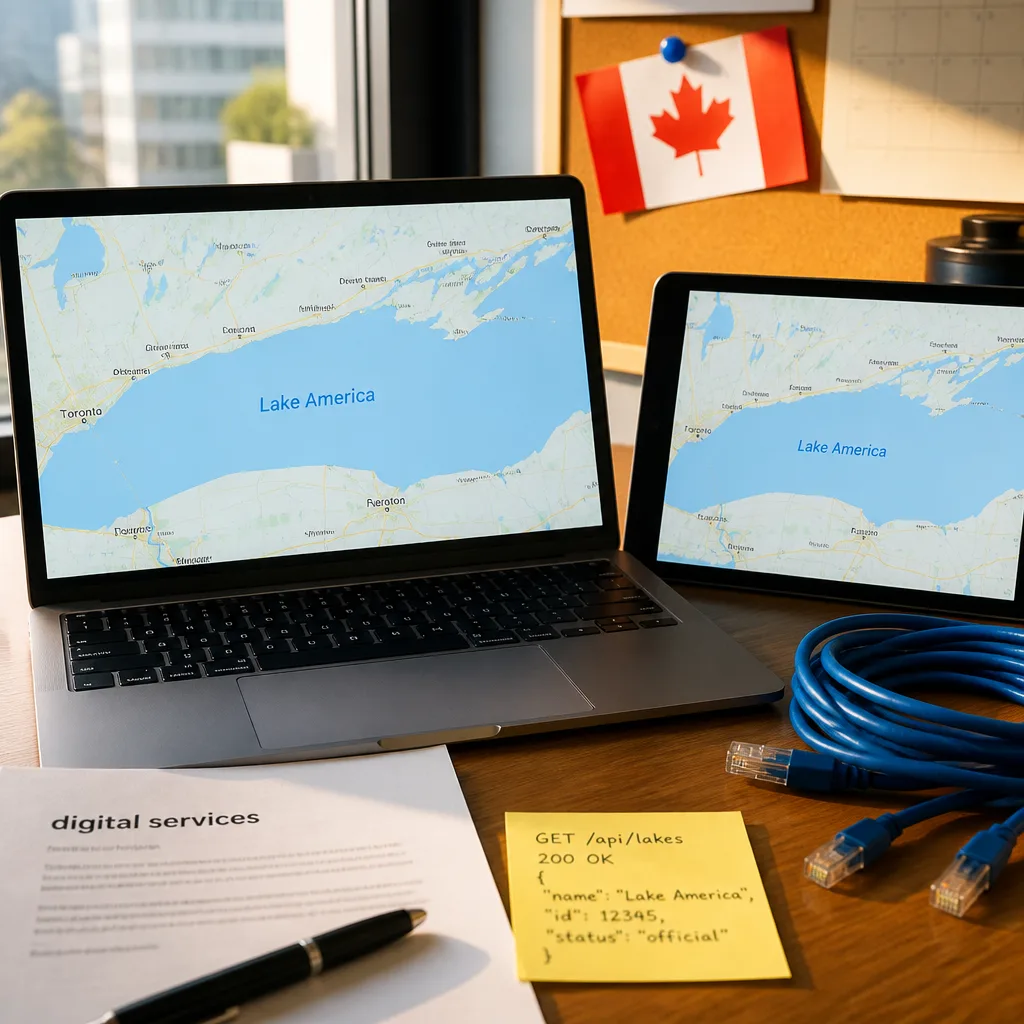
Google Maps has begun showing the label “Lake America” for the body of water Canadians know as Lake Ontario, a change linked to a U.S. presidential directive and one that has exposed how deeply Canadian government websites and businesses rely on American digital platforms.
What happened
The map label appeared after U.S. President Donald Trump signed an executive order instructing federal agencies to refer to the lake as “Lake America.” Google said it updated its maps to reflect that order and indicated the change would apply to users in the United States. Nonetheless, some Canadian websites — including federal pages — displayed the new label because they pull map data from U.S.-based application programming interfaces (APIs).
Why Canada was affected
Experts say the incident illustrates a familiar problem: many Canadian organisations and consumers are tied into services run by U.S. tech giants, and those companies’ data and policy decisions can have cross‑border impacts.
"Canadians really do live under the shadow of American tech monopolies, and we often forget that this is a fact until there are these moments of controversy," said Anne Pasek, Canada Research Chair in Media, Culture and the Environment at Trent University.
The reliance stems in part from the scarcity of viable non‑U.S. alternatives for mapping, mobile operating systems and cloud services. When major global platforms change how they label or serve data, downstream users and institutions in Canada can be swept up even if the change was intended for American audiences.
Practical consequences for business and government
For government digital services and private firms that embed third‑party maps or tools, the episode is a reminder that policy choices made by foreign tech operators can propagate quickly and unpredictably. That creates operational, reputational and political risks.
- Websites using U.S. map APIs can inherit U.S. policy-driven labels or content.
- Businesses that depend on embedded mapping or navigation features may face mismatches between their public messaging and what consumers see.
- Efforts to assert national naming or regulatory preferences can be undermined by the technical architecture of global platforms.
Platforms and status
At the centre of the story are a small number of platforms with outsized reach.
| Platform | Reported status |
|---|---|
| Google Maps | Displays “Lake America”; change tied to U.S. directive |
| Apple Maps / iPhone | President Trump urged Apple to adopt the change for its preinstalled navigation app |
Google maintained the change would be limited to U.S. users, but technical interconnections meant Canadian sites that rely on Google’s U.S. API still showed the altered label. The result has been sporadic and visible: federal pages and other prominent websites briefly reflected the new name.
Wider implications
The incident crystallises tensions about digital sovereignty. Canadian policymakers and corporate leaders face two choices: accept dependencies on dominant foreign platforms and manage the associated risks, or invest in domestic and allied alternatives — a path that can involve significant cost and coordination. For now, many institutions continue to rely on the convenience, scale and integration provided by U.S. companies.
For businesses, the takeaway is pragmatic. Contracts, technical architectures and contingency planning should account for the fact that third‑party platform changes can cascade quickly. For policymakers, the episode may add momentum to ongoing debates about data governance, procurement rules and the resilience of public digital services.
At minimum, the ‘Lake America’ episode has given Canadian officials, companies and the public a concrete demonstration of how a single change by a major U.S. tech firm can ripple across borders and into everyday digital life.