
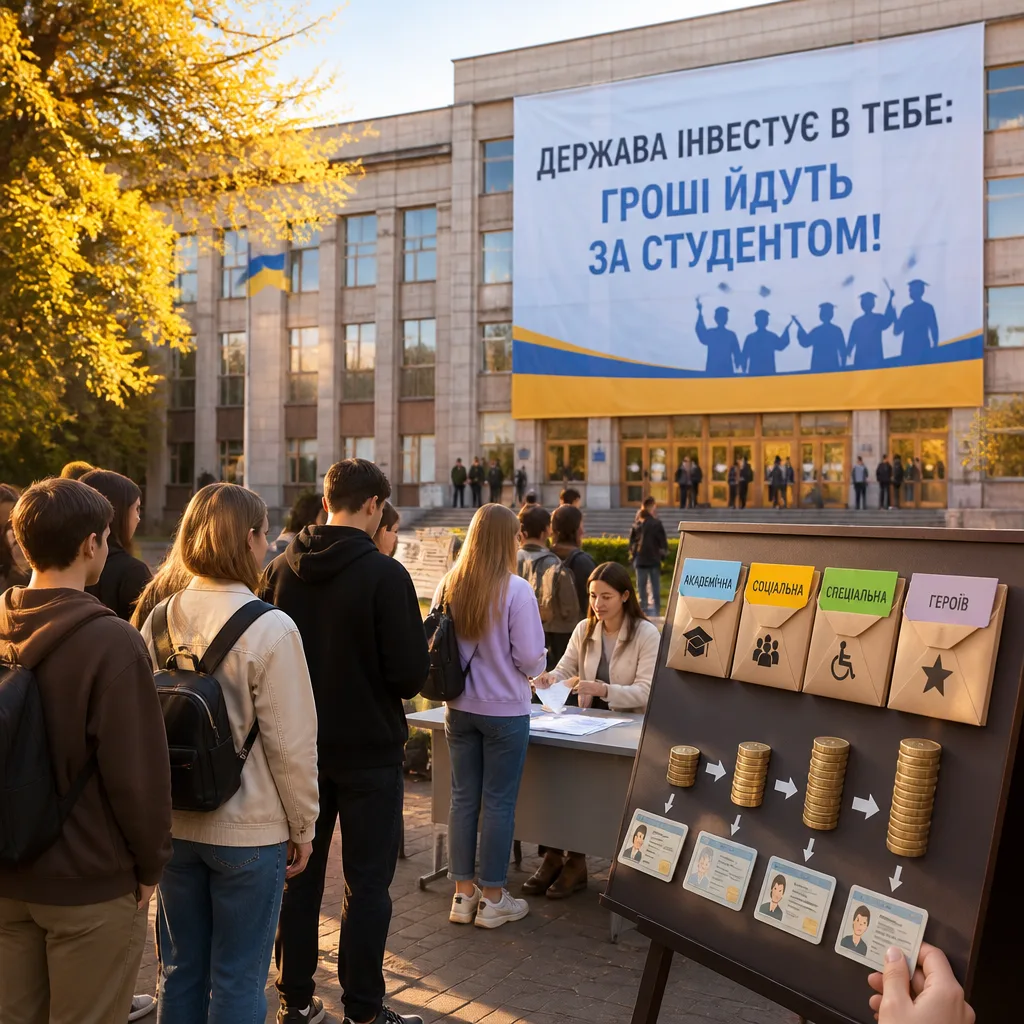
President Volodymyr Zelenskyy has signed Law No. 10399, instituting a phased change to Ukraine’s higher education funding that moves state support from institutions to students.
Key changes: grants, targeted support and minimum guarantees
The law establishes a system in which state financing will increasingly operate on the principle that “the money follows the student.” Under the new model, state grants will become a distinct tuition-payment instrument alongside traditional state-funded places, allowing applicants who secure fee-paying study places through competitive selection to apply for grants that may fully or partially cover educational costs.
The legislation specifies several types of grants:
- Academic grants — allocated on the basis of results from the national multi-subject test or external independent evaluation.
- Social grants — directed to applicants from vulnerable population groups.
- Special grants — for applicants with achievements in sport or the arts.
- Heroes’ grants — for veterans, people with war-related disabilities, and participants in the Revolution of Dignity.
“the money follows the student.”
While signalling a move towards student-centred financing, the law also contains safeguards intended to preserve baseline state support. State-funded places will remain in the system and spending on specialist training may not fall below the previous year’s level once adjusted for inflation. The legislation guarantees that at least 51% of general secondary education graduates will be able to study at the state’s expense, either through state-funded places or grants.
Progression and minimum quotas
The law includes further minimums for progression through higher degree levels. It sets out that at least 50% of bachelor’s degree graduates should have access to state-supported master’s programmes, and that a minimum of 5% of master’s graduates will be able to enrol in doctoral programmes to pursue a PhD or Doctor of Arts degree.
| Education level | Minimum state-supported share |
|---|---|
| General secondary graduates | 51% |
| Bachelor’s to master’s progression | 50% |
| Master’s to doctoral progression | 5% |
What this means for applicants and institutions
For applicants, the law ties different types of support to measurable achievements and circumstances: national test performance, social vulnerability, sporting or artistic merit, or veteran status. For institutions, the shift implies a reduction in the direct share of state funding over time, replaced by funds that follow successful applicants. The law outlines a phased approach, rather than an abrupt cut in institutional allocations.
Officials framed the safeguards as measures to prevent an overall decline in state involvement in specialist training and in guarantees of access. The requirement that spending on specialist training not drop below the prior year’s level adjusted for inflation is designed to maintain continuity for fields regarded as strategically important.
Context and possible consequences
The move to a student-centred funding model mirrors approaches used elsewhere where governments seek to increase competition, transparency and choice by allocating public funds in relation to student enrolment and outcomes. Advocates say such systems can expand opportunities for students from diverse backgrounds to access fee-paying places through grants, while critics warn of risks to institutional sustainability and to equitable access if safeguards are inadequate.
In Ukraine’s case, the law couples the funding shift with explicit minimums for state-supported places and progression to postgraduate study. Those minimum quotas will be critical to watch: they will determine whether the reform broadens choice without eroding guaranteed access to publicly funded higher education.
As implementation proceeds, details such as grant amounts, eligibility verification, competition rules for fee-paying places and timelines for the phased reduction of direct institutional funding will be central to assessing real-world impact on students and universities.











