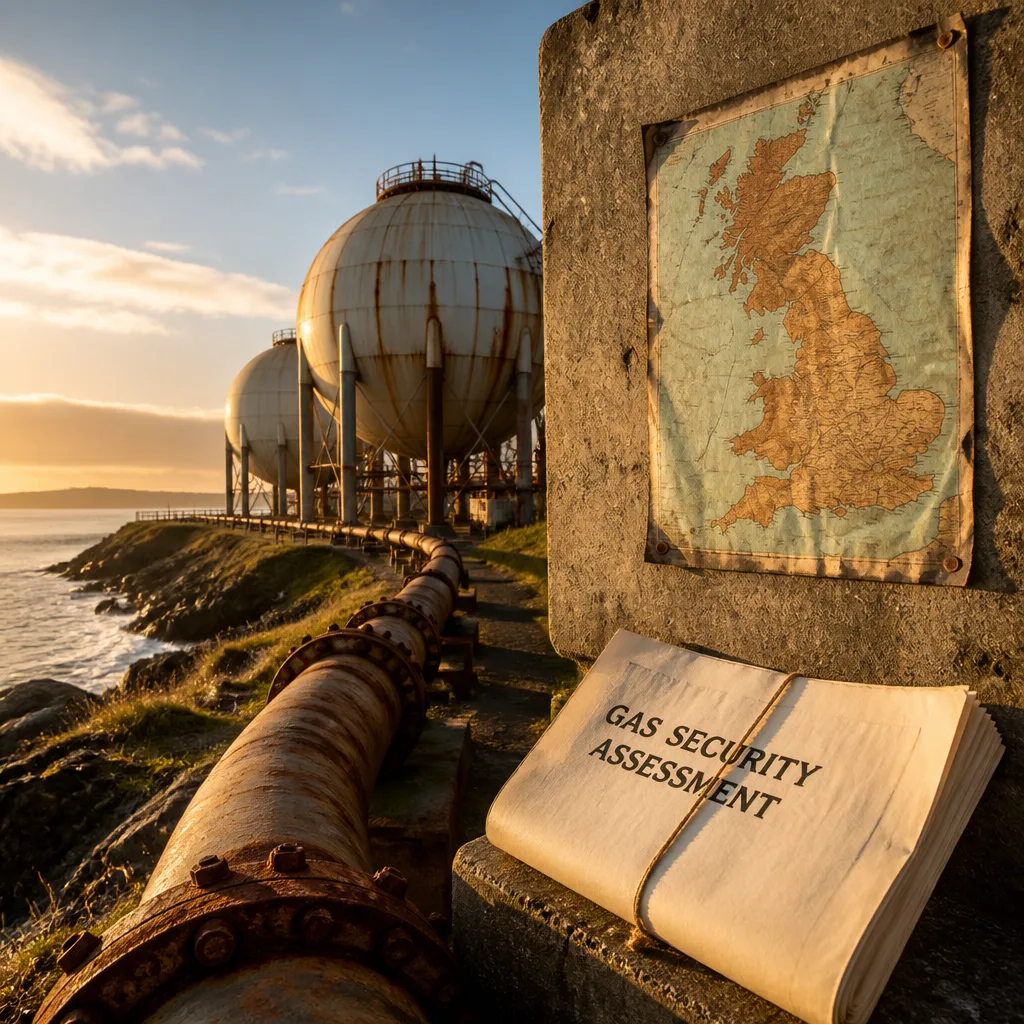
An official assessment of Great Britain’s gas security warns that the country could run out of gas in the 2030s unless ministers take “unprecedented” action to protect ageing infrastructure and guard against a potential supply shock.
What the assessment says
The assessment, released as part of a government consultation, describes a “high stress scenario” in which homes and businesses could be left without gas during prolonged cold weather as North Sea reserves decline. It says most industry respondents do not expect the private sector to prepare for low-probability, high-impact events, heightening the risk of a supply shortfall.
As a result, government officials are considering direct financial support for parts of the gas system to ensure they remain operable and economically viable as the country decarbonises. Options under review include subsidies or other forms of assistance aimed at owners of gas storage facilities and pipeline operators to encourage necessary upgrades and maintenance over coming decades.
“Any form of government intervention or investment in the gas market would be unprecedented and cannot be a decision we take lightly,” said Michael Shanks, the energy minister.
Why this matters to households and industry
The assessment underscores the tension facing energy policy: the UK is rapidly expanding clean power generation even as gas remains a central part of the system for heat, industrial processes and electricity balancing. The assessment notes that despite the drive to cut fossil-fuel dependence, the gas network will continue to play an important role for decades.
For households, a sustained shortage in winter months would mean reduced or lost heating for millions of homes at a time when energy bills remain politically and economically sensitive. For industry, gas-dependent sectors face production disruptions and higher operating risk. For markets, a credible threat to gas supply tends to push up forward prices and increase volatility in power markets, with knock-on effects for inflation and consumer energy costs.
Measures under consideration
Respondents to the consultation broadly agreed with warnings from the National Energy System Operator about an emerging risk to gas supply security. The government is therefore weighing measures that would be outstanding in peacetime energy policy, including:
- Direct financial support to owners of gas storage facilities to keep strategic reserves available.
- Financial assistance or incentives for gas pipeline operators to upgrade and maintain transmission infrastructure.
- Targeted interventions aimed at ensuring the economic viability of specific midstream assets through the transition.
The assessment makes clear such steps would be unprecedented and politically sensitive because they could be seen as supporting fossil-fuel assets at a time when the government is accelerating the growth of renewable energy.
Political and planning context
The findings come as ministers prepare to decide on controversial North Sea proposals, including the Rosebank and Jackdaw fields. The government says it will continue to reduce reliance on fossil fuels while recognising that the gas system will remain important for the foreseeable future.
Officials face a difficult balancing act: ensuring near-term security of supply and shielding households and industry from shocks, while avoiding long-term lock-in of high-emission infrastructure that would undermine net-zero targets.
| Issue | Implication |
|---|---|
| Declining North Sea output | Higher risk of supply shortfalls in prolonged cold periods |
| Industry risk appetite | Private sector unlikely to fund low-probability, high-impact resilience measures |
| Potential government action | Unprecedented financial support to storage and pipeline owners under review |
The assessment’s warning is a reminder that the transition to cleaner energy does not eliminate the immediate operational realities of energy systems. Governments must plan for both decarbonisation and continuity of supply. Any decision to underwrite parts of the gas system would have fiscal implications and raise questions about how to protect consumers and meet climate pledges.
For households and businesses, the practical takeaway is that energy security remains a live policy issue. Policymakers in the UK will need to show how interventions, if adopted, would limit the risk of supply disruptions without compromising long-term decarbonisation goals.
Energy markets will watch closely as ministers weigh a course of action that is, by the government’s own description, extraordinary and potentially far-reaching.