
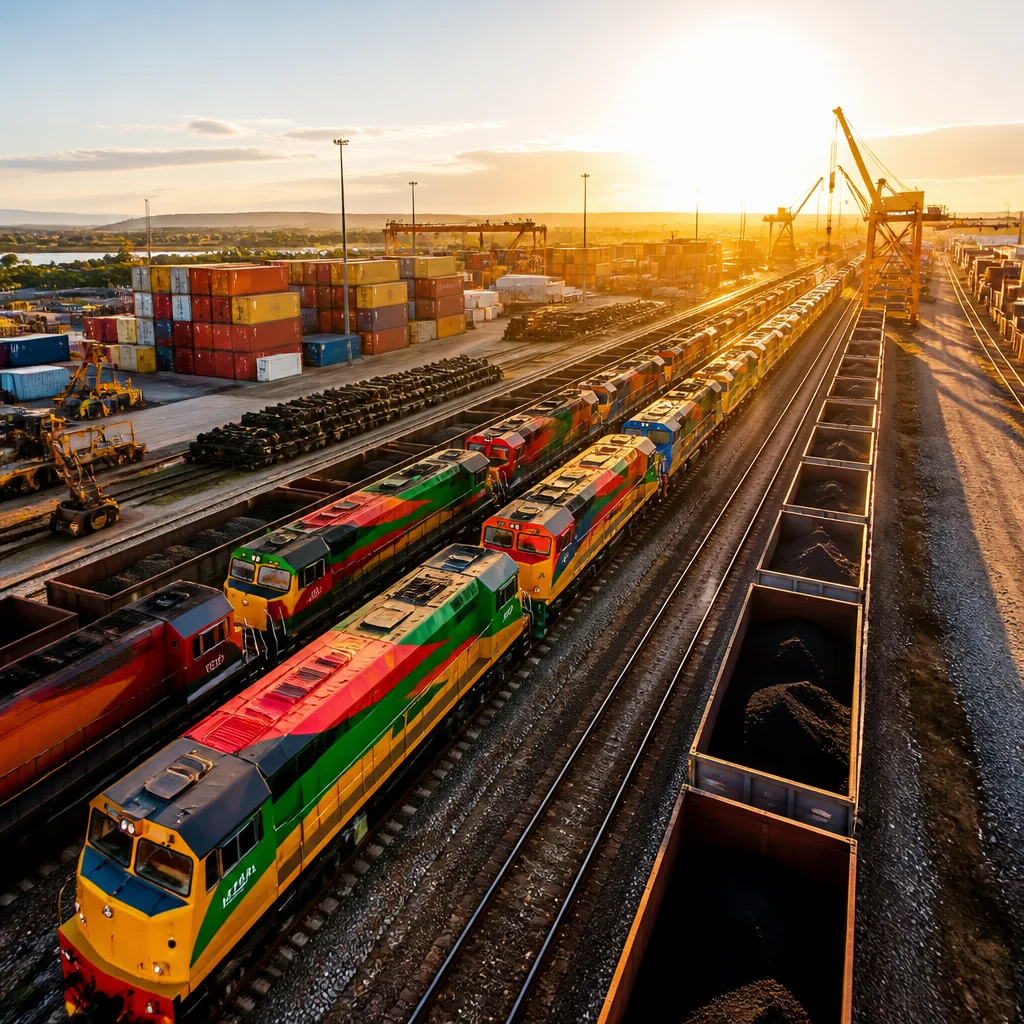
Traxtion, one of Africa’s largest private freight rail operators, has unveiled a R3.4bn rolling-stock investment to expand capacity as southern Africa opens state-owned freight networks to private operators. The programme, announced in December, will add 46 locomotives and 920 wagons, the company said on Friday.
Private access and a minerals-led demand surge
Traxtion’s move comes as South Africa implements an open-access model for the state-owned freight rail network, allowing private firms to run trains on state infrastructure. The policy shift is intended to increase capacity and private investment in rail logistics — a critical bottleneck for exporters of copper, lithium and other strategic minerals across the region.
The company also pointed to widening reform across neighbouring countries where it operates, including Angola, the Democratic Republic of the Congo (DRC), Zambia, Mozambique and Zimbabwe, which are pursuing concessions and modernisation to boost commodity exports.
"The fact that we have announced this investment says everything about our confidence in the direction of travel for the rail freight sector in South Africa and in the region,"
The statement, attributed to Traxtion CEO James Holley, underlines the operator’s view that regulatory change and infrastructure concessions will unlock new freight volumes tied to mining activity.
Regional projects that matter
Several high-profile regional projects and concessions were highlighted in recent coverage and are relevant to Traxtion’s strategy:
- Angola: a 30-year concession for the Lobito Corridor was awarded to a Trafigura-led consortium, linking Atlantic ports to inland mines.
- DRC: a concession awarded to Mota-Engil to upgrade rail links between Congolese mines and the Lobito route.
- Tanzania–Zambia (Tazara): a $1.4bn (reported as R22.66bn) Chinese-backed concession to rehabilitate the line.
- Zimbabwe: a proposed rail modernisation programme reported at $533m (R8.62bn) with China Railway International Group.
| Country / Corridor | Project | Value (reported) |
|---|---|---|
| Angola | Lobito Corridor concession | — |
| DRC | Rail upgrade concession to connect mines to Lobito (Mota-Engil) | — |
| Tanzania–Zambia (Tazara) | Rehabilitation concession | $1.4bn / R22.66bn |
| Zimbabwe | Rail modernisation | $533m / R8.62bn |
Traxtion’s investment is aimed at capturing the uplift in export volumes anticipated as these corridors become more commercially accessible. For South African shippers and miners, increased private motive power and rolling stock could reduce delays and lower logistics costs per tonne — provided regulatory and commercial frameworks function as intended.
Policy and financing remain hurdles
Despite the wave of concessions and open-access reforms, Traxtion and industry observers note the regional policy environment still requires improvement to enable private operators to raise funding and operate at scale. Issues include clarity on access charges, long-term contract certainty, and co-ordination between rail infrastructure owners and private train operators.
For households and businesses, the implications are practical. Better rail capacity can ease pressure on road freight, potentially lowering transport costs for bulk commodities and agricultural exports, and could reduce wear on highways. For the labour market, increased rail activity may create jobs in operations, maintenance and manufacturing of rolling stock, though the company has not specified employment figures tied to this R3.4bn spend.
Traxtion’s public commitment of capital — adding nearly a thousand wagons and dozens of locomotives — signals confidence that recent reforms will translate into contract opportunities and freight volumes. The scale of the investment also reflects the operator’s bet that southern Africa’s mineral boom will sustain higher rail demand over the medium term.
As the open-access model rolls out in South Africa and concessions advance across the region, the next test for policy-makers will be ensuring regulatory clarity and financing mechanisms that convert these policy changes into tangible improvements in capacity, reliability and cost for exporters and domestic users alike.
WE NEWS does not provide financial advice.













