
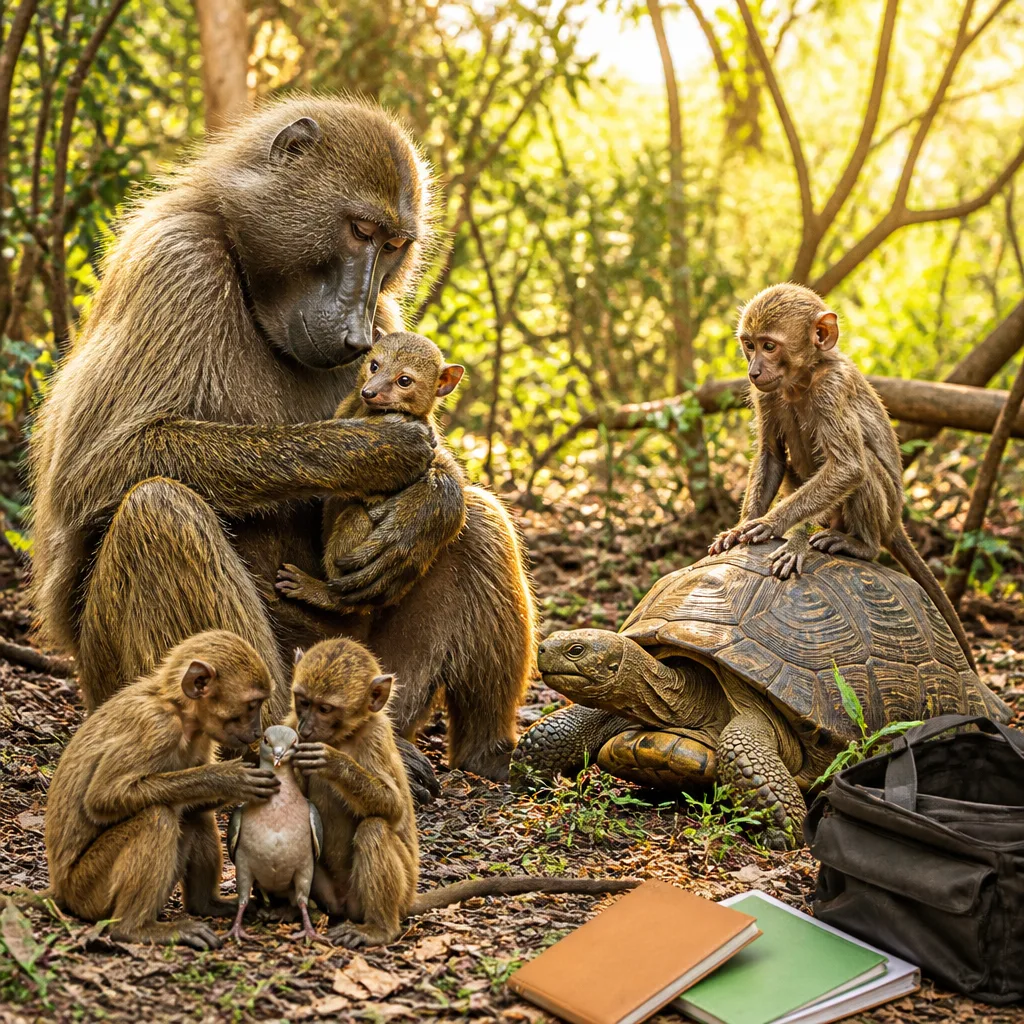
A comprehensive compilation of observations suggests that the tendency for primates to form affectionate or caretaking relationships with other animals is widespread across the order and may represent early evolutionary building blocks of human pet‑keeping, according to research led by an Oxford University anthropologist.
Broad survey of behaviours
The team, led by Cyril Grueter, an associate professor of anthropology at Oxford University, assembled more than 400 cases of interactions between primates and other species from scientific literature, media reports and surveys of primatologists, the reporting said. These incidents involved behaviour range from grooming and cradling to riding on, and in a few instances actions that could be construed as harmful.
In total, researchers documented encounters involving 88 primate species and 127 different species overall — comprising 72 primate species interacting with 55 non‑primate species. The array of examples spans wild and captive settings and includes both great apes and smaller monkeys.
| Metric | Count |
|---|---|
| Documented cases examined | 400+ |
| Primate species observed | 88 |
| Total species involved | 127 (including 55 non‑primates) |
Examples highlighted by the researchers include a male bonobo cradling a mongoose pup in Central Africa, a tufted gray langur stroking a giant grizzled squirrel in Sri Lanka, and stump‑tailed macaques grooming a domestic dog in Thailand. Photographs cited with the review show a squirrel monkey riding on a dog at an indigenous campsite in Colombia.
“These behaviors don’t amount to pet‑keeping as we know it, but they may represent some of the evolutionary building blocks from which human‑animal companionship eventually emerged,”
Grueter is reported to have said.
Patterns and caveats
The review notes several recurring patterns. Primates were often the initiators of contact, and juveniles and females appeared more likely to make the first move. While many interactions resembled affiliative care — grooming, close physical contact and tolerance — the authors also recorded cases that could be harmful or reflect mistaken parental instincts. In those instances, it was not necessarily clear that the primate intended to cause harm; rather, the behaviour may have been an unsuccessful or misdirected attempt at caregiving.
Because the study is a collation of reports rather than a controlled experiment, the authors emphasise limits to causal interpretation. The dataset draws on observations with differing levels of documentation and context, from peer‑reviewed field studies to media photographs and expert recollections. Nevertheless, the breadth of cases bolsters the argument that interspecific affiliative behaviour is neither rare nor confined to a single lineage of primates.
Relevance for understanding human‑animal bonds
Researchers propose that these cross‑species interactions could illuminate how the human propensity to keep companion animals evolved. By identifying behavioural elements such as care, tolerance and play that appear across diverse primate species, the review suggests a suite of predispositions may have been present in primate ancestors and subsequently shaped by ecological, social and cultural factors in humans.
- Observed behaviours included grooming, cradling, riding and close physical association.
- Interactions occurred in both wild and captive contexts and involved a wide taxonomic range.
- Some encounters were potentially harmful, highlighting the complexity of interpreting intent.
For South African readers, where primate species such as baboons and vervet monkeys frequently interact with human environments and domestic animals, the findings provide a comparative lens. They invite closer observation of how non‑human primates engage with other species and how such encounters might affect management, welfare and conservation approaches.
The study adds to a growing literature that sees empathy, social tolerance and exploratory interactions as not uniquely human, but part of a broader primate behavioural repertoire. Further systematic, controlled research will be needed to clarify the mechanisms, frequency and evolutionary significance of these interspecific bonds.