The Police and Prisons Civil Rights Union (POPCRU) has urged a comprehensive restructuring of the South African Police Service (SAPS), arguing the organisation’s national leadership is oversized and that resources should be redirected to frontline policing.
Union sets out specific proposals
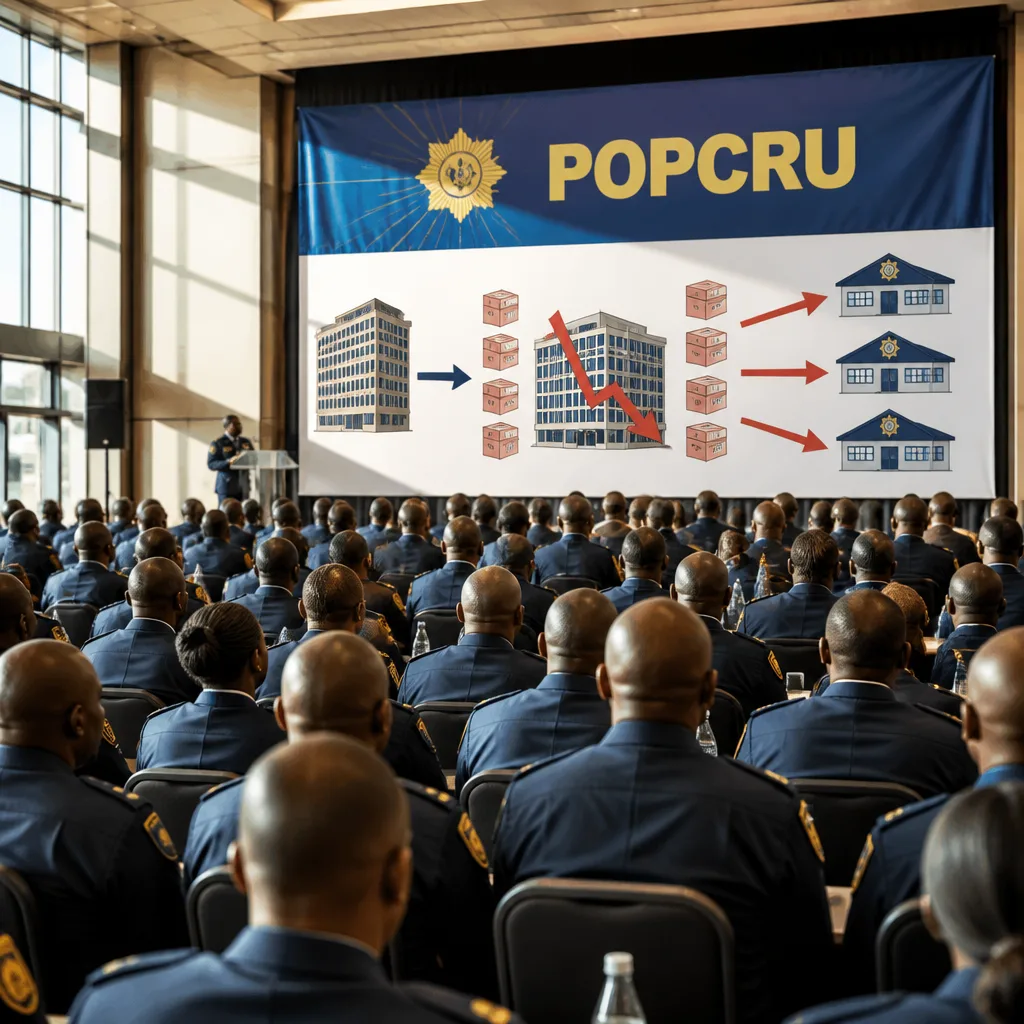
Addressing more than 700 delegates at POPCRU’s Central Executive Committee in Johannesburg this week, the union’s president, Thulani Ngwenya, proposed several concrete changes to how policing is organised and governed nationwide.
- Reduce the national head office to no more than 1 000 staff, shifting personnel and budgets towards operational stations;
- Separate policy from operations so that the Minister of Police retains responsibility for policy and transformation while the National Commissioner focuses on crime-fighting and investigations;
- Create a single national policing structure with specialist functions operating under one command rather than across multiple authorities;
- Unify traffic policing under a national approach, replacing the current fragmented provincial arrangements;
- Push back on austerity measures that the union says are eroding frontline capacity and public services.
Ngwenya framed the proposals as a practical realignment of resources and responsibilities. He argued the present configuration sees too many staff concentrated in head office roles that do not directly serve communities or contribute to frontline crime prevention.
“Crime is not taking place at the head office. The head office is not a police station and does not serve a local constituency that reports crimes,”
The union signalled its intention to present these recommendations at a broader policing indaba next year, seeking a national conversation on structural reform.
Rationale and implications
POPCRU’s critique rests on two central claims: that current institutional arrangements dilute operational focus, and that fiscal restraint has left frontline policing under-resourced. The union described the dual role of SAPS leadership—setting policy while running operations—as problematic, saying it creates conflicts and inefficiencies.
Under the union’s model, the Minister of Police would be primarily responsible for policy and transformation, while the National Commissioner would concentrate on investigations, public-order management and crime suppression. POPCRU said this division would clarify accountability and free operational leaders to direct resources where they are most needed.
Calls for a single command for specialist functions and a national traffic policing strategy reflect longstanding debates about overlaps between national and provincial authorities. The union argued that crimes do not respect institutional boundaries and that a more centralised operational command for specialised units would improve coordination.
Costs, capacity and political questions
While POPCRU’s proposals focus on structure and staffing, implementation would raise questions about cost, legislative change and governance. Reducing head office numbers to a capped figure would require personnel redeployment, retraining or potential transfers to provincial or station-level roles. A national traffic policing model could involve changes to provincial competencies and funding arrangements.
POPCRU also criticised what it described as austerity measures that, in its view, have weakened public institutions and placed further strain on frontline workers. The union warned that shrinking resources risk undermining the SAPS’s core responsibilities: fighting crime, conducting investigations and maintaining public order.
| Proposal | Intended effect |
|---|---|
| Limit head office to 1 000 staff | Redirect funding and personnel to frontline policing |
| Separate policy and operational roles | Clarify accountability between Minister and National Commissioner |
| Single command for specialist units | Improve coordination across jurisdictions |
| Unified national traffic policing | Standardise enforcement and reduce provincial fragmentation |
Any move towards these outcomes would require buy-in from national government, the National Commissioner, provincial administrations and Parliament. It would also prompt scrutiny from oversight bodies and civil-society stakeholders concerned with accountability, human rights and community policing.
POPCRU said it will take its proposals to a national policing indaba next year as part of a broader campaign to reshape how the country’s police service is organised and resourced.