Laboratory experiments now provide strong experimental indications that alloys of iron and hydrogen can enter a superionic state at pressures and temperatures comparable to those in Earth’s inner core, researchers from the Institute of Science Tokyo report in Nature Geoscience.
What is a superionic state?
A superionic state is an unusual state of matter in which one species of atom — typically a light element such as hydrogen, oxygen or carbon — becomes mobile and flows through a rigid lattice formed by heavier atoms. In the experiments reported by Science Tokyo, iron atoms remained fixed around their lattice sites while hydrogen moved rapidly through the structure. This combination gives the material a hybrid set of properties: mechanically resembling a solid while permitting fast ionic transport similar to a liquid.
How the experiments were done
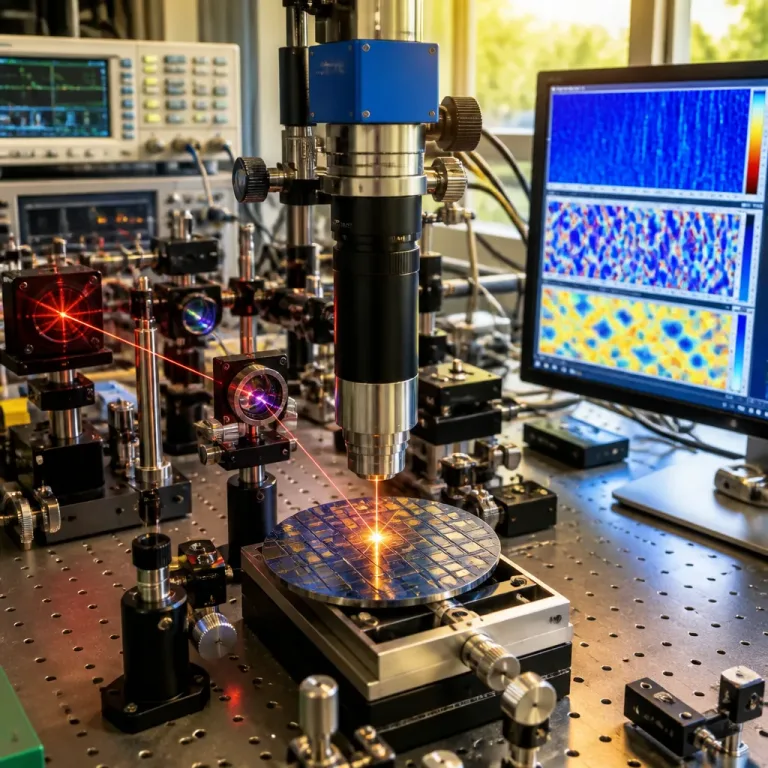
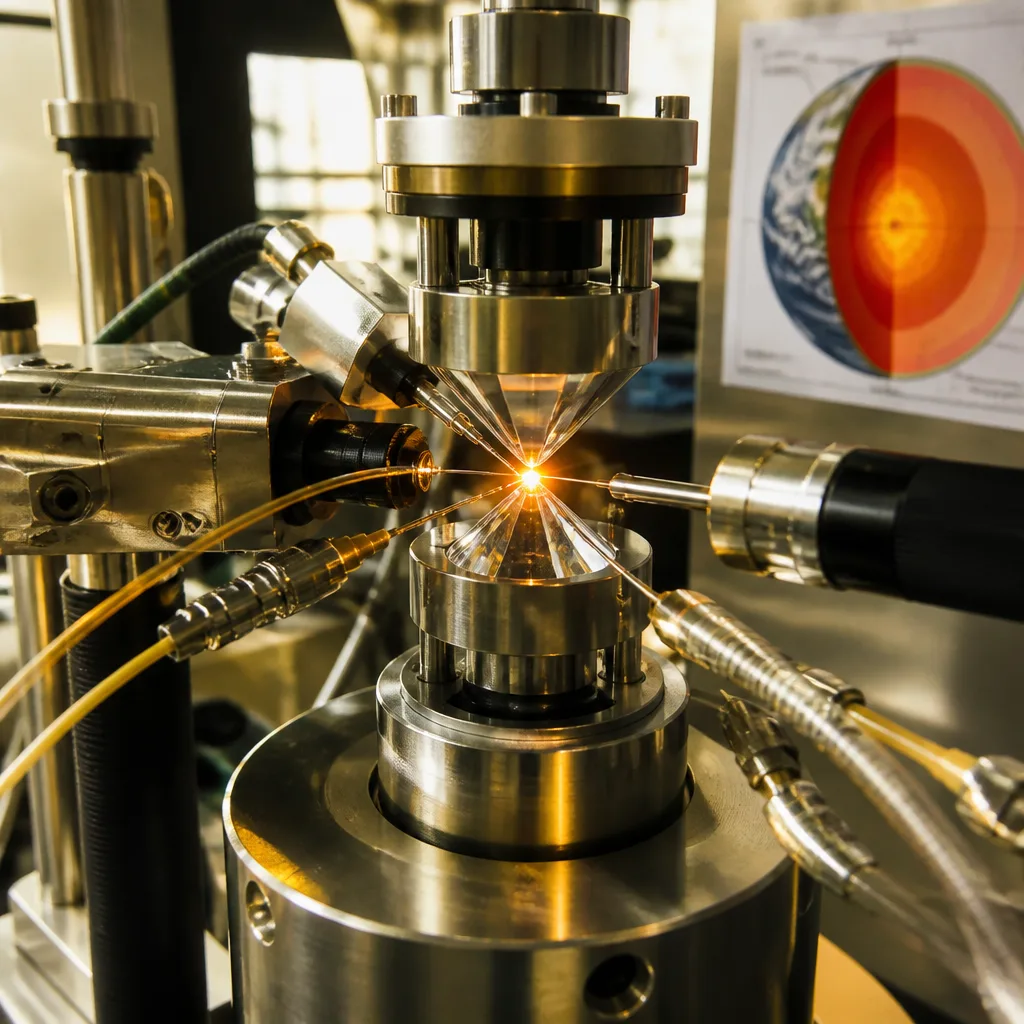
The team compressed samples of iron hydride in diamond-anvil cells and heated them with lasers. The samples were electrically wired to allow controlled heating, and analysed with synchrotron X-ray diffraction to probe atomic arrangements under the extreme conditions. These techniques can reproduce pressures and temperatures that approximate those found at the depths of Earth’s inner core.
The results show experimental signatures that the face-centred cubic form of iron hydride (FeHx) transitions into a regime consistent with fast hydrogen mobility through a crystalline iron matrix. Until now, much of the support for superionic behaviour in iron-light-element alloys came from molecular dynamics simulations rather than direct laboratory observation.
Why this matters for geoscience
Understanding whether iron alloys become superionic inside Earth matters for several reasons:
- Seismic wave behaviour — Laboratory and theoretical work suggests that superionicity leads to shear softening of the alloy. This could help explain why seismic shear waves (S-waves) travel more slowly through the inner core than expected from a purely solid iron composition.
- Transport properties — If light elements are mobile they will affect thermal and electrical conductivity in the core, which in turn influences heat flow and the dynamics that drive the geodynamo responsible for Earth’s magnetic field.
- Core composition and evolution — Direct experimental evidence narrows the range of viable models for the proportions and behaviour of light elements in the core, sharpening constraints on Earth’s formation and thermal history.
Interpreting the findings cautiously
These are strong experimental indications rather than a final, comprehensive characterisation. Laboratory experiments using diamond-anvil cells and laser heating reproduce core-like conditions only for very small samples and for limited durations. The work reported by the authors led by doctoral researchers Yoshihiro Nagaya and Yusuke Okazaki with Professor Kenji Ohta represents a major step from simulation to measurement, but it does not — and cannot yet — replicate the full complexity of the real core over geological time.
Further experimental work and independent replication will be needed to confirm the extent and stability of superionic behaviour across a wider range of compositions and to measure transport properties precisely. Complementary seismic, mineral physics and computational studies will also be required to connect laboratory signatures to the observable properties of Earth’s deep interior.
| State | Atomic arrangement | Key property |
|---|---|---|
| Solid | Both species fixed in lattice | Stable shear strength |
| Superionic | Heavy atoms fixed; light atoms mobile | High ionic mobility with shear softening |
| Liquid | No long-range lattice order | Flowing material |
The research is published in Nature Geoscience and marks an important experimental advance in the study of core materials. It narrows the gap between theoretical predictions — many of them from molecular dynamics simulations — and laboratory evidence about how iron and light elements behave at millions of atmospheres of pressure and temperatures of thousands of degrees.
For geophysicists and seismologists, these results offer a plausible explanation for some anomalous seismic observations of the inner core. For the wider scientific community, they provide a reminder that Earth’s deep interior remains a frontier where novel states of matter can complicate our models and invite further investigation.