
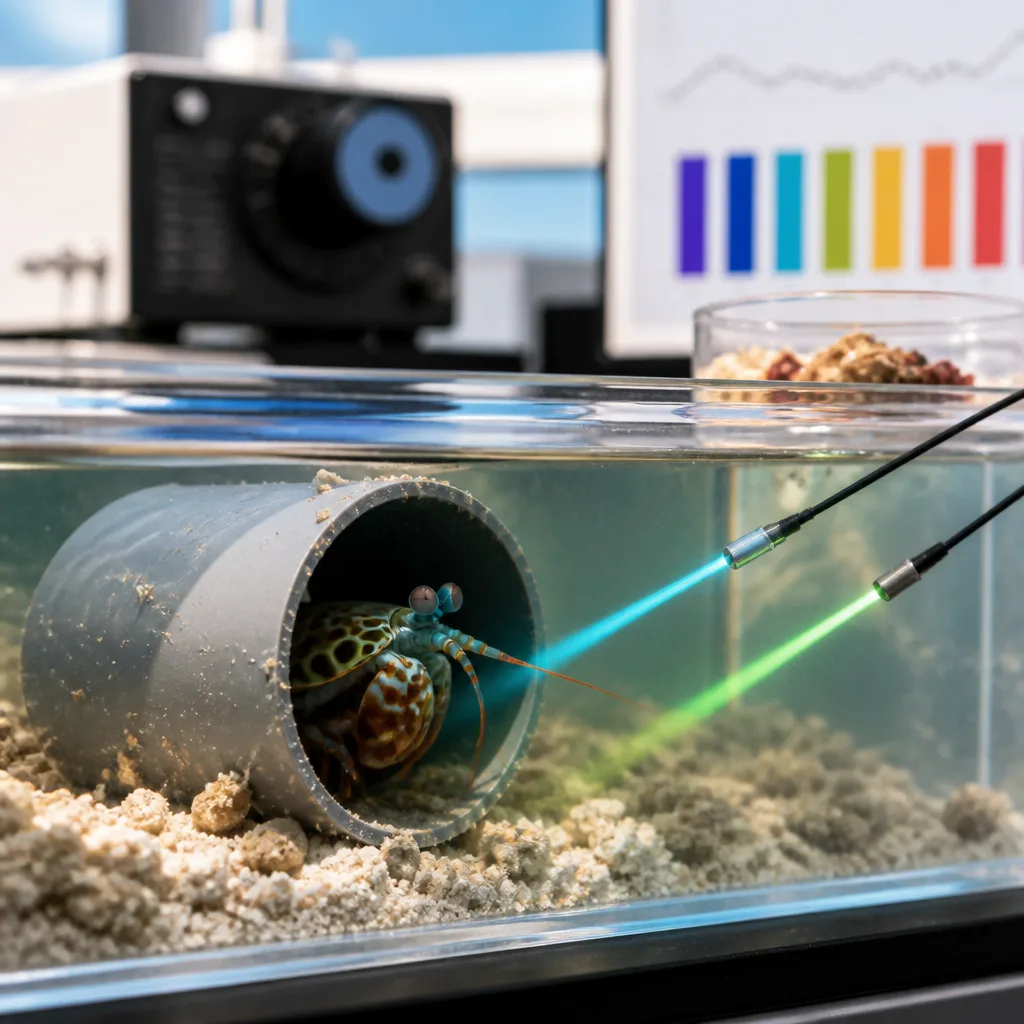
The long-standing claim that mantis shrimp see a vastly richer palette than humans rests on a simple counting argument: some species possess many more photoreceptor classes than people do. A 2014 study published in Science, led by Hanne H. Thoen at the University of Queensland, tested that idea and found a surprising result — at least for the species studied.
What researchers tested
The team trained specimens of the reef-dwelling mantis shrimp Haptosquilla trispinosa to associate light of a specific wavelength with a food reward. In a controlled choice task, individual animals emerged from their burrow and selected between two optical fibres: one producing the rewarded wavelength and a second producing a comparison wavelength. The researchers progressively moved the comparison wavelength closer to the rewarded value to determine how small a difference the animals could reliably detect.
Key findings
Across the wavelengths tested, the mantis shrimp typically required a difference of about 15–25 nanometres to discriminate successfully. By comparison, under similar narrow-band laboratory conditions and depending on colour and illumination, human wavelength discrimination thresholds can fall to roughly 1–8 nanometres. In other words, despite having many more receptor classes (up to 12 in some mantis shrimp species), these animals were less precise than humans at distinguishing nearby narrow-band lights in this test.
| Observer | Photoreceptor classes | Typical discrimination threshold (nm) |
|---|---|---|
| Mantis shrimp (H. trispinosa) | 12 | 15–25 nm |
| Humans | 3 | ~1–8 nm |
How to interpret the result
It would be an overstatement to infer from this experiment that mantis shrimp are colour-blind or that their complex eyes lack function. The study measured a very specific ability: telling apart two narrow, well-controlled wavelengths in a laboratory choice paradigm. Natural reef light is far more complex — broad spectra, changing illumination, varying polarisation, movement and textured objects all contribute information. Those ecological factors create different visual problems from the narrow discrimination task used in the experiment.
Researchers have proposed that mantis shrimp vision may operate more like a barcode scanner than a painter’s eye. In that model, a greater number of photoreceptor channels could support fast, categorical recognition of coloured signals and patterns rather than fine-grained spectral discrimination between very similar hues. In other words, more receptor types do not automatically produce minute wavelength discrimination; they may support different computational strategies suited to the animal’s ecology.
- Experiment scope: single species (H. trispinosa) in a laboratory task.
- Measured outcome: ability to choose a learned wavelength over a progressively closer alternative.
- Broader point: receptor count alone does not define subjective colour perception.
The study therefore serves as a reminder to separate receptor anatomy from perceptual performance. The number of photoreceptor classes provides one constraint on vision, but how neural circuits sample, compare and interpret incoming signals is equally decisive. Different animals may trade off fine discrimination for speed, robustness or detection of particular signals important to their life history.
Future work on mantis shrimp vision has continued to explore how these animals use spectral, polarisation and spatial cues in natural settings. For South African readers, the results are a useful example of how straightforward laboratory measures can overturn intuitive conclusions based on anatomy alone, and why careful tests of perception are needed to understand animal sensory worlds.









