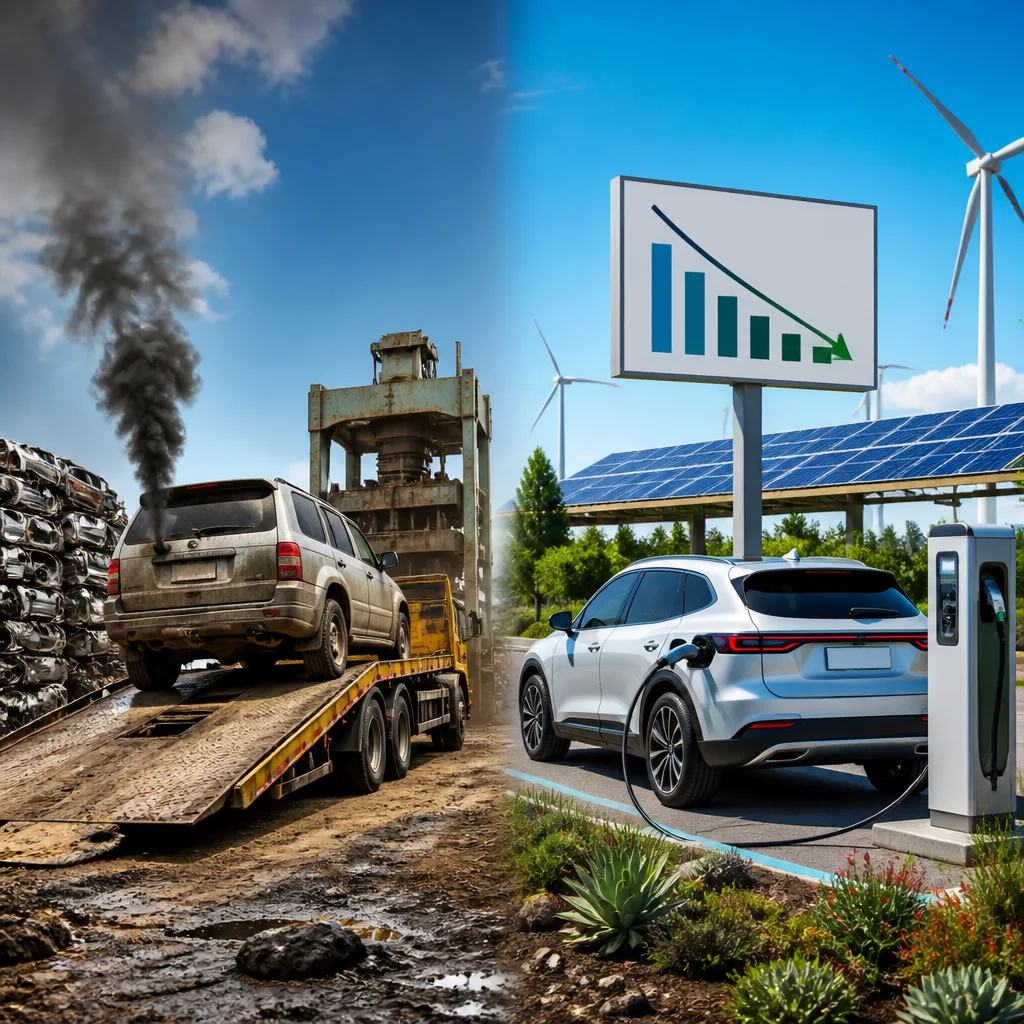
Replacing a functioning petrol car with an electric vehicle can reduce overall greenhouse‑gas emissions even after accounting for the extra emissions created by making a new car, a lifecycle study published in Science finds. The research, by J. Elliott Campbell (UC Santa Cruz) and Roland Geyer (UC Santa Barbara), directly addresses the long‑running assertion that "the greenest car is the one already built".
What the researchers did
The authors modelled the full lifecycle emissions of two choices: keep driving a working internal combustion vehicle to the end of its life, or permanently scrap it early and replace it with a battery electric vehicle (BEV). Rather than using a single, optimistic EV case, the study varied key parameters:
- vehicle fuel efficiency and annual kilometres travelled;
- battery manufacturing emissions and battery size;
- regional electricity grid emissions intensity.
This approach lets the results reflect a range of realistic conditions rather than a single best‑case scenario for EVs.
Principal findings
For a representative production‑weighted SUV operating on an average US electricity grid, the study found that scrapping the petrol vehicle in its second year and replacing it with a BEV reduced cumulative emissions over the modelled 16‑year period by 44%. The authors note that manufacturing the replacement EV produces a predictable initial carbon bump, but lower operating emissions from electricity use rather than petrol combustion deliver large emissions savings over time.
"The greenest car is the one already built"
The study reframes that maxim by pointing out that it implicitly treats all future petrol the existing car will burn as if it carries no emissions cost. By contrast, replacing a combustion vehicle early transfers emissions from years of fuel use into the one‑off cost of manufacturing a BEV — a trade‑off that can favour early replacement in many plausible scenarios.
Why the result matters
Three technical factors determine whether early scrappage reduces emissions:
- Operating emissions difference: how much lower are tailpipe plus upstream emissions for the BEV compared with the petrol car, given the electricity mix?
- Manufacturing carbon debt: the extra emissions from producing the new BEV, especially the battery.
- Usage pattern: annual kilometres travelled and vehicle lifetime — higher annual use accelerates payback of the manufacturing emissions.
In the authors' sensitivity tests, results changed with battery manufacturing emissions, battery size and grid carbon intensity. The study therefore does not claim a single universal rule but demonstrates that under many realistic parameter combinations, early replacement is environmentally preferable.
| Parameter | Effect on outcome |
|---|---|
| Higher battery manufacturing emissions | Reduces advantage of early replacement |
| Cleaner electricity grid | Increases emissions savings from BEVs |
| Higher annual mileage | Shortens payback time for manufacturing emissions |
Implications for policy and practice
The study strengthens the environmental case for policies that retire high‑emitting vehicles early and accelerate uptake of low‑emission alternatives, provided production impacts — especially battery manufacturing emissions — are managed. For countries such as South Africa, where the electricity system's carbon intensity remains a central concern, the result underlines two concurrent priorities:
- decarbonise electricity supply to maximise the operating benefits of electrified transport;
- reduce the carbon intensity of battery and vehicle manufacturing through cleaner industrial energy and recycled materials.
The authors' approach — exploring a wide range of realistic variables rather than a single assumption — makes the work a useful reference for policymakers weighing scrappage schemes, incentives or regulation. It also reminds decision‑makers that lifecycle thinking must include both the one‑off manufacturing emissions and the stream of fuel emissions avoided by earlier electrification.
As with all model‑based lifecycle studies, outcomes depend on assumptions about future electricity decarbonisation, battery production emissions and vehicle usage. The paper therefore strengthens the evidence base without offering a single universal prescription; the correct policy response will still depend on local conditions and trajectories for cleaner electricity and manufacturing.