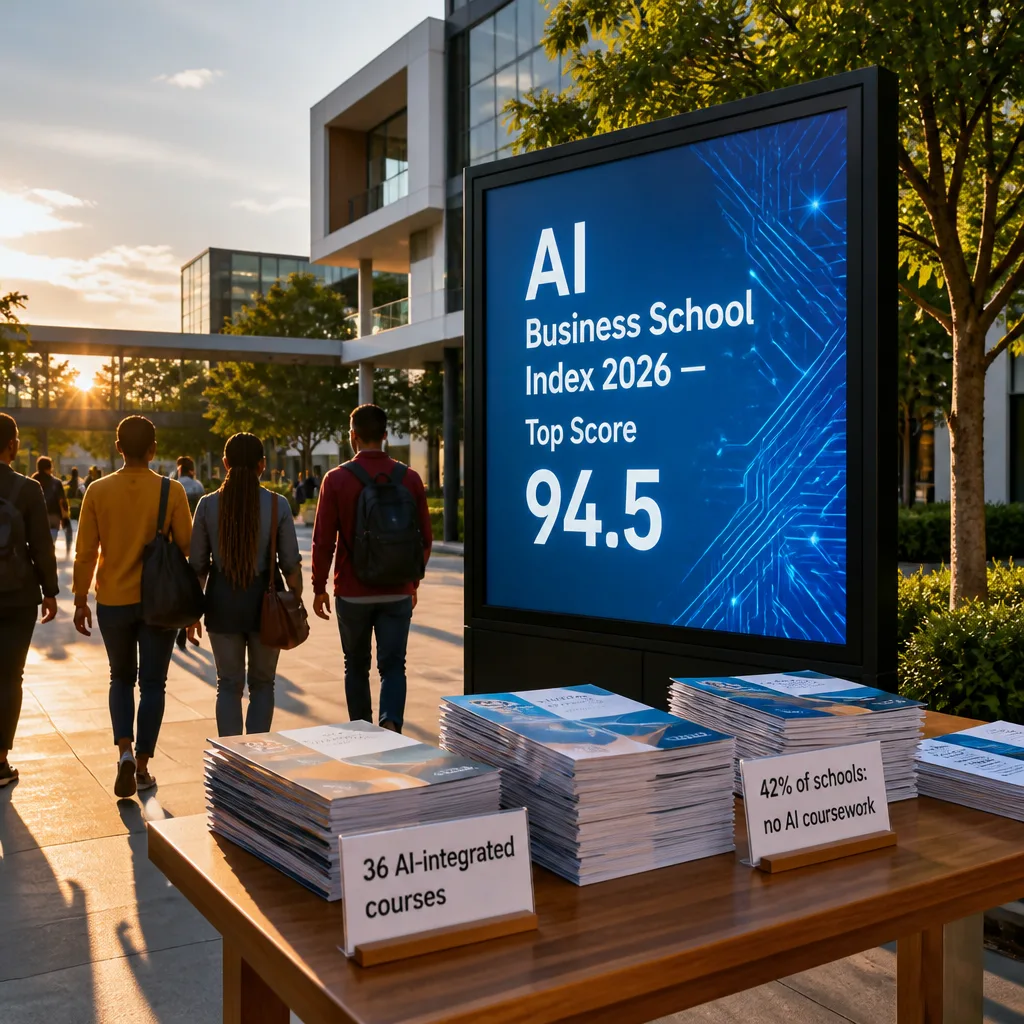
The Stanford Graduate School of Business has been ranked first in a new global index measuring how well business schools prepare students for an economy shaped by artificial intelligence, posting a composite score of 94.5 out of 100 across six dimensions of AI readiness.
Top positions dominated by elite US schools
The AI Business School Index 2026, published by 5W AI Communications — the AI-focused arm of US public relations firm 5W Public Relations — assessed 60 business schools in 14 countries. The ranking awarded equal weight to six categories: AI curriculum integration, AI-founder and executive alumni, corporate AI partnerships, executive AI education, AI-focused research output, and AI citation share across large language models.
Stanford was followed by MIT Sloan on 92.0 and Wharton on 90.5. The top seven places were swept by the so-called M7 schools, with Harvard Business School, Kellogg, Chicago Booth and Columbia completing the group.
| Rank | Business school | Composite score |
|---|---|---|
| 1 | Stanford Graduate School of Business | 94.5 |
| 2 | MIT Sloan | 92.0 |
| 3 | Wharton | 90.5 |
Wide disparities in course offerings
The index’s most striking finding is the gulf in curricular integration. Stanford lists roughly 36 AI-integrated courses — about 18 times the median of two AI courses among the 60 schools studied. At the other end of the distribution, the report found that 25 of the 60 institutions — 42% — do not require any AI coursework, offering AI topics only as electives or not integrating them into required courses.
- 36 — approximate number of AI-integrated courses at Stanford GSB.
- 2 — median number of AI-integrated courses among the 60 schools.
- 25 (42%) — number and share of schools requiring no AI coursework.
The report also highlights individual programme developments: Wharton is cited as the only M7 school with a named AI major, "AI for Business", which began in autumn 2025 and carries a STEM designation. Kellogg is named as the only M7 school offering a standalone AI degree, an 18-month programme referred to as MBAi.
Methodology and independence
5W AI Communications positions the index as the first benchmark of its kind. The publisher is a division of 5W Public Relations, a New York-based agency that also provides commercial services such as generative-engine optimisation and AI-visibility offerings to corporate clients. The report follows similar self-published rankings produced previously by the firm.
As with industry-commissioned rankings, the report’s methodology, data sources and scoring model have not been independently verified or peer-reviewed. That caveat is material for universities and employers that might use the index to inform hiring, fee-setting or curriculum decisions.
Implications for students and employers
For prospective MBA students and corporate talent managers, the index underscores two practical realities. First, exposure to AI topics varies markedly across the global business school landscape — which affects graduates’ readiness to work with large language models, machine-learning pipelines and AI governance frameworks. Second, the concentration of AI curriculum and research at a small group of elite schools could amplify existing recruitment patterns, concentrating AI-literate talent among organisations that already hire from those campuses.
For South African students weighing the cost of international programmes, the index provides another lens for evaluating value: beyond brand and alumni networks, it quantifies curriculum exposure to a technology already reconfiguring frontline tasks and middle-management decision-making. However, the lack of independent verification of the index means it should be treated as a directional assessment rather than a definitive audit.
Finally, universities outside the top cohort may face pressure from employers and domestic policymakers to accelerate AI curriculum integration if they wish to remain competitive in graduate employability. That will have implications for faculty hiring, research investment and industry partnerships — all of which carry a financial cost that will ultimately be weighed against student fees and donor support.
WE NEWS does not provide financial advice.