
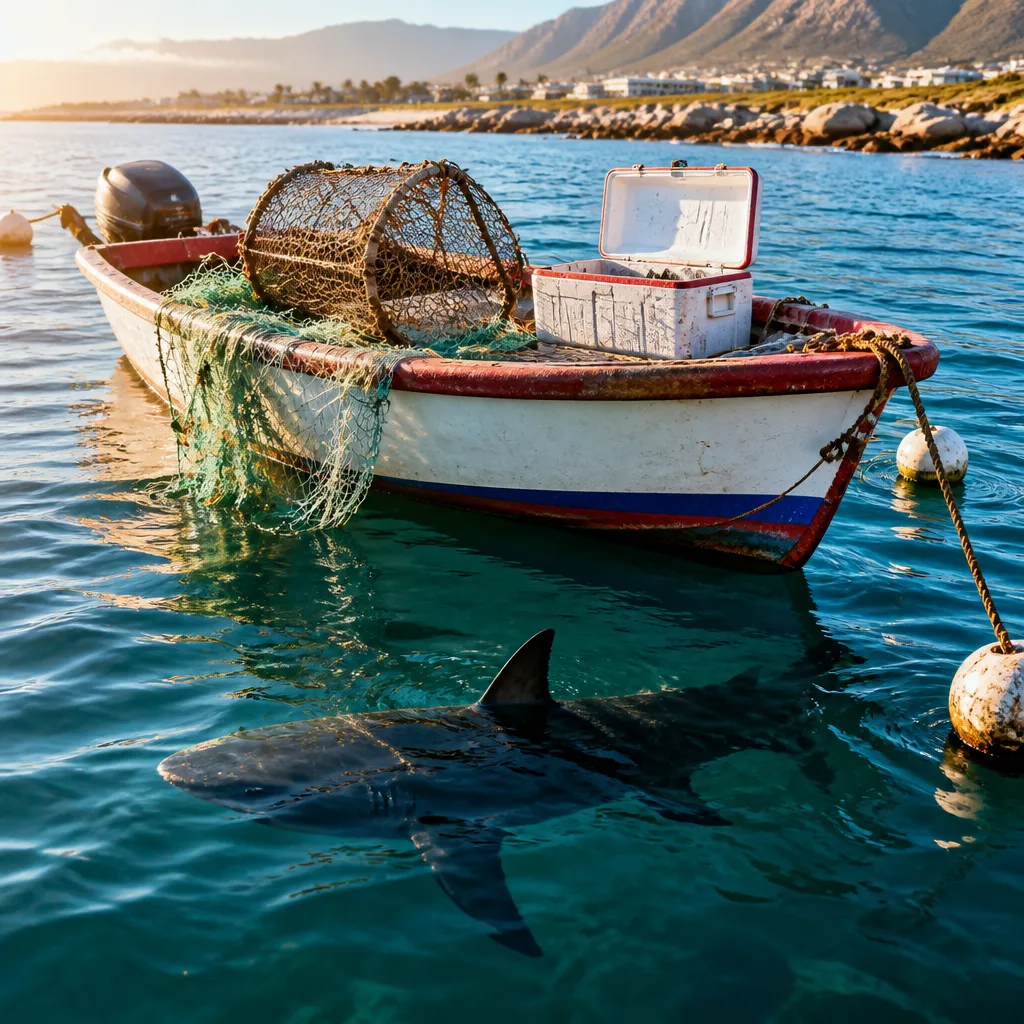
Sharks are altering their natural hunting patterns in response to human activity, and scientists say the changes could have widespread consequences for marine ecosystems and commercial and recreational fisheries. Recent reporting and research describe a steady rise in depredation — when sharks remove fish from fishermen’s lines or traps — and link the behaviour to heavy fishing pressure and learned associations with people and boats.
Depredation: a behavioural shift with practical consequences
Depredation has been recorded increasingly in several regions, most notably in the Gulf of Mexico, where researchers and community groups have documented sharks stealing hooked or landed fish from anglers and commercial gears. The behaviour reduces catch retained by fishers, raises safety concerns when sharks come close to boats, and may change predator–prey dynamics on local scales.
“Sharks have learned to associate the sound of boat engines with an easy meal,” Marcus Drymon, a shark specialist and professor at Mississippi State University, said in the report.
Scientists describe this as a form of learning: individual sharks that find a reliable food source at boats are likely to repeat and refine that behaviour, and the practice can spread socially among conspecifics. The shift from active hunting to scavenging off human activity is not merely anecdotal — it reflects an ecological response to altered prey availability and pervasive human presence in coastal waters.
Scale of the problem
One review cited in the reporting estimates that around 80 million sharks are killed each year by global fishing activity. That level of removal is enormous and can drive changes in population structure, reduce the number of large, wide-ranging individuals, and create ecological openings that surviving sharks may exploit in novel ways.
- Depredation reduces landed catch and can damage gear, affecting livelihoods.
- Behavioural learning appears to be driving repeat interactions between sharks and boats.
- Large-scale fishing mortality (tens of millions annually) is likely a root cause of shifting behaviours.
| Issue | Reported detail |
|---|---|
| Annual shark mortality (global) | ~80 million sharks |
| Observed behaviour | Increased depredation — taking fish from lines and traps |
Implications for South Africa and management options
Although the reporting focused largely on the Gulf of Mexico, the mechanisms described are relevant to South African waters. Our coastline supports diverse shark populations and active commercial and recreational fisheries. If sharks begin to associate boats or fishing activity with easy meals here, the result could be similar: lost catch, greater risk of negative human–shark encounters, and pressure on fisheries that already face sustainability challenges.
Fisheries managers have several tools that can reduce the frequency and impact of depredation. These include modifying gear and baiting practices, improving handling and release techniques to reduce post-release mortality, and using deterrent technologies where appropriate. Importantly, reducing overall fishing mortality on sharks and their prey will lower the ecological pressures that encourage risky opportunistic behaviour.
Scientists emphasise that managed responses should be evidence-based. Monitoring and local research are needed to establish the scale of depredation in South African waters, identify hotspots, and test interventions. Community engagement with fishers is also critical: those on the water often observe changes first and can help design practical solutions.
Where the science stands
The evidence for behaviour change combines direct observation, fishery reports and ecological reasoning about the effects of intense fishing pressure. Researchers caution against overgeneralising from one region; local studies are required to quantify impacts and inform management. Still, the available data indicate a clear link between human activity and changing predator behaviour.
For policy-makers and fisheries managers the takeaway is straightforward: human actions are reshaping marine predator behaviour, and mitigation will require a mix of reduced pressure, adaptive fisheries practices and targeted research. Coordinated monitoring across regions will be necessary to understand whether the patterns documented elsewhere are emerging along South Africa’s coasts, and to devise proportionate, practical responses that protect biodiversity and livelihoods.









