
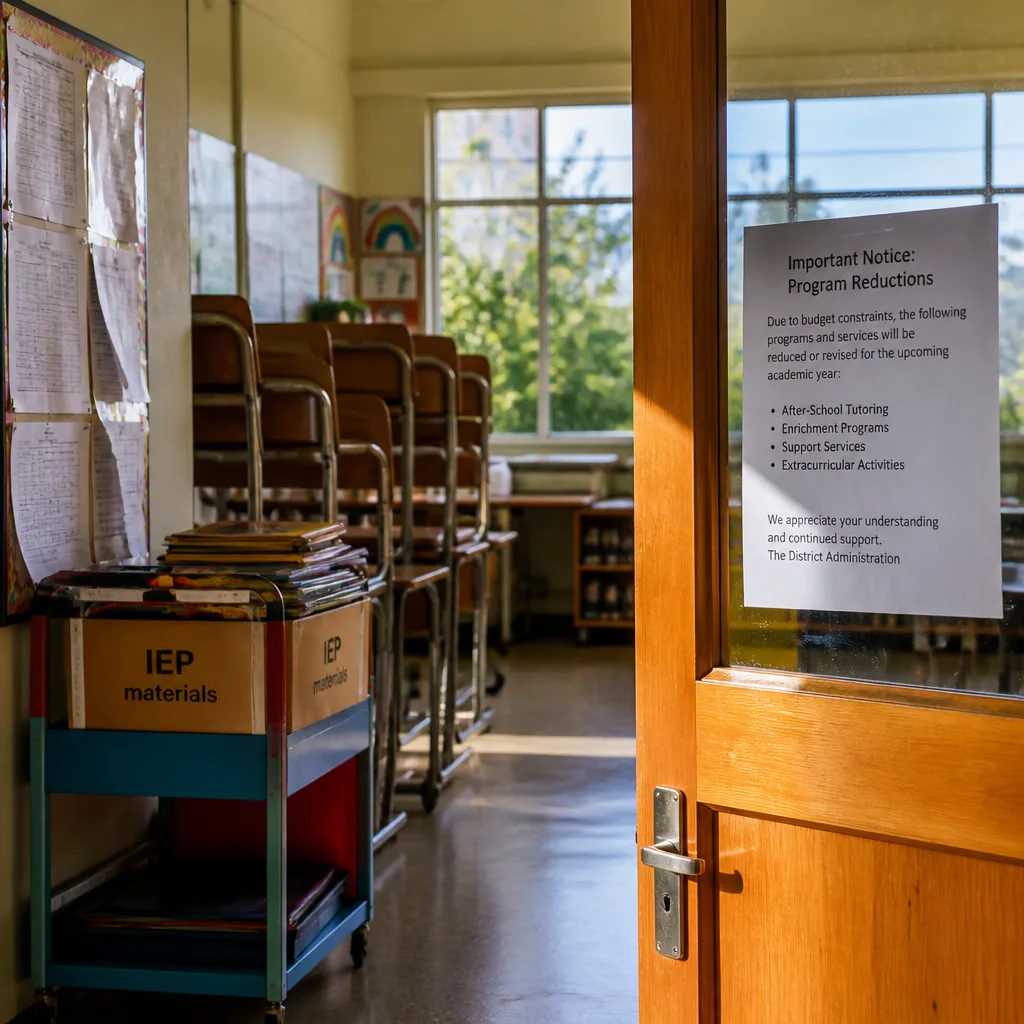
Santa Rosa City Schools has started the 2026–27 academic year after approving steep reductions to its special education provision, a move that will remove an elementary tier of support and end many co-teaching classes at middle and high schools, The Press Democrat reported.
Budget decisions and scale of services
The district’s special education allocation accounted for $72 million of a total $236 million budget as of 2025, the newspaper reported. Around 20% of students in the district participate in a special education programme, and there were 1,581 middle- and high-school learners with an Individualised Education Program (IEP) last year, according to the report.
| Item | Figure |
|---|---|
| District total budget (2025) | $236 million |
| Special education share | $72 million |
| Students in special education | ~20% of district enrolment |
| Middle & high school students with IEPs (last year) | 1,581 |
Programme changes and classroom implications
Among the cuts is the removal of a tier of support for elementary learners known as “special day classes.” At secondary level, the district plans to eliminate many co-teaching classes — classrooms staffed by two teachers, one of whom is a credentialled special education teacher. The Press Democrat reported that roughly half of the students enrolled in those co-teaching classes have an IEP.
Teachers and union representatives object to the changes, warning of a shift to smaller-group instruction that could nevertheless see group sizes rise into the 20s. In June, the school board approved a reorganisation of the special services department intended, the district said, to "build a more coherent, compliant, and sustainable district-wide support system," according to The Press Democrat.
“It worked, but it was expensive,” Kathryn Howell, president of the Santa Rosa Teachers Association, told The Press Democrat. “Two teachers are in a classroom when there would otherwise have been one … but also, that’s why it worked. Because there isn’t a way to do this without all of the teachers being able to talk to each other.”
The association president’s concern reflects classroom realities: co-teaching models are designed to allow special education and general education teachers to collaborate in real time. Removing that structure can affect how accommodations are delivered and how instruction is differentiated for learners with diverse needs.
What the district says and what it means for learners
The district framed the changes as an effort to create a more compliant and sustainable support system across all schools. The Press Democrat reported the board’s vote on a reorganisation plan in June as the catalyst for the 2026–27 adjustments.
For learners, parents and teachers, the changes will be measured in everyday practice: whether students with IEPs continue to receive required supports, how teacher workloads and collaboration are managed, and whether small-group models can replicate the personalised attention of co-taught classrooms. The report suggests some secondary students formerly in co-teaching classes will be moved into small-group instruction, a model that recent experience has shown can swell to sizes that may challenge effective individual support.
- Special education comprised $72 million of the district’s $236 million budget in 2025.
- About 20% of students are in special education programmes; 1,581 secondary students had IEPs last year.
- District approved reorganisation in June aimed at greater compliance and sustainability but leading to cuts in direct support models such as special day classes and co-teaching.
The Press Democrat provided the reporting on the budget figures and the changes to classroom programmes. As districts across the United States face fiscal pressures, the Santa Rosa case highlights the difficult trade-offs between budget sustainability and maintaining models of inclusive instruction that depend on team teaching and lower adult-to-student ratios.
For teachers, parents and learners in Santa Rosa, the coming months will be a test of whether restructured services can deliver both compliance and the day-to-day support that helps students with additional needs thrive in mainstream classrooms.











