
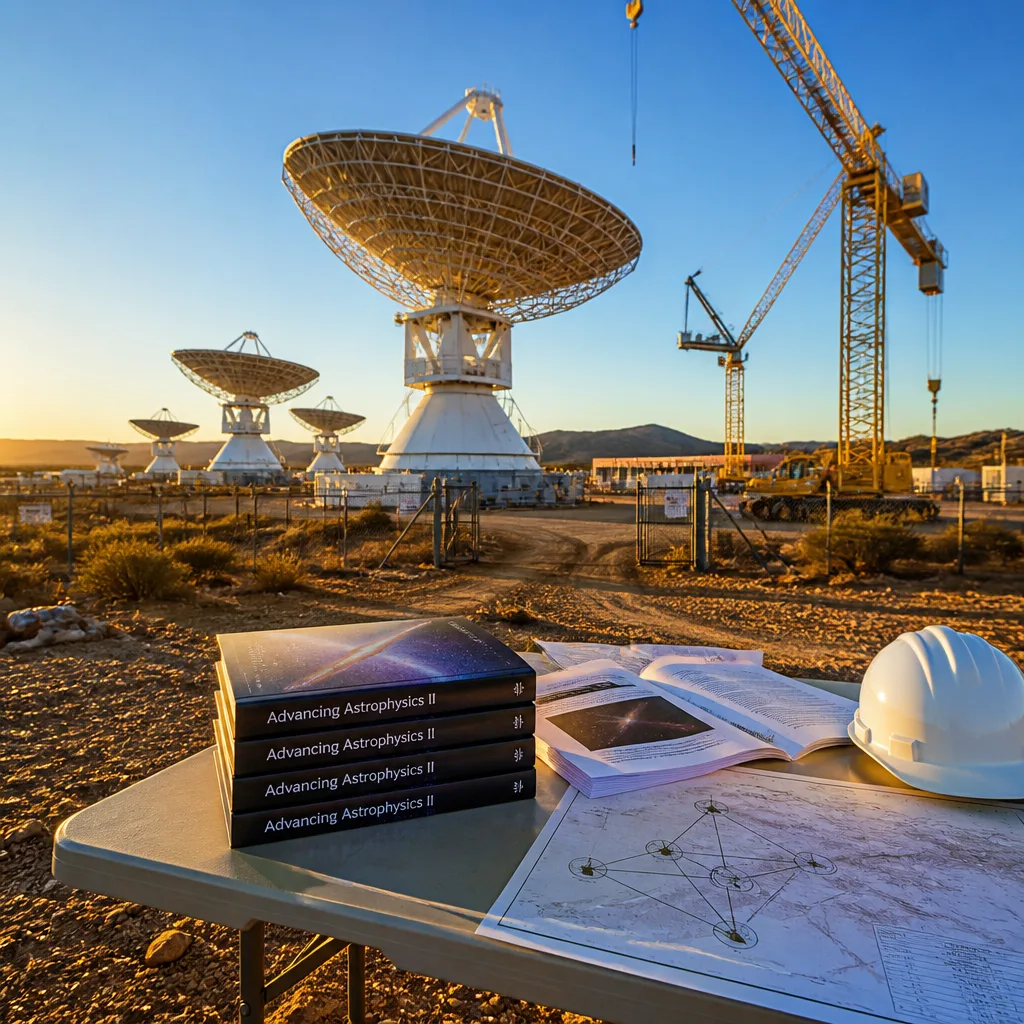
The SKA Observatory (SKAO) has published a major compendium laying out the research community’s priorities for the Square Kilometre Array (SKA) as construction of both telescope elements progresses. The book, titled Advancing Astrophysics II, collects 221 peer‑reviewed papers from more than 1 500 scientists across 51 countries and will help shape science planning for the international radio‑astronomy facility.
What the book contains and why it matters
The volume groups proposed investigations into six broad themes: the Sun, Earth and planets; star formation and stellar evolution; the Milky Way to distant galaxies; the cosmos; the extreme Universe; and methods and techniques. These areas reflect the scientific reach the SKA design aims to deliver: very high sensitivity, fast survey speed and advanced imaging over a wide range of angular scales and frequencies.
The SKA consists of two principal elements. South Africa is host to SKA‑Mid, an array that will ultimately include 197 dishes and incorporates the existing MeerKAT telescope. Australia is host to SKA‑Low, planned to comprise 131 072 antennas. SKA‑Low produced a first test image in March last year using 1 024 antennas; SKA‑Mid is expected to release its initial image later this year, using four dishes.
“The science cases presented here will shape the SKAO’s scientific strategy as the telescope arrays grow towards completion, and inform priorities for upgrades and the continued evolution of the Observatory’s capabilities in the coming years,”
The SKAO’s head of scientific services, Dr Anna Bonaldi, highlighted that the book will guide priorities for future upgrades and the Observatory’s evolving capabilities.
International scale and South African context
The book’s authorship underlines the SKA’s international character: contributors span 51 countries, while the SKAO currently has 14 full member countries. Of the contributing authors, the largest single national contingent comes from Italy (14.9%), followed by the United Kingdom (10.4%), Germany (8.7%) and China (8.6%). These proportions illustrate the global appetite for SKA science as the facility nears its operational era.
For South Africa, hosting SKA‑Mid builds on the legacy of MeerKAT, which has already produced world‑class science and trained a generation of radio astronomers and engineers. The new compendium offers an articulated set of science cases that local researchers and funders can use to align national support, training and infrastructure investments with the Observatory’s projected priorities.
- Scope: 221 peer‑reviewed papers covering six scientific themes.
- Participation: More than 1 500 scientists from 51 countries contributed.
- Infrastructure: SKA‑Mid will reach 197 dishes; SKA‑Low will reach 131 072 antennas.
Implications for research, industry and skills
The SKA’s science agenda is not only about astrophysics. Delivering the instrument and extracting science from its data require substantial investments in computing, data storage, software development, and high‑performance networking. These technical needs present opportunities for South African universities, industry partners and research institutions to deepen involvement in areas such as signal processing, machine learning for big data, and systems engineering.
Moreover, the book’s wide authorship indicates a growing user community. As the array grows towards completion, demand for observing time, data products and collaborative projects will increase. National stakeholders will need to consider how best to support local scientists to access SKA resources, participate in international collaborations, and translate SKA capacities into broader economic and educational benefits.
| Item | Figure |
|---|---|
| Peer‑reviewed papers in the book | 221 |
| Contributing scientists | 1 500+ |
| Countries represented | 51 |
| SKA‑Mid dishes (final) | 197 |
| SKA‑Low antennas (final) | 131 072 |
The SKAO head office is hosted in the United Kingdom, reflecting the multinational governance and funding model of the Observatory. As the arrays move from construction to early science operations, the compendium will act as a reference point for setting observing programmes, upgrade pathways and the Observatory’s strategic planning.
For readers tracking South Africa’s role in cutting‑edge science infrastructure, the book is a reminder that the SKA is both a large telescope project and a long‑term platform for international collaboration, technical development and human capital formation. The next milestones — SKA‑Mid’s first images and the first coordinated science projects — will be important tests of how the global science cases in the new volume translate into concrete discoveries and national benefit.









