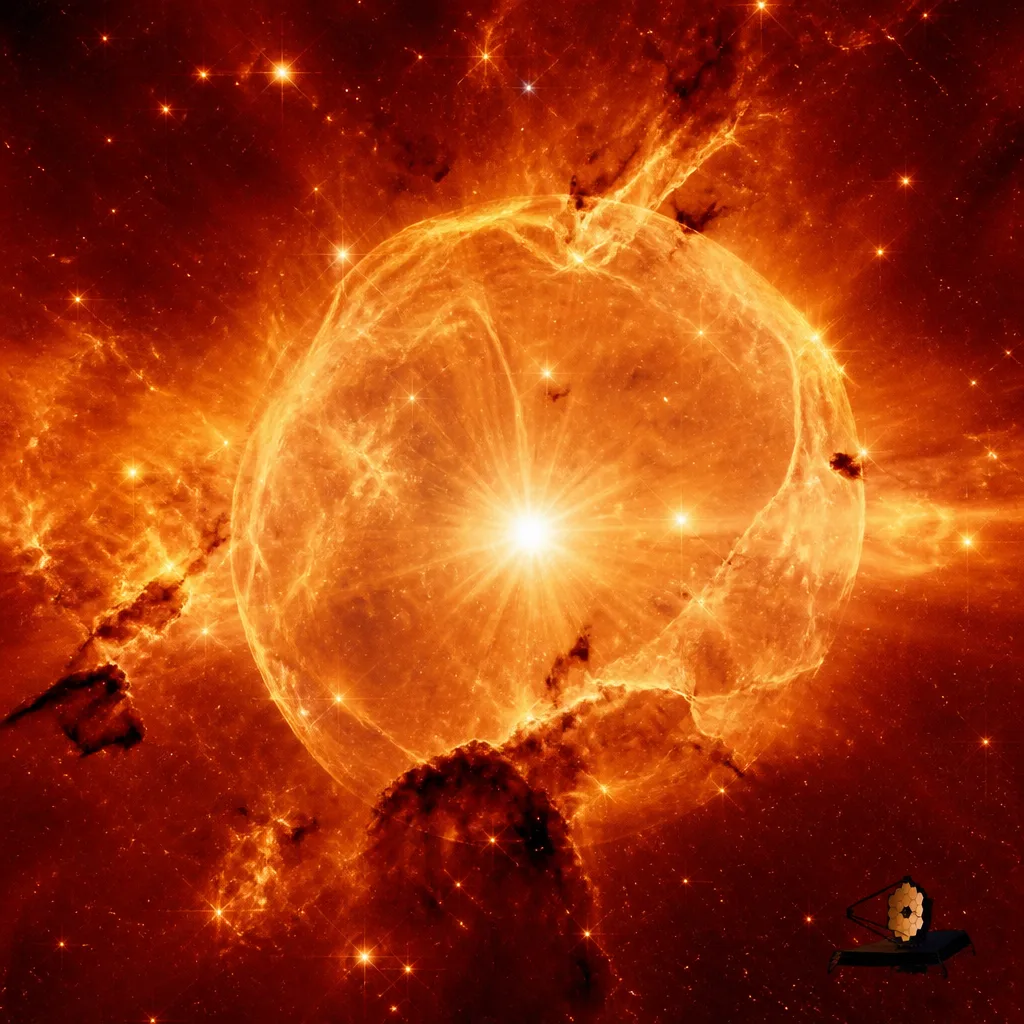
The NASA/ESA/CSA James Webb Space Telescope has captured new, high-resolution infrared images of the planetary nebula NGC 2392, commonly known as the Lion Nebula. The observations, made with Webb’s NIRCam (Near Infrared Camera) and MIRI (Mid-Infrared Instrument), reveal compact clumps of dust and filamentary ionised gas that help explain how the remains of a dying star sculpt its immediate environment.
What Webb shows that Hubble could not
Hubble first imaged the Lion Nebula in visible light in 2000, revealing a face-like structure and a hazy ‘mane’ of comet-shaped objects. Webb’s infrared sensitivity does not overturn that broad appearance but adds detail: it penetrates cooler dust and highlights structures that are faint or obscured at optical wavelengths. The new images emphasise the presence of compact dust clumps and a haze of ionised gas around the nebula’s interior.
- Compact dust clumps: dense knots that survive the central star’s radiation and appear to cast tails of material behind them.
- Ionised gas bubble: the central region, energized by the white dwarf, forms an expanding bubble that illuminates the nebula’s face-like appearance.
- Illuminated dust shell: the so-called mane corresponds to the inner surface of a dust shell that glows when lit by the central star.
These features are snapshots of a dynamic process. Webb’s images effectively ‘freeze’ the nebula at one moment, while the underlying physical processes—expansion, erosion of dust, and redistribution of gas—continue to unfold on astronomical timescales.
Why the structure matters
Planetary nebulae are formed when low- to intermediate-mass stars reach the end of their lives and shed their outer layers. The leftover stellar core—a white dwarf—emits strong ultraviolet radiation that ionises surrounding gas and erodes dust. In NGC 2392, this central white dwarf is responsible for much of the nebula’s appearance: the bubble of ionised gas forms the lion’s face, while surviving dust clumps create the mane’s tufts.
Understanding how rings, shells and clumps form around dying stars is an ongoing area of research. The new Webb data provide sharper diagnostics for models of mass loss, dust survival and radiative shaping. Observers can now examine the relative distribution of warm dust and ionised gas with greater clarity, helping to distinguish between competing explanations for the nebula’s complex morphology.
| Instrument | Capability | What it highlights in NGC 2392 |
|---|---|---|
| NIRCam | Near-infrared imaging | Warm dust and fine structural detail in inner regions |
| MIRI | Mid-infrared imaging | Cooler dust emission, ionised gas haze and compact clumps |
"Webb’s imagery ‘freezes’ this planetary nebula in time, though the star's death, and its tumultuous effects, go on."
That quote, used by the team presenting the images, succinctly captures the scientific value: Webb provides a sharper instantaneous record of an evolving phenomenon, which can then be compared with observations taken at other wavelengths and at other epochs.
Timescales and what to expect next
Astronomers estimate that the Lion Nebula will disperse over roughly 10,000 years, a blink in cosmic terms but far longer than human observation campaigns. Even so, the combination of infrared and optical data allows researchers to trace how material is being swept away from the central star and how pockets of dust resist destruction. These survival pockets, appearing as comet-like tails or knots, protect material in their lee and affect the nebula’s eventual dispersal.
Future work will compare Webb’s images with archival Hubble data and with spectroscopy that can measure velocities and compositions. Such multi-wavelength, multi-epoch studies are essential to test models of how stellar winds, radiation pressure and pre-existing density structures combine to form rings, shells and clumps.
The new Webb observations of NGC 2392 are a timely reminder that planetary nebulae, though often called simple—an expanding shell illuminated by a hot core—can host much more complex physical processes. Webb’s infrared eye is proving especially useful at revealing those hidden details.