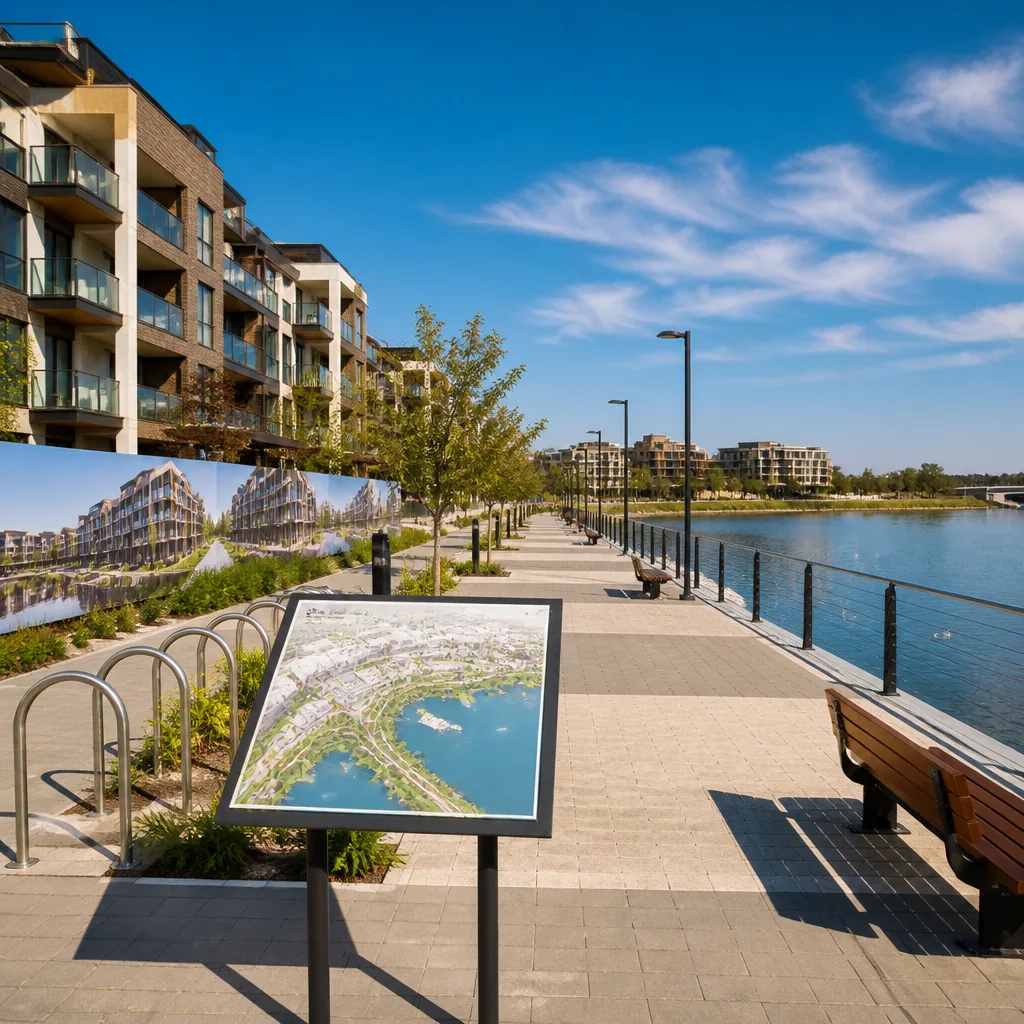
Developers are increasingly promoting proximity to water not only as a luxury selling point but as a potential public-health asset, as an expanding body of research suggests that being near bodies of water — so-called blue space — can benefit mental and physical wellbeing.
What is blue space and why does it matter?
Blue space describes outdoor settings where water is a prominent feature: oceans, lakes, rivers, ponds, canals or urban fountains, whether natural or man-made. Researchers studying the phenomenon distinguish between active engagement (walking, swimming, boating) and passive exposure (viewing water, listening to waves), both of which have been associated with improved health outcomes.
Several studies point to three consistent pathways by which blue space may improve wellbeing:
- Increased physical activity: water-adjacent routes and parks encourage walking and recreation, which support cardiovascular and mental health.
- Stress reduction: passive exposure to water — seeing waves or hearing running water — can promote calm and help regulate stress-response systems.
- Social interaction: waterfronts often act as focal points for community activity, strengthening social ties that protect mental health.
Evidence so far
The School of Marine and Environmental Affairs at the University of Washington has helped define the concept, while empirical studies have built the evidence base. Research highlighted in recent reporting links coastal lifestyles with lower cortisol (a stress hormone), higher self-reported happiness and better sleep. A study published in Health & Place about a decade ago found that, after controlling for income, population density and other factors, residents who had direct visual contact with blue space from their homes reported lower psychological distress. The reporting also notes that the National Institutes of Health has highlighted differences between green- and blue-space effects, with blue visibility showing a stronger localised mental-health association in some studies.
These findings are not uniform across every context, and scientists emphasise caution: associations do not always prove causation, and effects vary by population, type of waterbody, accessibility and the wider urban environment.
Why developers are changing the sales pitch
High-end residential projects in coastal US cities are reframing waterfront proximity as part of a wellness narrative. Instead of only advertising views and recreation, marketing increasingly cites research linking water exposure to better sleep, reduced stress and greater longevity. For buyers, developers argue, the adjacency of blue space could be a factor in long-term wellbeing — not merely aesthetic value.
That shift has consequences for how urban planners and policymakers think about waterfront development. If water adjacency conveys public-health benefits, equitable access to blue space becomes a planning concern rather than purely a market one.
| Type of blue space | Typical associated benefits |
|---|---|
| Coastal/ocean | Lower stress biomarkers, improved sleep, recreational activity |
| Rivers and canals | Active transport routes, social spaces, visual calm |
| Ponds and urban fountains | Localised stress relief, passive exposure in dense areas |
Policy and equity considerations
For South Africa — a country with extensive coastline and many rivers — the blue-space conversation raises policy questions. Access to waterfronts is uneven: premium waterfront housing often excludes lower-income groups. If proximity to water contributes to better mental health, then equitable planning should be considered. City authorities, environmental planners and public-health officials may need to weigh how to balance private development with inclusive public access to blue spaces.
Researchers and planners also note environmental constraints. Waterfront development must account for climate risks such as sea-level rise and flooding, and preserve ecological function. In short, harnessing the potential wellbeing benefits of blue space requires integrated thinking across health, urban design and environmental management.
The current evidence suggests blue spaces are a promising area for further study and policy attention, but not a simple cure-all. Findings to date support the idea that water adjacency can contribute to healthier lifestyles and reduced psychological distress, yet outcomes depend on context, accessibility and how spaces are designed and managed.
Key implications: planners should consider equitable public access to waterfronts; developers may legitimately highlight mental-health research when marketing; and scientists must continue to parse which features of blue spaces deliver the clearest benefits, for whom, and under what conditions.