
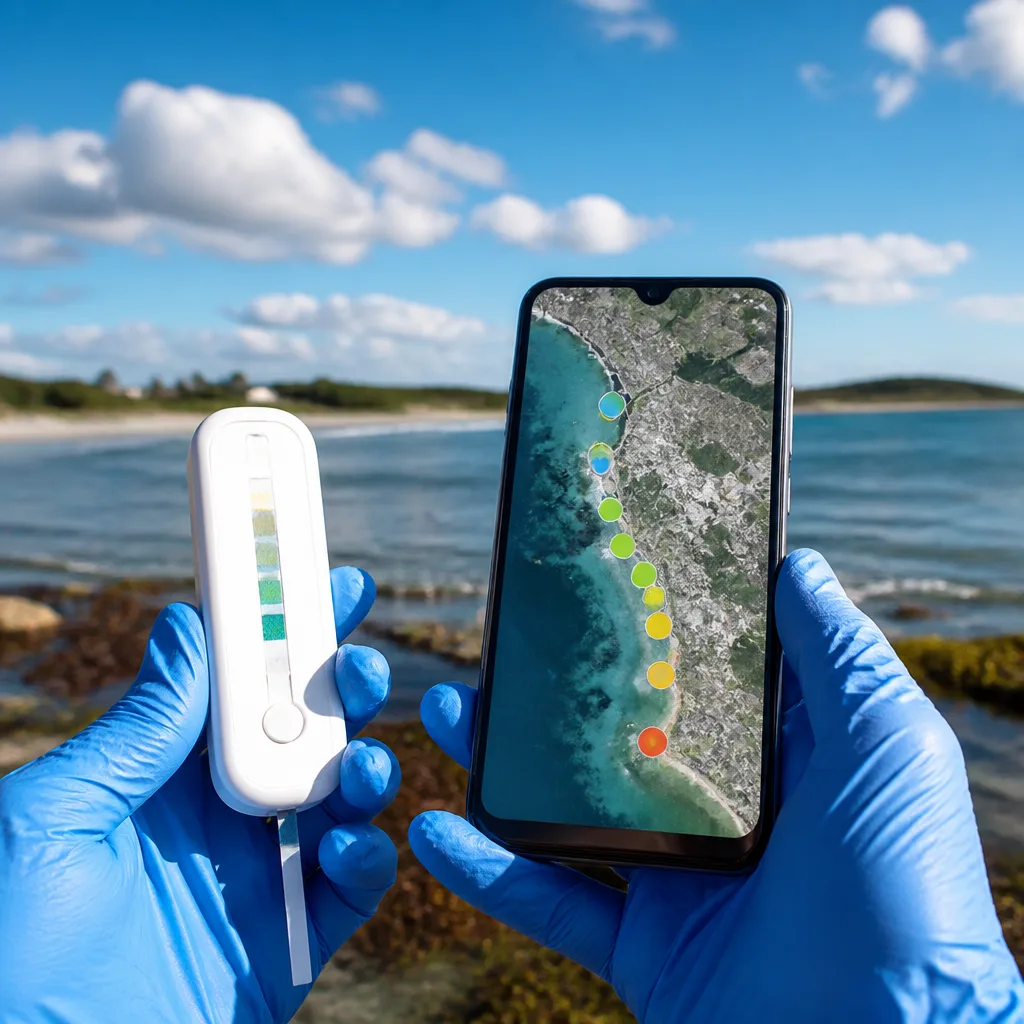
Molendotech, a spinout from the University of Plymouth, will roll out live water‑quality maps in the UK and the US this October, pairing its portable bacterial test with an app that collates field results, rainfall and tidal data and uses artificial intelligence to produce predictive water‑safety models.
What the product does
The firm is already known for a handheld test called Bactiquick. The device produces a colour change when it detects harmful gram‑negative bacteria; that reaction is converted into electrical signals and reported in real time, removing the two‑day laboratory wait that typically follows water sampling.
“You can test the water repeatedly on the same day. You get a result in real time,” said Simon Jackson, professor of environment and human health at Plymouth University and Molendotech’s chief scientific officer.
The test can detect organisms commonly associated with recreational and potable‑water risks, including E. coli, Pseudomonas, Legionella and salmonella. Molendotech plans to aggregate daily results from distributed tests with environmental inputs such as rainfall, river flows and tides to create maps and short‑term forecasts.
Market and public‑health context
The launch comes amid growing public concern about sewage spills and river pollution in Britain. Campaign groups have recorded large numbers of reports of illness after swimming, describing ailments from gastroenteritis to ear and skin infections. The company says its tool is aimed at companies, community groups and individuals who need fast, portable testing rather than waiting for laboratory confirmation.
For businesses that depend on coastal and river users — from hospitality at beaches to leisure‑boat operators — faster information on contamination can reduce reputational and operational risk. For households, shorter notification times about water safety translate into clearer choices about recreational activities and reduce the chance of avoidable medical expenses or lost workdays after illness.
- Launch: Planned in the UK and US in October.
- Technology: Handheld colour‑change test (Bactiquick) with electrical readout and an AI‑driven mapping app.
- Targets: E. coli, Pseudomonas, Legionella, salmonella and other gram‑negative bacteria.
Commercial and regulatory considerations
Rapid, decentralised testing could expand markets for private environmental monitoring, consultancy and sensor data services. Local authorities and water utilities may also be prospective customers — though public agencies typically rely on accredited laboratory results for regulatory action, leaving a role for field tests as early‑warning or supplementary tools rather than replacements for compliance testing.
The success of an app that combines distributed tests with predictive modelling will depend on data density and quality. Predictive accuracy improves where tests are frequent and geographically dispersed; a sparse network of readings risks false confidence in model outputs. The firm intends to use daily tests and hydrological inputs such as rainfall and tidal flows to overcome that constraint.
| Element | Role |
|---|---|
| Bactiquick | On‑the‑spot detection of gram‑negative bacteria |
| App and maps | Aggregation of test results, rain/tidal data and AI‑driven forecasts |
| Target markets | Individuals, community groups, private companies, potential interest from public agencies |
Implications for households and jobs
Faster testing can help households avoid illness that carries direct costs such as medical treatment and indirect costs like time off work. For coastal communities and businesses whose income depends on safe, attractive beaches and rivers, reliable near‑real‑time information can reduce cancellations and help manage staffing and supply decisions.
On the employment side, scaling up production, distribution and data services around the app could create roles in manufacturing, field testing, data analysis and customer support. The pace and scale of job creation will hinge on commercial uptake in both consumer and institutional channels.
Molendotech was formed in 2018 from research at Plymouth. The planned October launch in two major markets will test demand for rapid, portable bacterial testing linked to predictive mapping — an approach that, if widely adopted, could shift how recreational water quality is monitored and communicated.
WE NEWS does not provide financial advice.













