
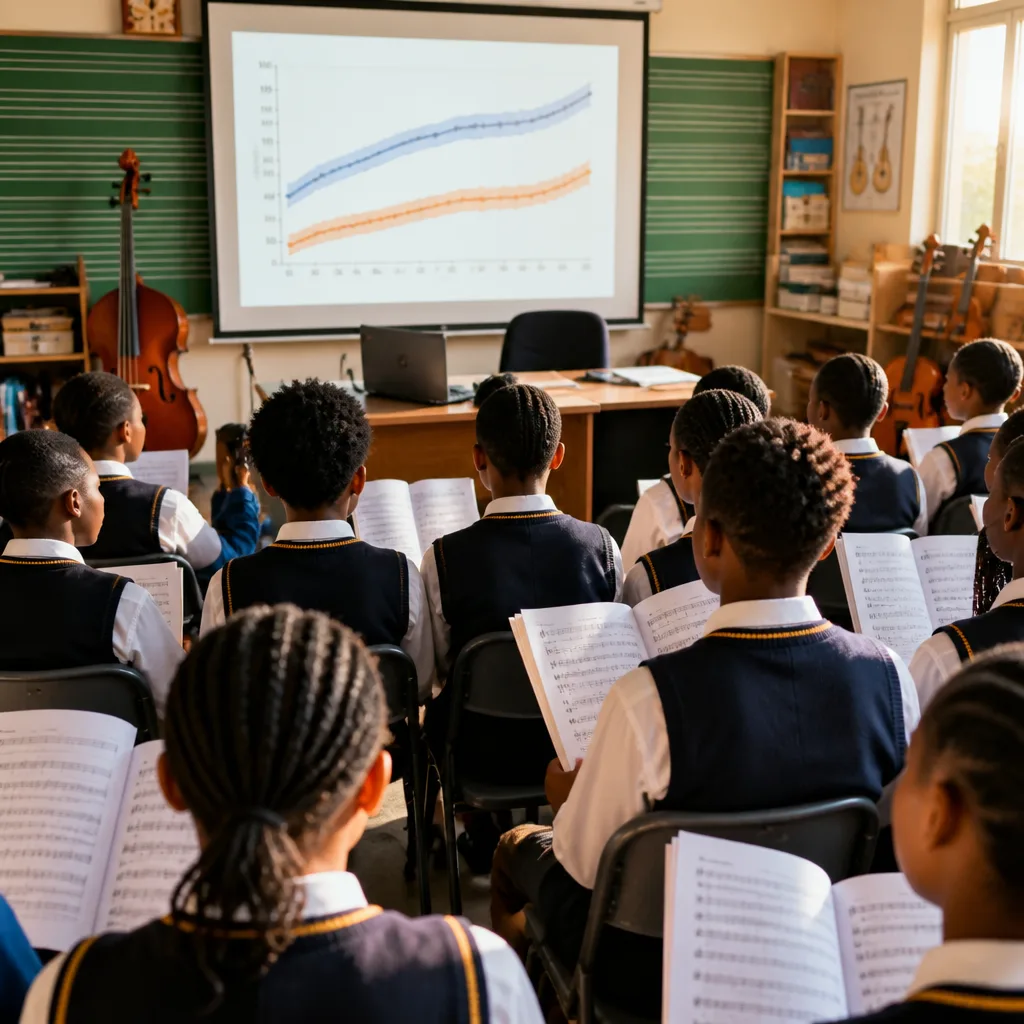
A large-scale analysis of school-based music practice in China has quantified how pupils’ singing accuracy improves with repetition and how accuracy differs across vocal registers, findings that carry practical lessons for classroom teaching and curriculum planning.
Key findings from a national classroom corpus
Researchers examined a corpus of 2,432 student–song practice sequences contributed by 1,074 learners, analysing a total of 2,458,825 pitched note attempts. The study found a clear learning curve: mean correctness rose from 0.656 on the first practice attempt to 0.727 by the thirtieth repetition.
Accuracy also varied by pitch register. Low pitches were sung more accurately than high pitches, with mean correctness of 0.749 for low pitches compared with 0.703 for high pitches. The analysis identified a broad spread of latent singing ability across learners, with ability parameter (theta) values ranging from –3.79 to 3.36 logits.
| Measure | Value |
|---|---|
| First practice correctness (mean) | 0.656 |
| Thirtieth repetition correctness (mean) | 0.727 |
| Low-pitch correctness (mean) | 0.749 |
| High-pitch correctness (mean) | 0.703 |
| Latent ability (theta) range | –3.79 to 3.36 logits |
Models and predictive performance
The study compared several statistical models to predict correct singing at the note level. An Item Response Theory (IRT) model achieved an area under the curve (AUC) of 0.673, while a per-pitch Bayesian Knowledge Tracing (BKT) model reached an accuracy of 0.752 on held-out attempts. Both models outperformed simple baseline approaches, though the authors note the absolute gains were modest.
Because the dataset and analysis are observational, the researchers present their results as evidence-informed hypotheses rather than causal claims. They suggest their findings could inform register-graded curriculum design, repetition-rich practice schedules, and adaptive, per-learner feedback — proposals that require testing in controlled classroom trials.
Implications for teachers, curriculum planners and assessment
For classroom teachers and curriculum designers, the study offers measurable benchmarks and practical directions that could be applied in South African contexts where school music remains an important part of the arts curriculum. Practical takeaways include:
- Designing practice schedules that deliberately incorporate repetition to exploit the observed learning curve.
- Adapting repertoire and exercises to account for register-related accuracy differences, offering scaffolding for high-pitch work.
- Using per-learner assessment data to tailor feedback and set realistic, incremental targets.
These suggestions align with classroom realities: repetition must be balanced with curriculum time, learner motivation and the resources available to teachers. The study’s emphasis on per-learner variability also underscores the need for differentiated instruction, particularly in large classes and multi-grade settings.
Context and next steps
The research draws on digitally collected practice data, reflecting how assessment platforms can enable large-scale, granular study of learning trajectories. The authors recommend that the hypotheses emerging from this observational work be followed by controlled trials in classroom settings to test whether register-graded curricula or adaptive practice scheduling produce reliable learning gains.
For South African education stakeholders, the study offers a template: combine routine classroom assessment with analysis to build locally relevant evidence. As schools seek to strengthen arts education, pragmatic trials that test repetition strategies and adaptive feedback in our schools would help determine whether the observed patterns hold across different languages, vocal traditions and resource environments.
The study provides a rare quantitative benchmark for vocal-skill acquisition that can help teachers set expectations and plan instruction, but only careful, context-sensitive implementation and research will show how these findings translate into improved classroom outcomes.











