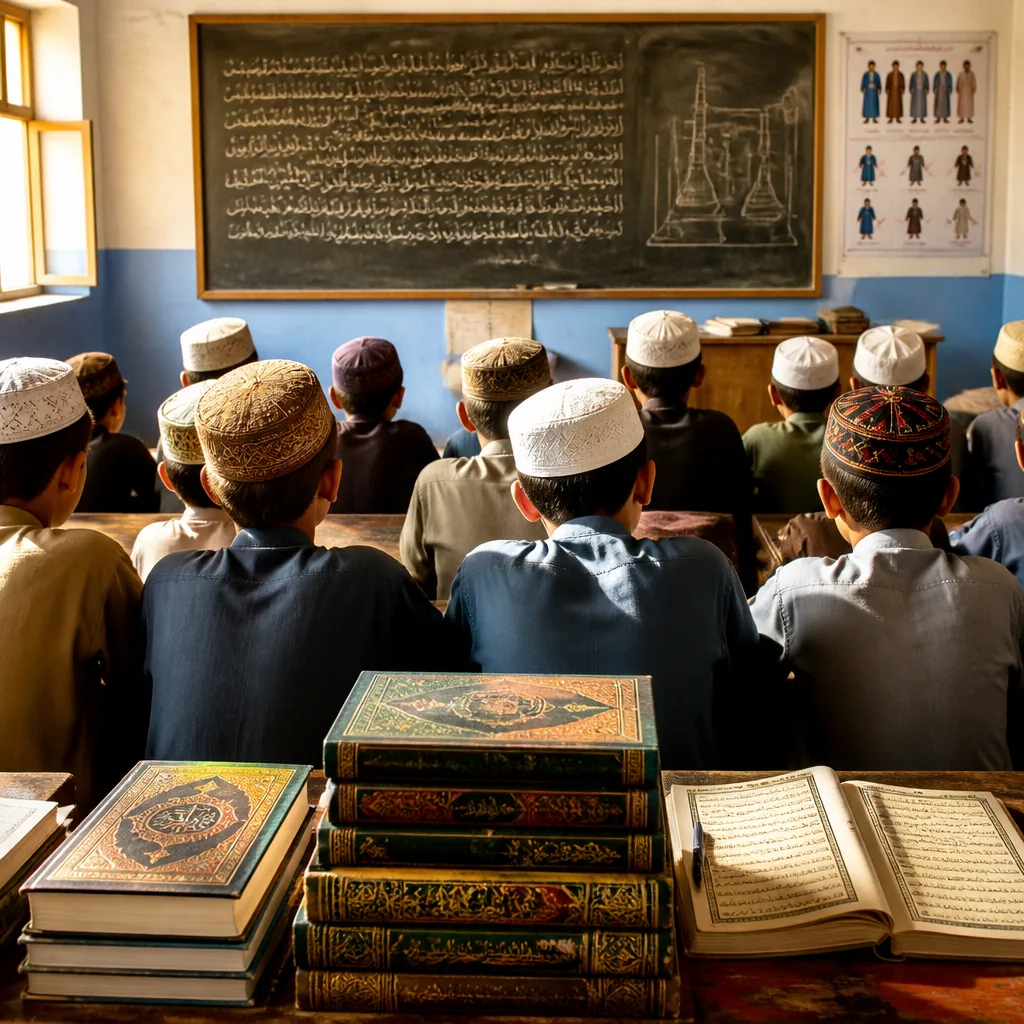
Boys in Afghanistan remain enrolled in schools, but many say the education they receive has been fundamentally reshaped since the Taliban returned to power on 15 August 2021, with less focus on science, languages and civic subjects and a greater emphasis on religious teaching, according to reporting by NPR.
Students report narrower curricula and stricter rules
NPR spoke with 15 middle and high school students from Kabul, Herat, Helmand, Ghazni, Ghor, Mazar-e-Sharif and Bamiyan. Their accounts describe a classroom environment where subjects such as science, mathematics, English and Persian receive reduced attention, while religious studies now occupy a larger share of class time. Pupils also described more restrictive dress codes and limits on open discussion in lessons.
One student from Ghazni said boys in grades 7–12 at public schools were instructed at the start of a school year to wear white clothing and a turban, prompting him to transfer to a private school. Even there, he told NPR, the curriculum placed less emphasis on topics like parliament, the Loya Jirga and the previous constitution.
“I felt I was wasting my time at school rather than learning,” NPR quoted 19‑year‑old Hashmat Mubariz, reflecting on changes at his former public school.
Official figures show expansion of religious centres
The Taliban‑controlled Ministry of Education reported that it now oversees 22,972 religious education centres, compared with about 5,000 registered under the previous government. The ministry also said 269 new modern schools were established during the same period.
The Afghan Centre for Human Rights noted that only 316 of the religious centres are newly established; many pre‑existing institutions were reportedly incorporated into the Taliban’s system. The ministry did not respond to NPR’s requests for comment, the report said.
| Type | Figure |
|---|---|
| Religious education centres now overseen | 22,972 |
| Religious centres under previous government (approx.) | 5,000 |
| Religious centres newly established | 316 |
| New modern schools established | 269 |
Consequences for learners and the future workforce
Students interviewed by NPR said the shift has also affected classroom dynamics: fewer opportunities for debate, some experienced teachers missing from staff lists and replacements without formal training. Those changes have led some boys and their families to question whether the schooling on offer will equip learners for higher education or careers that require language skills, scientific knowledge or civic literacy.
19‑year‑old Mubariz, who had become an English teacher and podcast host despite interruptions to his schooling, described his former school as once being a place where students could express opinions and ask questions. He told NPR that after the Taliban’s return, the atmosphere “slowly disappeared”, contributing to what he called a broader education crisis affecting boys as well as girls.
- Students report reduced emphasis on science, mathematics, English and Persian.
- Religious instruction has expanded sharply in official counts of education centres.
- Concerns include limits on classroom discussion, teacher shortages and suitability of training for replacements.
The reporting highlights how shifts in curriculum and school culture can have ripple effects beyond immediate classroom experience: altering career paths, access to higher education and civic understanding. The figures cited by the Taliban‑led ministry and the Afghan Centre for Human Rights provide measurable evidence of structural change, even as former students describe the lived reality inside schools.
For educators, parents and policymakers watching developments in Afghanistan, the accounts assembled by NPR underscore the need to track both enrolment and the quality and content of instruction when assessing the state of education under political transitions.