
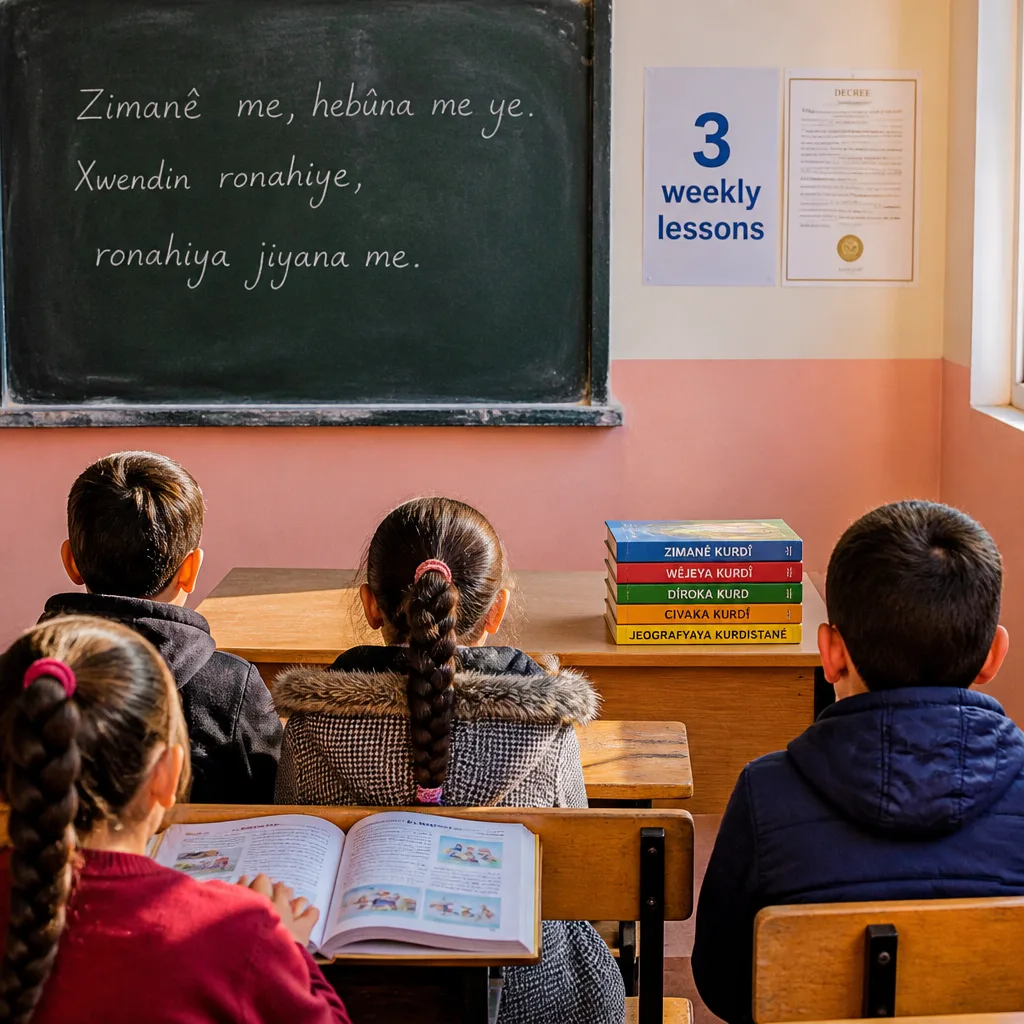
The decision by Syria’s transitional government Ministry of Education to restrict Kurdish-language instruction to three weekly classes has drawn sharp criticism from intellectuals in the Jazira region, who say the measure does not meet the community’s aspirations and could undermine learners’ educational outcomes.
Community leaders call for mother‑tongue instruction
Reaction has mounted following Decision No. 964/2068, which designates Kurdish teaching as optional and limits it to three lessons per week. Intellectuals in the city of Qamishlo argued the move falls short of what they regard as a fundamental educational right: the ability to learn in one’s mother tongue.
Representatives of the al‑Jazira Union of Intellectuals told the reporting agency that Kurdish people expect their language to be formally integrated into curricula and protected in any new constitution. They want Kurdish to be available as a language of instruction rather than confined to a few optional lessons.
“the mother tongue is of great importance to peoples. It begins with a person from birth and is therefore of great importance to all nationalities and peoples.”
The quote was attributed to Hassina Ahmed, a member of the union, who emphasised that the demand for mother‑tongue education does not imply a rejection of Arabic. Instead, she framed bilingual or multilingual education as a right that would help Kurdish children transition more smoothly into formal schooling.
Concerns about learning and identity
Intellectuals said Kurdish children often start school speaking Kurdish at home and in their communities, so entering a classroom where lessons are delivered principally in Arabic can create educational and psychological difficulties. They warned that limiting Kurdish instruction to a token number of optional classes overlooks those practical effects.
Speakers pointed to historical experience, noting that earlier generations studied mainly in Arabic yet retained Kurdish in the home. They argued that official recognition of Kurdish within the school system would support both cultural preservation and improved learning outcomes.
- Decision No. 964/2068 sets Kurdish instruction at three optional weekly classes.
- Intellectuals from the Jazira region seek Kurdish to be offered alongside Arabic as a language of instruction.
- Calls were made for constitutional safeguards to enshrine mother‑tongue rights.
What this means for classrooms
Limiting Kurdish to optional sessions may have several classroom implications. Teachers may find it difficult to integrate learners who speak Kurdish at home into lessons taught in Arabic; students may lag in comprehension and participation; and curricula and assessment systems may not reflect learners’ linguistic realities.
Those arguing for expanded Kurdish provision stressed that the policy is not about supplanting Arabic. Instead, they presented mother‑tongue education as a complementary approach that can strengthen cognitive development and support multilingual competence.
| Aspect | Current provision | Requested change |
|---|---|---|
| Weekly Kurdish classes | 3 (optional) | Integrated alongside Arabic as language of instruction |
| Constitutional status | Not specified in reporting | Enshrine Kurdish language rights in new constitution |
Advocates maintained that recognising Kurdish formally in curricula would reflect the sacrifices the community says it made during Syria’s political transitions and would align education with the linguistic realities of many learners in the region.
As debate continues, the key questions for policymakers include how to balance national cohesion and the status of Arabic with legitimate claims for mother‑tongue instruction, and how to translate those policy choices into teacher training, curriculum development and assessment practices that support learners in the classroom.
For parents, teachers and learners in Jazira, the outcome will determine whether Kurdish remains a peripheral elective or becomes a living medium of classroom learning.











