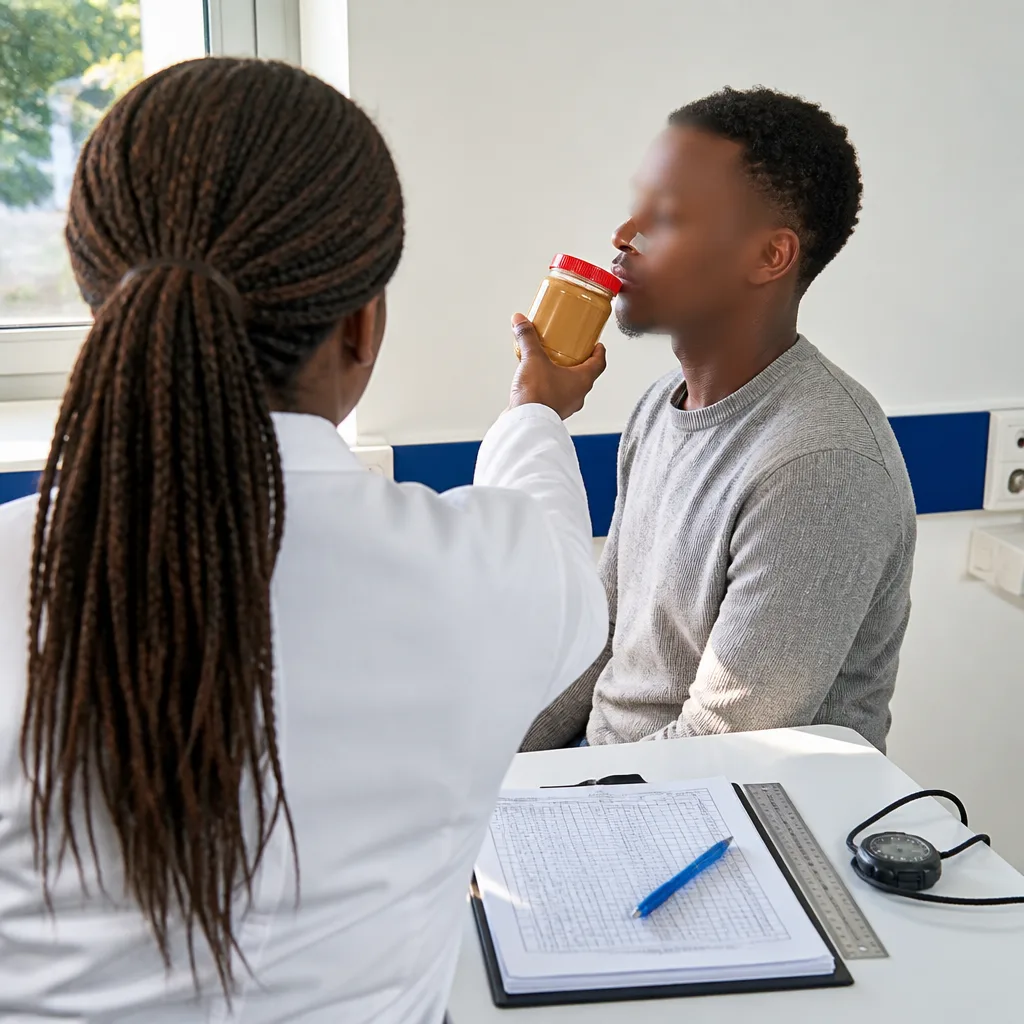
Researchers who first reported a simple smell test for early Alzheimer’s disease have not had their results reproduced by a subsequent, more rigorous study. The original 2013 experiment suggested a striking asymmetry in smell detection between nostrils in people with Alzheimer’s, but a 2014 replication attempt found no significant difference.
What the original test involved
The 2013 protocol, conducted by a team at the University of Florida, asked participants to close their eyes while an investigator brought a jar of peanut butter to one nostril at a time. The participant signalled the distance at which they could detect the smell. The headline result was that people with Alzheimer’s reportedly detected the scent later with the left nostril than with the right.
Why the result seemed plausible
There was a clear anatomical rationale for interest in odour tests. The sense of smell is carried by the first cranial nerve (the olfactory nerve), and the anterior temporal lobe — a brain region involved in odour processing — is among the earliest to show pathological changes in Alzheimer’s disease. That made a simple, non‑invasive nasal test an attractive candidate for early screening.
Replication and methodological refinement
However, a 2014 study at the University of Pennsylvania sought to reproduce the findings and introduced a tighter control to avoid technique-related artefacts. Rather than a finger being used to occlude one nostril — which can compress soft tissues and alter airflow — researchers used tape to block the nostril. The replication team followed the original protocol and also tried a different scent test. Neither approach produced the reported left‑right asymmetry.
The key outcome was that no significant difference between nostrils was observed in the replication study, calling into question the robustness of the original finding. The negative replication highlights how subtle procedural differences can produce misleading results in small, sensory tests.
Lessons for diagnostic research
This episode illustrates several important points for clinicians, researchers and the public:
- Initial positive findings need independent replication. A single study, especially if small or headline‑friendly, should be treated as preliminary until reproduced by others using tighter controls.
- Procedural details matter. Minor variations in how a test is administered — here, finger occlusion versus taped occlusion — can affect outcomes and create artefacts that masquerade as biological signals.
- Biological plausibility aids hypotheses but does not guarantee diagnostic utility. The fact that the temporal lobe is affected early in Alzheimer’s gives reason to explore smell‑based tests, but plausibility alone cannot substitute for reproducible evidence of sensitivity and specificity.
What this means for patients and clinicians
For people concerned about dementia risk and for clinicians seeking screening tools, the cautious takeaway is that the peanut‑butter nostril test is not a validated diagnostic method. It remains an interesting research observation that prompted useful scrutiny, but it has not matured into a reliable clinical tool.
Developing early, low‑cost tests for Alzheimer’s is still a priority. Robust progress will depend on larger studies, standardised protocols, and transparent replication. Until then, established clinical assessments and validated biomarkers should remain the basis for diagnosis and for conversations about care and planning.
In short: the peanut‑butter test captured headlines because of its simplicity and apparent link to early brain changes, but subsequent work failed to confirm its effectiveness. The case is a reminder that good science requires careful methods and independent verification before a promising idea becomes a practice.