
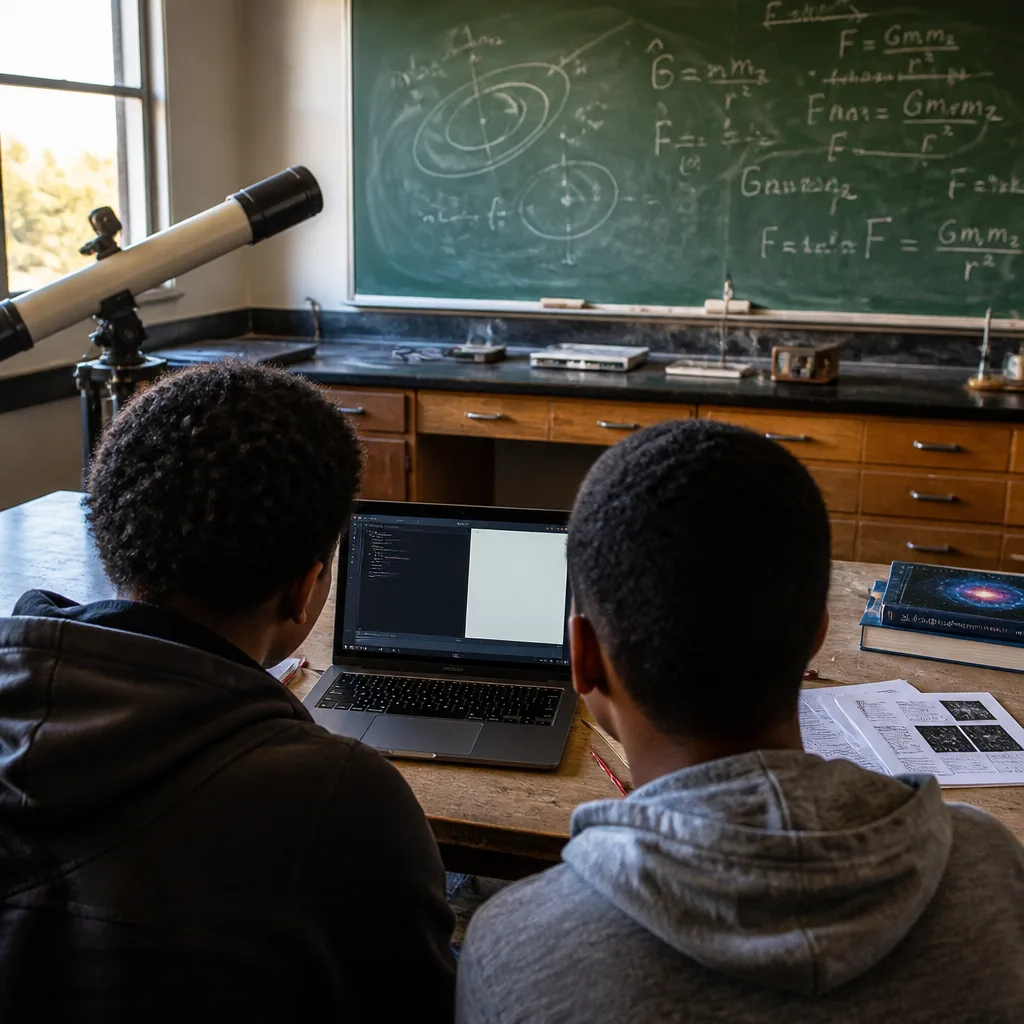
A national review of astronomy teaching in India has found that many undergraduates arrive at postgraduate programmes without basic practical skills now common in international observatories and research groups. The analysis, reported by The Hindu, says students often have never run a script, handled a FITS file, or taken part in supervised observational projects.
Practical skills lag behind global practice
Modern astronomy research rests on three complementary pillars: observations (collecting data), computation (processing and simulation) and data analysis (interpreting statistical trends). According to the report, Indian undergraduate programmes typically teach orbital mechanics and stellar evolution as paper exercises and textbook theory rather than through practical, experiential learning.
The Hindu notes that, unlike many Australian and British universities where students commonly use tools such as GADGET, MESA or custom Python frameworks, students in India rarely gain familiarity with essential software and data formats. International practice often includes mandatory observing projects, computational labs and supervised research theses from early years; India has few standalone undergraduate astronomy degrees offering that progression.
Where Indian programmes currently sit
The report highlights that India does not have a dedicated BSc in Astronomy. The closest models are integrated science degrees at institutes such as the IISERs and NISER, where astrophysics remains an optional specialisation in later years. Other universities — the University of Delhi, Pune University and Osmania University — offer astrophysics electives but without a structured, staged pathway to hands‑on research experience.
- Tools and software identified as essential: Python, IRAF, AstroPy, and machine‑learning pipelines.
- Large public survey datasets mentioned: SDSS, GAIA, and India’s AstroSat.
- Recommended experiential elements: supervised observing projects, lab‑based computation, and thesis work at undergraduate level.
| Founding pillar | Examples / tools |
|---|---|
| Observations | Remote telescopes, AstroSat data, FITS files |
| Computation | Python, GADGET, MESA, simulation frameworks |
| Data analysis | SDSS, GAIA catalogues, statistical interpretation |
Consequences for learners and the research pipeline
The report argues that the current structure creates a predictable handicap: postgraduate programmes must first teach incoming students the practical skills assumed elsewhere. For learners this means lost time and uneven preparation; for supervisors and research groups it demands remedial training rather than immediate engagement with research problems.
For teachers and programme planners the critique points to concrete interventions: curriculum reform to integrate coding and data handling; establishing dedicated undergraduate degrees or well‑mapped specialisation tracks; and investing in infrastructure that gives students remote access to telescopes and public survey archives for real research projects.
Parents and learners considering science pathways should note the shifting landscape of skills in astronomy. As the field becomes ever more computational, the ability to work with software, large datasets and remote observing platforms is now a core part of scientific literacy for aspiring astronomers.
The Hindu's coverage stops short of detailing implementation plans, but it makes a clear educational case: updating undergraduate astronomy education to emphasise learn‑by‑doing will strengthen intuition, better prepare students for global research practice and reduce remedial burdens on postgraduate programmes.
Any reform will require collaboration between universities, national research institutes and funding bodies to build curricula, teacher capacity and the infrastructure — such as national telescope programmes and computational resources — that allow students to practise the craft of modern astronomy.











