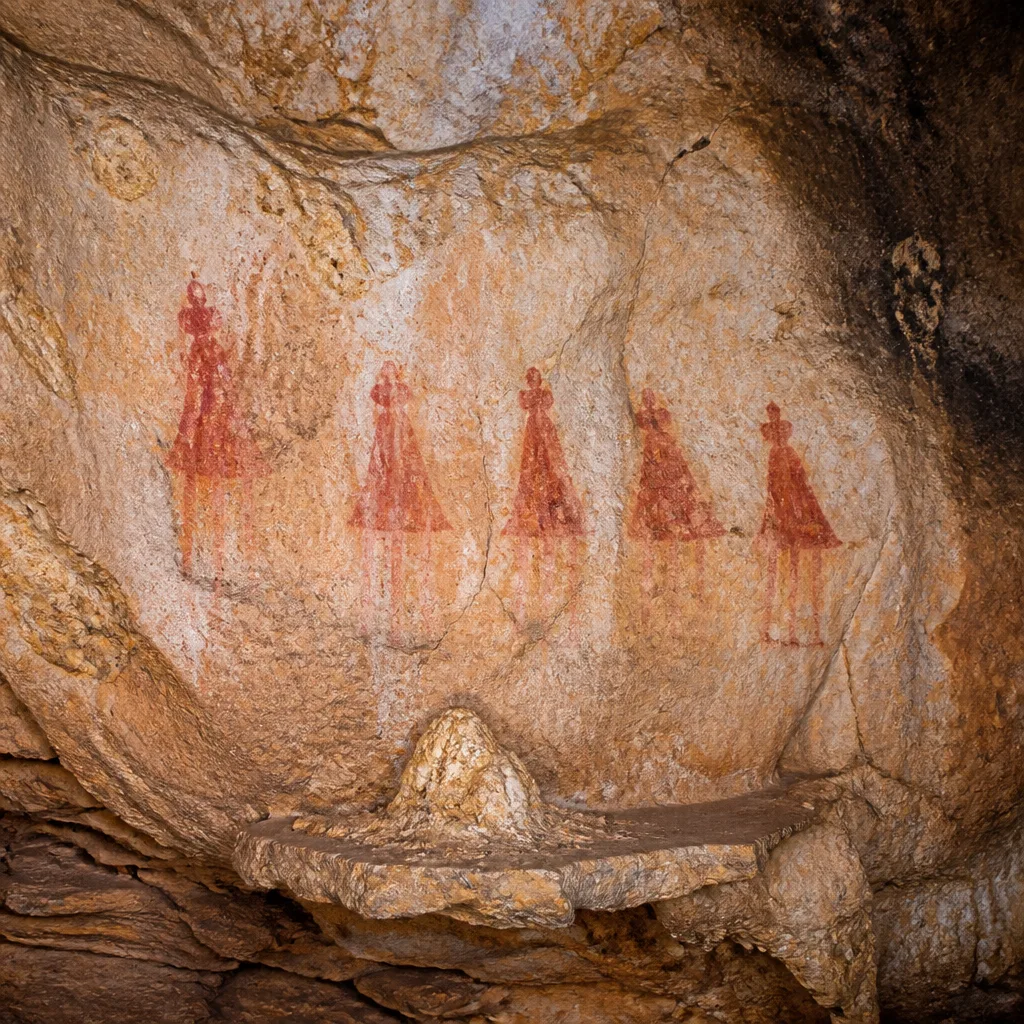
Five small red signs painted on a side panel of El Castillo cave in northern Spain some 17,000–15,000 years ago may be depictions of drooping, bell‑shaped flowers of psychoactive nightshades, according to a researcher building on long‑standing palaeolithic records.
What was found and why it matters
The panel shows five similarly shaped red motifs standing above a natural ledge that looks like a shelf or altar. Archaeologists have catalogued such motifs under the neutral label “bell‑shaped signs” for over a century, but the recent interpretation reads their silhouette — a flared mouth, downward hang and central vein — as resembling the corolla of plants such as Atropa belladonna (belladonna) or regional species of Hyoscyamus (henbane).
If the interpretation holds, these marks would be notable as possibly the earliest known pictorial representation of a mind‑altering plant anywhere in the world, predating other candidate images by thousands of years. The claim draws on comparative botany: the bell‑shaped floral form and faint internal venation that appear in the painted signs can match developmental stages of those nightshade flowers.
Evidence, limits and precedent
The researcher warns that simple shapes recur in many contexts and that resemblance alone is not conclusive. The argument gains weight, however, from two lines of reasoning:
- the specific combination of shape features in the painted signs — flared rim, downward orientation and a central line — corresponds closely to the bellhouse morphology of the candidate plants; and
- ethnographic and historical records show repeated associations between certain plants and shamanic or spirit‑seeking practices worldwide, supporting the plausibility that Ice Age people could have depicted psychoactive flora.
The researcher cites a useful precedent for stronger proof: at Pinwheel Cave in California, archaeologists recovered chewed plant fragments embedded in the rock that unambiguously linked a depicted plant with its ingestion at the site. Such direct residue evidence is the sort of corroboration that would lift resemblance to demonstration.
“Archaeologists have simply catalogued these as ‘bell‑shaped signs’, filed under the vast heading of ice age marks we don’t know the meaning of.”
Context and caution
Rock art interpretation is frequently contested. Similarities between an image and a natural object can be coincidental; motifs may carry symbolic meanings no longer recoverable; and organic residues that could confirm plant use rarely survive tens of thousands of years in many cave contexts. The researcher acknowledges these constraints and frames the claim as a testable hypothesis rather than a settled fact.
The discussion also connects to earlier work by the same scholar, who argued in 2021 that an image on the Chu Silk Manuscript — China’s oldest illustrated text — depicted a plant described in early herbals as enabling spiritual visions. That comparative trajectory shows how converging lines of botanical, iconographic and textual evidence can strengthen interpretations.
What comes next
To move beyond resemblance, archaeologists would look for:
- direct residue analyses from the cave context that might preserve plant biomarkers,
- further iconographic studies comparing other Ice Age motifs with local plant morphology, and
- broader regional studies to see whether similar motifs recur with contextual associations suggestive of ritual use.
Until such corroboration is available, the El Castillo bell signs remain a compelling but provisional reading: an invitation to re‑examine some of the oldest images made by people for evidence of how they perceived and engaged with the plant world.
| Item | Detail |
|---|---|
| Site | El Castillo cave, northern Spain |
| Age | 17,000–15,000 years |
| Motif | Five red, bell‑shaped signs above a natural ledge |
| Suggested identification | Bell‑shaped flowers of psychoactive nightshade (belladonna or henbane) |
| Required corroboration | Residue analysis or other physical evidence linking depiction to ingestion |