
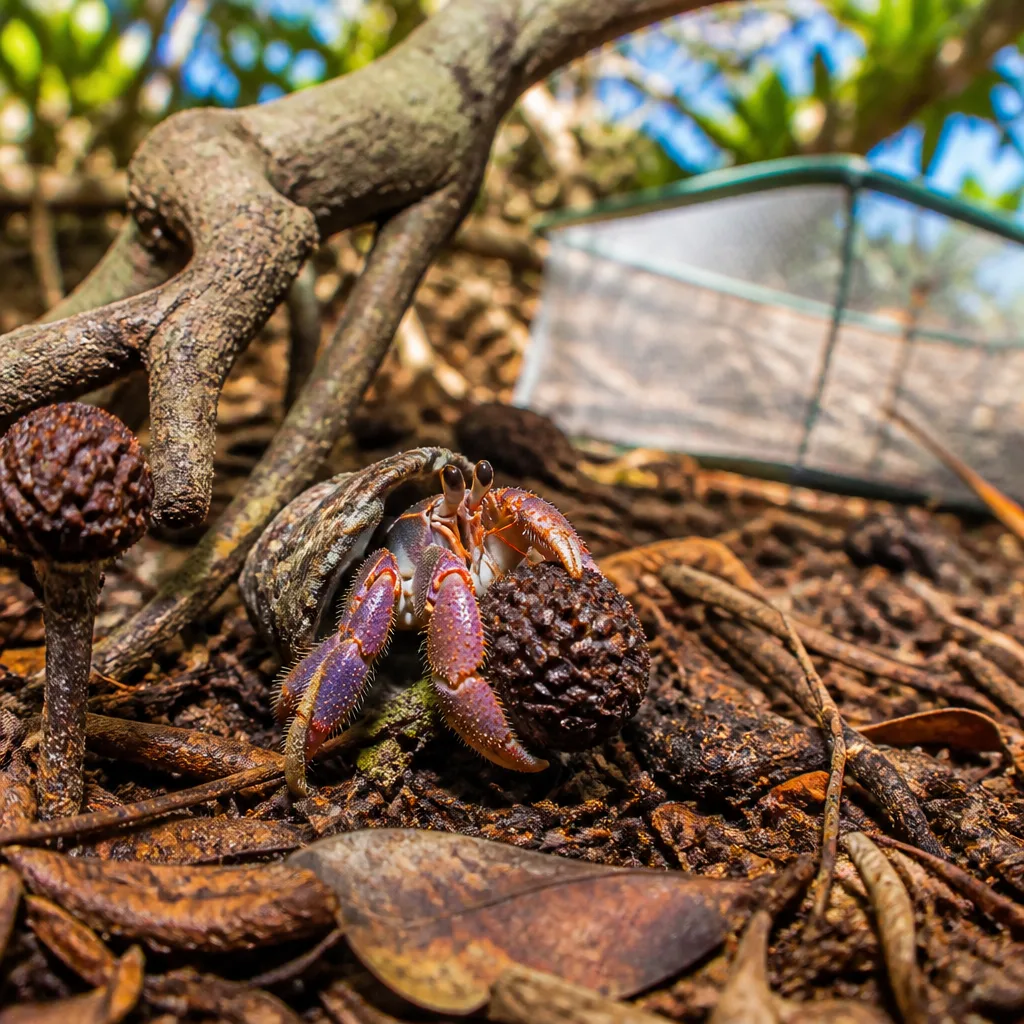
Land hermit crabs have been recorded removing and dispersing the dry fruits of Balanophora fungosa, a parasitic plant that looks like a mushroom and can produce up to one million tiny seeds each year, according to research by Kobe University botanist Suetsugu Kenji.
Unusual seed dispersal in a humid forest
Balanophora fungosa grows on the forest floor of coastal forests near Okinawa, Japan. Though its dark, cap-like structures resemble fungi, the plant is parasitic and obtains nutrients from the roots of neighbouring plants. The plant emits a yeasty scent and bears dry fruits that enclose vast numbers of very small seeds.
Because the forest floor where the plant grows is humid and often windless, simple falling or wind dispersal seemed unlikely. "Many people assumed that they simply fall by gravity and are carried away by the wind, but the humid and windless forest floor makes this seem rather implausible," Suetsugu said, describing the initial puzzle the team faced.
From ants to hermit crabs: following the visitors
Earlier work by Suetsugu and colleagues had shown that a variety of invertebrates—including ants, crickets and cockroaches—can visit and move the plant's fruits. However, those observations carried important caveats:
- Fruits that were firmly attached to the plant were typically handled by invertebrates with strong mandibles.
- Fruits that detached easily were more frequently visited by smaller invertebrates.
Based on the dull colours, yeasty smell and easily detachable fruits, the team suspected ants would be major dispersers. To test the idea they used netting experiments that allowed ants through but excluded larger animals. When plants were covered with nets that allowed ants to pass but prevented access by larger animals, the fruits were no longer removed.
"Many people assumed that they simply fall by gravity and are carried away by the wind, but the humid and windless forest floor makes this seem rather implausible," Suetsugu said.
To catch the disperser in action the researchers deployed time-lapse cameras. The cameras recorded land hermit crabs (Coenobita brevimanus) scraping fruits from the plant and carrying them away, establishing hermit crabs as a key agent of fruit removal and likely seed dispersal in this system.
What this means for forest ecology
The observations change the way we think about seed movement for this parasite. Where wind and gravity are ineffective, animal vectors become crucial. Hermit crabs, which are mobile and commonly forage on the forest floor, can transport the dry fruits—each carrying many seeds—away from the parent plant. That movement could influence the plant's local distribution and its interactions with host plants.
The study also highlights how multiple animal groups participate in dispersal, but with differing roles depending on fruit attachment and the animal's physical traits. In summary:
- Strong-mandible invertebrates (some ants, crickets, cockroaches) handle firmly attached fruits.
- Smaller invertebrates visit easily detachable fruits but may move them only short distances.
- Hermit crabs remove and carry fruits away from the plant, acting as effective dispersal agents in the humid, low-wind forest floor environment.
| Disperser group | Typical fruit interaction |
|---|---|
| Ants, crickets, cockroaches | Handle firmly attached fruits; variable transport distance |
| Smaller invertebrates | Visit easily detachable fruits; limited movement |
| Hermit crabs (<em>Coenobita brevimanus</em>) | Scrape off and carry fruits away; likely long-distance dispersal on forest floor |
These findings remind us that seed dispersal is often a multi-species process. Discovering an animal as conspicuous as a hermit crab playing a central role demonstrates how overlooked behaviours can shape plant distributions, especially in specialised systems such as parasitic plants that depend on nearby hosts.
Further work would be needed to quantify how far hermit crabs move the fruits and whether seeds remain viable after passage in crab gut contents or attachment to the crab's shell. The observations reported by Suetsugu and colleagues, however, provide a clear behavioural link between a mobile coastal crustacean and the spread of a prolific parasitic plant on the forest floor.









