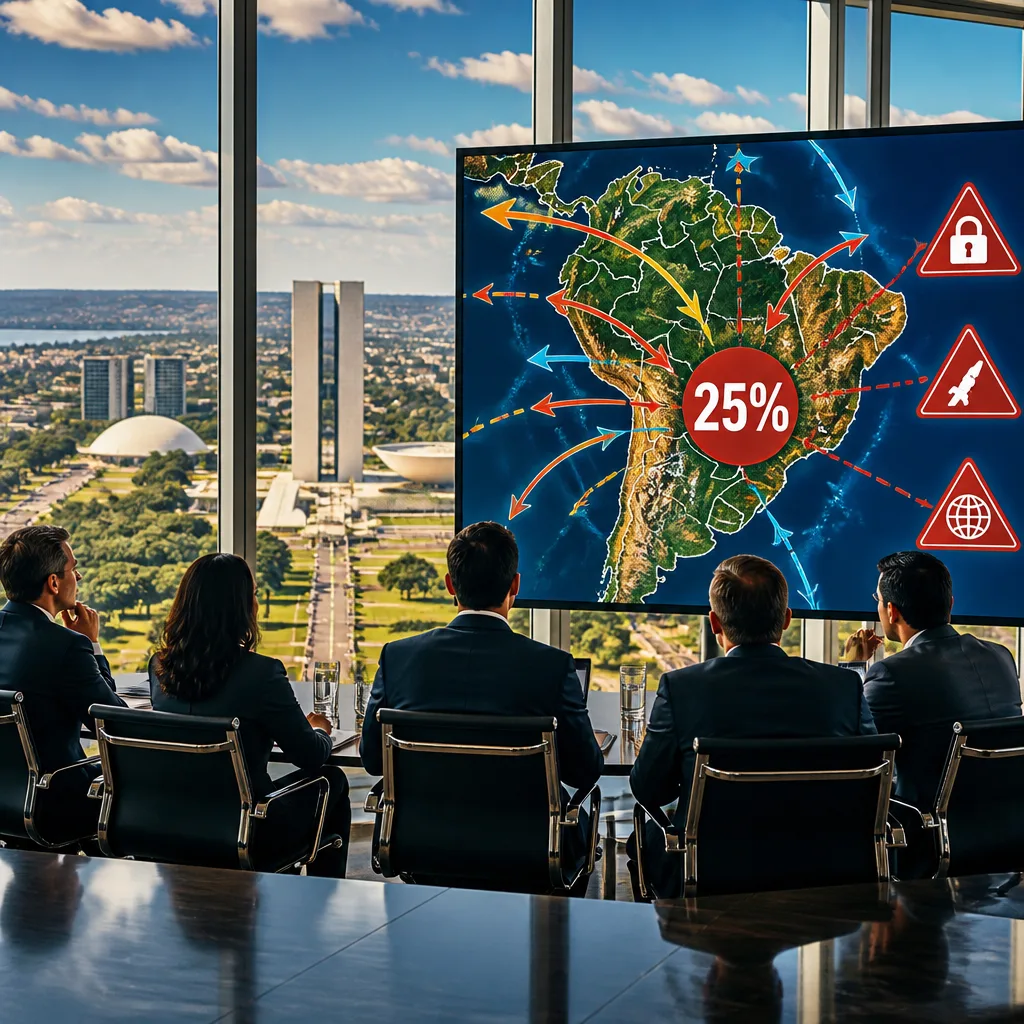
Brazil’s approaching general election in October 2026 has converted what used to be peripheral political noise into a persistent and material risk for businesses, according to an analysis by FTI Consulting. The consultancy says that domestic polarisation, institutional strain and growing external pressure from the United States and other capitals now combine to reshape the investment and operational calculus for firms active in Brazil.
Domestic polarisation meets international pressure
FTI’s assessment argues that politics in Brasília can no longer be analysed in isolation from geopolitical disputes in Washington, Brussels and Beijing. On the domestic front, the report points to deep polarisation between a Workers’ Party‑led administration under Luiz Inácio Lula da Silva and an active opposition aligned with former president Jair Bolsonaro. That opposition, FTI says, maintains ties with international far‑right networks such as the Conservative Political Action Conference (CPAC) and Foro de Madrid and mobilises electorates around narratives of crime, sovereignty and opposition to globalism.
At the same time, external measures are increasingly targeting Brazil’s internal dynamics. FTI highlights proposed US tariffs of 25% under Section 301 and the US decision to designate major criminal organisations as terrorist entities as examples of policy moves that export geopolitical friction into Brazil’s domestic governance and business environment. These measures mean multinational firms and foreign investors must factor decisions taken in foreign capitals into their Brazil strategies as much as developments in Brasília.
What this means for companies
According to the consultancy, the new environment converts episodic political events into continuous sources of volatility that have direct implications for medium‑ to long‑term planning. The immediate consequences include:
- Heightened regulatory uncertainty as foreign policy disputes spill into trade and customs enforcement.
- Operational risks from public security narratives that influence policing, judicial action and potential sanctions against organisations deemed linked to criminality or transnational networks.
- Reputational exposure for multinationals that may be pulled into political narratives or face divergent expectations from different governments.
FTI emphasises that these pressures are particularly acute for multinationals and foreign investors. Firms that previously modelled Brazil risk largely on electoral cycles must now expand their scenario planning to include international policy shifts and cross‑border security measures.
Five risk areas on the watchlist
The report identifies five principal risks shaping the current Brazilian business environment and presents them on a heatmap. While the published excerpt does not list each risk item by name, FTI’s interviews with Brazilian academics conducted in March and April support the view that governing capacity, institutional tensions, public security narratives, fragmentation of the party system and international trade and security measures are the underlying variables driving business risk.
| Risk category | Business impact |
|---|---|
| Institutional strain and polarisation | Policy whiplash, regulatory unpredictability |
| Security narratives and criminal designations | Legal and reputational exposure, supply‑chain disruption |
| External trade measures | Tariffs, tariff risk and market access volatility |
For South African companies with interests in Latin America, or firms that depend on global commodity and supply chains, these shifts are a reminder that country risk assessments must encompass external geopolitical actions as well as domestic politics. FTI’s message is clear: decisions taken in Washington or Brussels can have immediate, operational consequences for businesses operating in São Paulo or Manaus.
Implications for investors and corporate strategy
Practically, FTI’s analysis suggests investors should tighten stress testing and expand scenario planning horizons. That includes modelling for trade restrictions, the possibility of foreign‑led legal actions affecting local partners, and reputational risk from being associated — fairly or unfairly — with actors labelled as security threats by third countries. It also underscores the need for closer political monitoring and for corporate communications to be prepared for rapid escalation of issues that were once considered national.
FTI’s wider point is a strategic one: in a world where domestic politics and geopolitics are intertwined, treating political risk as background noise is no longer an option. For firms, the cost of underestimating these dynamics may be borne in higher compliance costs, interrupted operations and greater difficulty in planning capital allocation — effects that ultimately filter down to household budgets through prices, jobs and investment decisions.
FTI Consulting’s report is based on interviews with Brazilian academics and a synthesis of observable policy moves up to mid‑2026. The consultancy’s assessment provides a framework for corporates and investors to reassess how they factor political and geopolitical variables into business strategy in Brazil.
WE NEWS does not provide financial advice.