
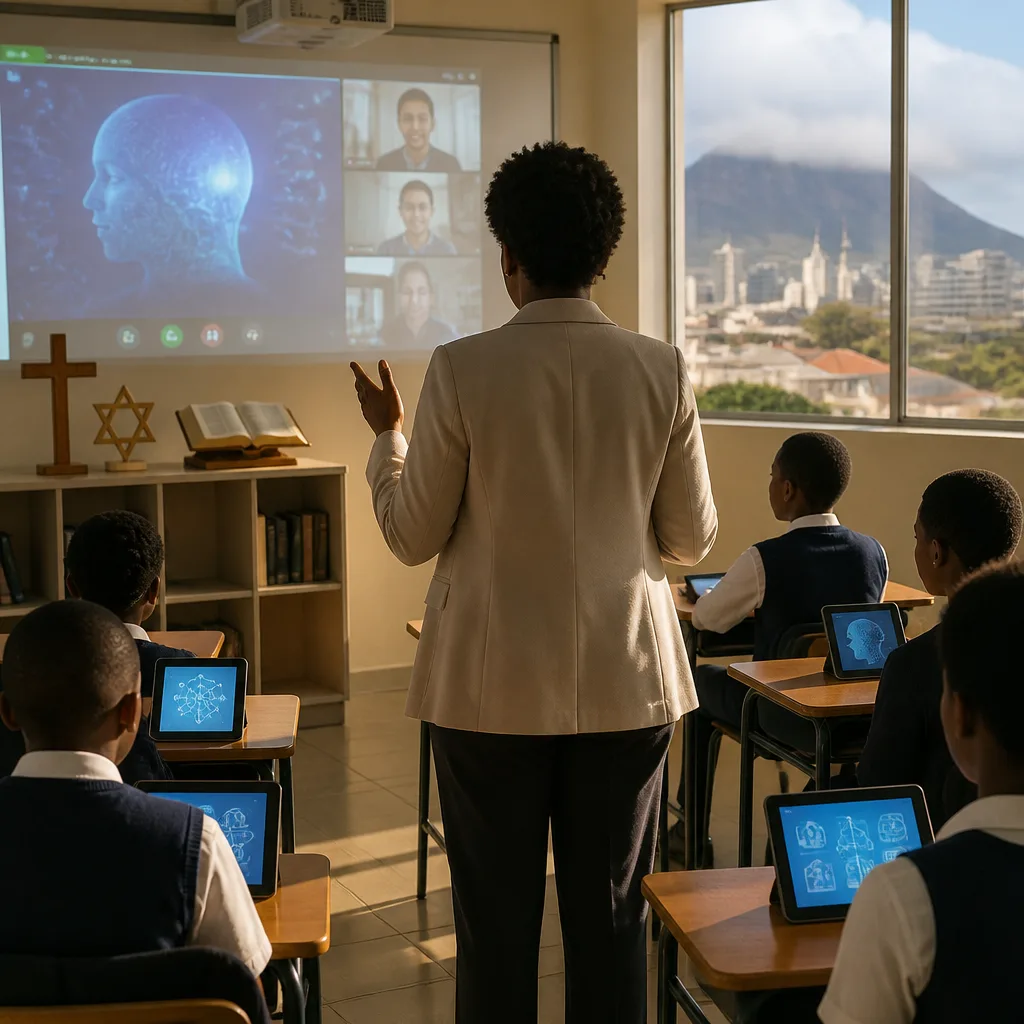
Faith leaders and artificial intelligence policy specialists are urging educators to preserve the human dimensions of learning as schools rapidly adopt AI tools, according to a report by EINPresswire. The call comes ahead of a public webinar titled “AI and Education”, part of the G20 Interfaith Forum’s series on AI and human flourishing, scheduled for 13 August 2026.
Panel frames AI as an opportunity — and a test of values
The event, organised by the G20 Interfaith Forum (IF20) together with the International Academy for Multicultural Cooperation, will bring together a public theologian, an AI governance scholar and a family policy director to question not only how fast AI can teach, but what the purpose of schooling should be. The webinar is set to explore the trade-offs that come with personalised learning systems and automation in classrooms.
Speakers told EINPresswire that while AI can free teachers from administrative burdens and provide adaptive instruction, it also raises unresolved concerns about equity, student data privacy and excessive reliance on automated decision-making. Panellists argued that these issues are not merely technical problems but questions about what societies want education to cultivate.
"AI has extraordinary potential to expand what is possible in education, but we must remember that our goal should not be to make students more efficient versions of machines," said Medlir Mema, director of the AI Ethics and Governance Institute (AEGIX), according to the report.
Mr Mema, a political scientist, emphasised that education should continue to develop capacities that are distinctively human: imagination, critical questioning, creativity, judgement and meaning-making. He said these qualities depend on relationality, embodiment, friction and agency, which he warned should not be surrendered to the tendencies of current AI models.
Practical stakes for teachers, learners and parents
The debate has immediate implications for classroom practice in South Africa where schools already face unequal access to devices, inconsistent connectivity and varying teacher readiness for digital pedagogy. The panel’s concerns about equity and data governance are particularly salient where learners’ home environments and resource constraints vary widely.
Speakers framed AI as both an opportunity and a test: it can personalise learning and reduce teacher workloads, but only if implementation is guided by clear values and safeguards. The panel will also examine how reliance on automated assessment and recommendation systems could reshape what counts as achievement and whose voices shape curricula.
- Webinar: "AI and Education" (IF20 series on AI and Human Flourishing)
- Date: 13 August 2026
- Time: 12:00 PM EDT / 10:00 AM MDT / 9:00 AM PDT / 5:00 PM BST (organisers' listing)
- Organisers: G20 Interfaith Forum and the International Academy for Multicultural Cooperation (reported by EINPresswire)
Although the panel is international in scope, the themes speak directly to South African education authorities and school leaders as they consider policy on digital learning, learner data protection and the evolving role of the teacher. The discussion underscores the need for locally appropriate frameworks that weigh technological benefits against social and pedagogical costs.
| Issue | Concerns raised |
|---|---|
| Personalised learning | Potential to adapt to learner pace; risk of entrenching inequities |
| Teacher workload | AI could reduce administrative tasks but may reshape mentoring roles |
| Data privacy | Student data protection and governance questions remain unresolved |
Faith leaders on the panel framed the shift as an ethical opportunity as much as a technical one, inviting educators to ask whether schooling’s purpose is solely measurable outcomes or fostering the capacities necessary for democratic and creative life. The organisers describe the webinar as part of a broader effort to bring moral and human-centred perspectives into AI governance conversations.
For South African education policymakers, the panel’s message is timely: adopting AI in schools should be accompanied by deliberate decisions about curriculum priorities, data protection protocols, teacher professional development and measures to prevent the worsening of existing inequalities.
As the global conversation about AI in schools advances, the webinar aims to shift the emphasis from what machines can do for learning to what learning must remain human for.











