
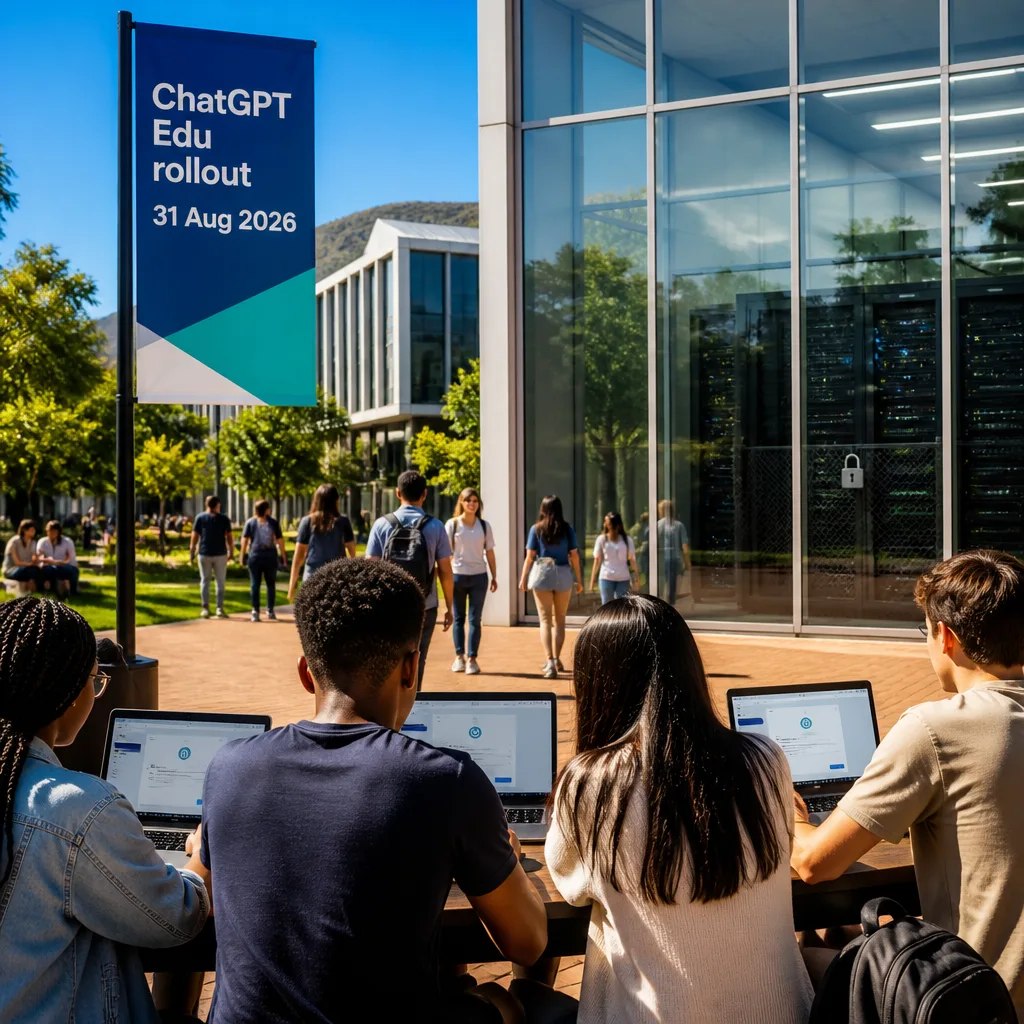
The National University of Singapore (NUS) has announced a strategic collaboration with OpenAI that will give its entire campus community access to the enterprise-grade platform ChatGPT Edu, with the rollout set to begin on 31 August 2026. The partnership aims to strengthen the university's artificial intelligence ecosystem across education, research and administration.
Campus-wide access and controlled environment
According to the university's announcement, all NUS students, faculty and staff will be able to use ChatGPT Edu inside a secure, university-managed workspace. The institution said this environment offers broader access to the model's core capabilities than the free ChatGPT while providing enhanced privacy, security and administrative controls. NUS emphasised that conversations and data in the NUS workspace will not be used to train OpenAI's models.
"This collaboration with OpenAI is a pivotal step in our human-centric AI strategy, further enriching the robust suite of tools we provide," said Professor Aaron Thean, Deputy President (Academic Affairs) and Provost of NUS.
The university plans an initial pilot in selected courses using advanced tools from OpenAI's platform, with a staged expansion thereafter. NUS framed the collaboration as part of a broader effort to treat AI as a "force multiplier"—supporting, rather than replacing, human judgement, creativity and critical thinking.
Talent development, research and governance
The collaboration is described as extending beyond infrastructure: NUS and OpenAI will jointly promote initiatives to nurture AI talent and drive innovation. The stated objectives include supporting research productivity, accelerating problem-solving in complex domains, and preparing students, faculty and staff to use AI tools responsibly.
Key elements highlighted by NUS include:
- Secure access: a university-managed ChatGPT Edu workspace with stronger privacy and administrative controls than the consumer product.
- Pilot teaching integration: advanced tools to be tested in selected courses before broader rollout.
- Ethics and human-centric focus: explicit emphasis on critical thinking, ethical discernment and preserving human agency in decision-making.
For higher education institutions, the NUS model points to several governance considerations when adopting commercial AI services: contractual limits on data use, local platform management, staged piloting in curricula, and programmes to develop staff and student capacity.
What the rollout will look like
The university said the initial phase will focus on selected courses, after which the platform will be progressively made available across the campus. The announcement did not disclose a detailed timetable for the staged expansion or the specific courses involved.
| Item | Detail |
|---|---|
| Platform | ChatGPT Edu (OpenAI enterprise-grade) |
| Access start date | 31 August 2026 |
| Initial scope | Pilot in selected courses; subsequent progressive rollout |
Implications for universities and classrooms
NUS presents the collaboration as a way to accelerate research, support administrative efficiency and expand learning possibilities. For educators, the approach suggests a framework for adopting AI tools that balances innovation with safeguards: manage platforms centrally, limit model training on institutional data, pilot pedagogical uses and invest in staff development.
For students and researchers, the availability of advanced tools in a managed environment may lower technical barriers and permit experimentation with new workflows. But the announcement also raises questions institutions elsewhere will need to address themselves, such as academic integrity policies for AI-assisted work, equitable access across faculties, and resourcing for training and oversight.
While the details on assessment of educational impact or specific governance mechanisms remain limited in the public announcement, NUS's emphasis on human-centred AI—combined with contractual constraints on data use—offers a model other universities may study as they develop their own AI strategies.
As tertiary institutions around the world and in South Africa consider similar partnerships, the NUS–OpenAI arrangement will be watched for lessons on balancing innovation, privacy and pedagogy in an era of rapidly evolving AI capability.











