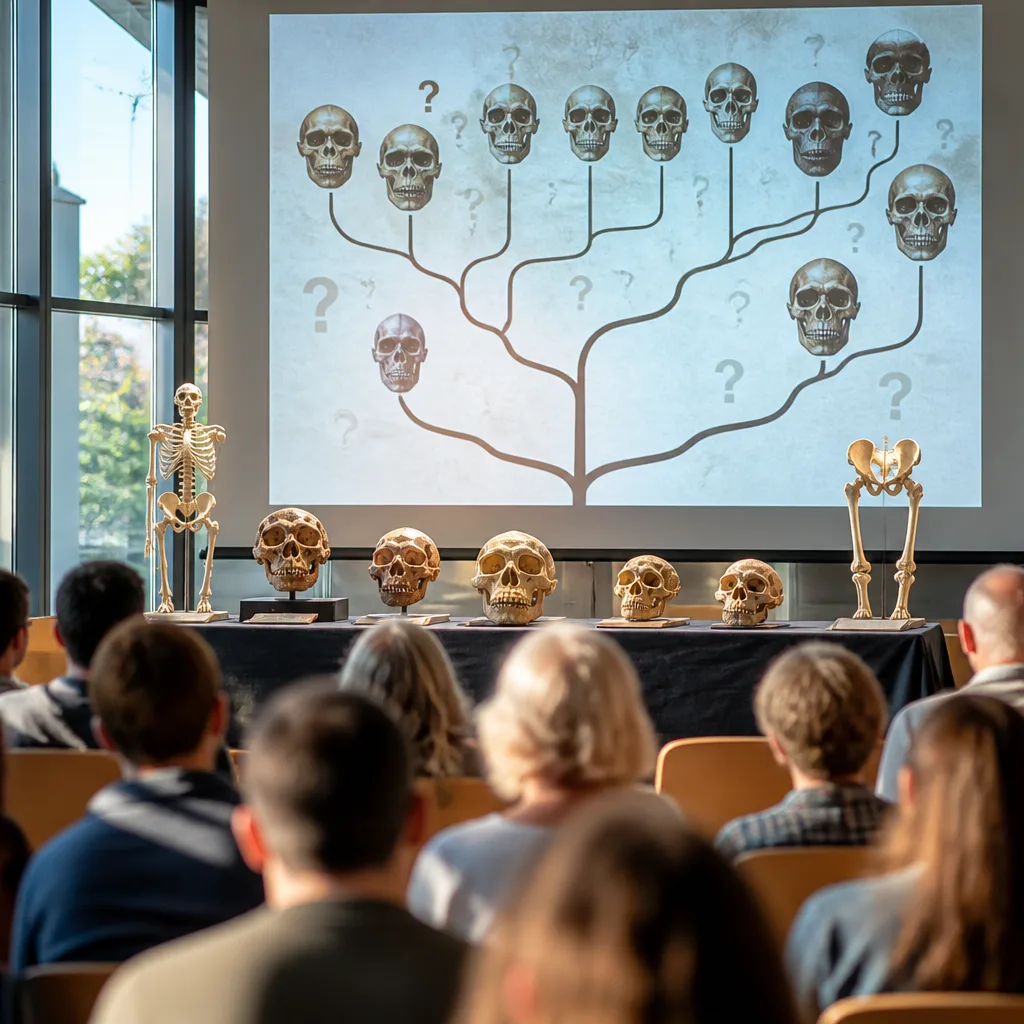
Recent commentary and media content have reopened debate about how scientists should describe the history of life and human evolution. At issue is whether there exists an invariant, privileged biological history — a single narrative against which all other reconstructions are measured — or whether that formulation should be abandoned.
What prompted the discussion
Matthew Haber of the University of Utah is cited for proposing what the source calls “the rejection of absolute biological history, the idea that there is an invariant, privileged biological history against which other histories are measured or deviate from.” Around the same time, a New Scientist video presented the provocative line: “The Human Family Tree Has No Beginning.” These interventions have prompted critics and commentators to question whether such positions follow logically from new data, or whether they stretch beyond what the evidence supports.
Where the controversy centres
The debate covers two related but distinct claims:
- Whether the concept of a single, fixed biological history is useful or defensible in light of complex, reticulate, or poorly resolved data.
- Whether the empirical evidence supports gradual continuity between early hominins such as the species represented by the famous fossil Lucy and later species like Homo erectus, or whether there are substantial anatomical discontinuities.
The source material highlights a tension: some commentators argue that mounting evidence complicates the simple picture of universal common descent progressing through smooth, gradual change. Others stress that abandoning the idea of a coherent biological history risks sliding into epistemic confusion — in other words, denying the reality of historical facts while claiming to know them.
“The Human Family Tree Has No Beginning.”
Evidence and interpretation
Critics of the more radical framing point to what they describe as a visible anatomical gap between certain australopithecine taxa (the group that includes the specimen nicknamed Lucy) and Homo erectus. The source references work by Casey Luskin and a Science Uprising episode as further material arguing for a substantive break between ape-like precursors and later Homo species.
It is important to separate three things when assessing these claims: the fossil record itself, the interpretation of morphological discontinuities, and the philosophical or methodological stance one takes towards historical narratives. Fossil evidence is often fragmentary and uneven in time and space; interpretations of gaps can change as new specimens are found. Methodological stances — for example, whether to privilege a single tree-like model of descent or to allow for more network-like reconstructions — influence how the same data are framed.
| Claim | What it asserts | What the source notes |
|---|---|---|
| Rejection of absolute biological history | There is no invariant, privileged historical narrative for biology. | Proposed by Matthew Haber; presented as a conceptual shift. |
| Human family tree has no beginning | Human origins resist locating a single starting point. | Advanced in a New Scientist video; framed as challenging linear origin stories. |
| Substantial anatomical gap | There is a genuine break between certain australopithecines and Homo. | Argued by commentators cited in the source (Casey Luskin, Science Uprising). |
Why this matters
How scientists and communicators describe deep time shapes public understanding of evolution and influences research priorities. If the community adopts a pluralistic view of history — allowing multiple, overlapping or incomplete histories — this could emphasise uncertainty and complexity. Alternatively, critics warn that overstating philosophical uncertainty could be misread by the public as scientific uncertainty about evolution itself.
Readers should note that the source material mixes scholarly suggestion, mainstream science journalism, and commentary from critics. The differences between empirical findings (what fossils and genes show) and interpretative frameworks (how we organise that evidence into narratives) are central. As with many debates at the frontiers of palaeoanthropology, future fossil discoveries and improved analytical methods will be decisive in clarifying which interpretations best fit the evidence.
Key takeaways:
- Scholars and journalists are re-examining whether a single, fixed biological history is an appropriate model for evolution.
- Some commentators argue for significant anatomical discontinuities between early hominins and later Homo, a claim that is contested.
- The discussion mixes empirical issues and philosophical positions; more data will be needed to resolve competing interpretations.