
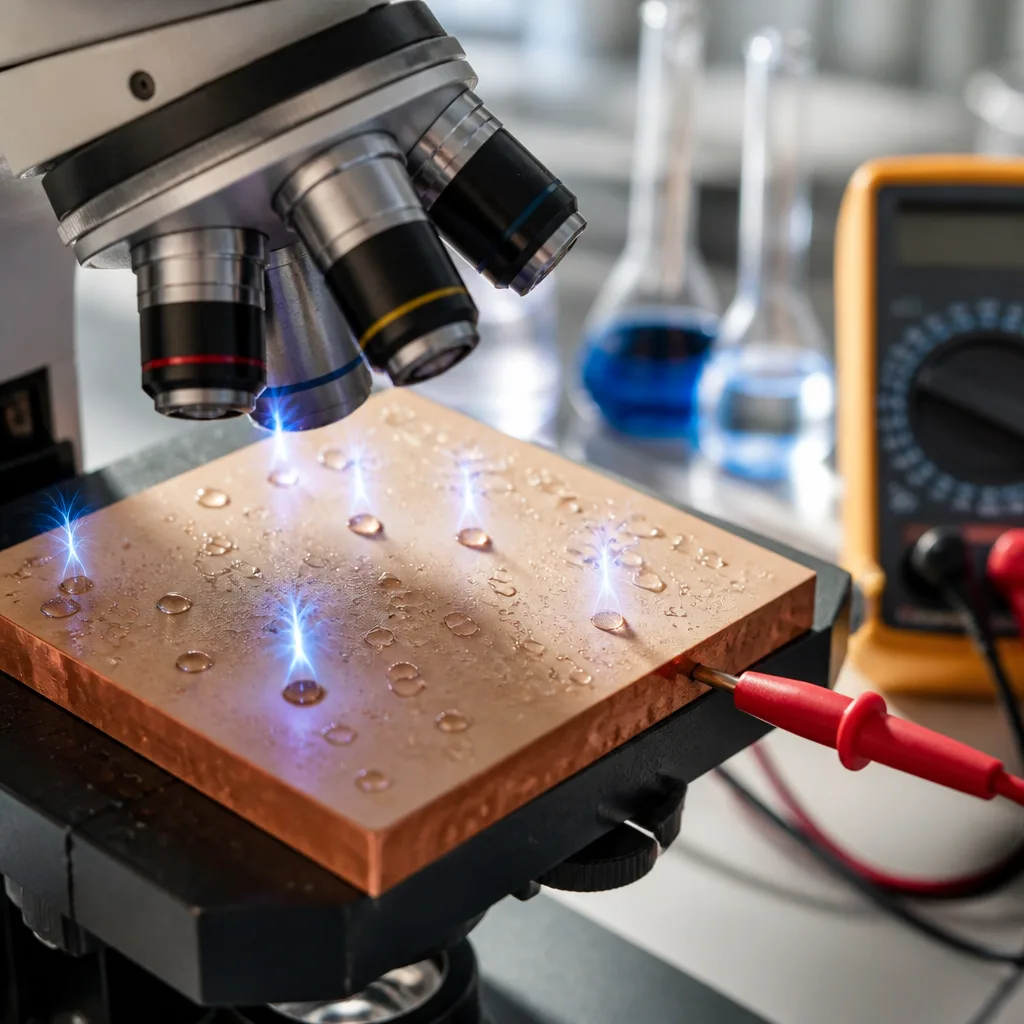
Laboratory experiments by researchers at the Max Planck Institute for Polymer Research show that tiny water droplets which become electrically charged while moving across surfaces can degrade protective coatings and corrode the metal beneath. The findings, reported in recent coverage of the group’s work, suggest a previously overlooked weathering mechanism that may affect cars, buildings and outdoor structures.
How water picks up charge
Scientists have long known that water can acquire electrical charge when it moves across different materials — a process related to triboelectric charging, which produces static electricity when dissimilar surfaces rub together. The Max Planck team describes this as contact or sliding electrification for water drops: droplets moving over plant leaves, insect wings, glass, plastics and building surfaces can leave or take on charge.
"Water drops spontaneously become electrically charged when moving on different surfaces, such as plant leaves, insect wings, building walls, window glass, and plastic. This process, known as contact or sliding electrification, is analogous to tribocharging between solids," said Zhongyuan Ni, a PhD candidate at Max Planck and a co‑author on the work.
Experimental evidence of damage
In controlled tests, the researchers exposed samples of Teflon coating over copper to thousands of water droplets that had been electrically charged. The charged droplets caused measurable degradation of the Teflon and corrosion of the underlying copper. In comparison, droplets that were not charged did not produce comparable damage under the same conditions.
- Charged droplets: caused degradation of Teflon and corrosion of copper beneath.
- Uncharged droplets: produced no comparable damage in the experiments.
The experiments indicate that the presence of electrical charge on moving water may accelerate chemical or electrochemical processes at material interfaces, although the precise mechanisms and real‑world rates of deterioration require further study.
Why this matters for South Africa
Many South African vehicles, coastal buildings, bridges and monuments rely on protective coatings to limit corrosion. If moving water in the form of rain, spray or dew regularly acquires charge and then attacks coatings more aggressively than neutral water, engineers and asset managers will need to reassess maintenance intervals, coating specifications and inspection regimes.
Coastal environments are particularly relevant: wind‑driven spray and sea mist generate moving droplets that interact with salt‑laden surfaces, potentially combining chemical and electrostatic factors that deepen corrosion. The research also raises questions for heritage structures that use specialised coatings and for items with thin polymer films such as painted surfaces and some automotive finishes.
What is known and what needs research
The Max Planck results establish an experimental demonstration that charged droplets can cause harm in the laboratory, but several important questions remain before conclusions can be translated directly to field practice:
- How often do droplets in natural settings reach the charge densities used in the lab?
- Do environmental factors such as salinity, pollutants or biological fouling amplify or inhibit the effect?
- Which coatings and metals are most vulnerable, and how do real‑world exposure periods compare to the thousands of droplets used in experiments?
Answering these questions will require field studies, longer‑term exposure tests and collaboration between materials scientists, corrosion engineers and infrastructure custodians.
Practical implications and next steps
For now, the study serves as an alert to asset managers and designers. Practical steps that could be considered while research continues include:
- Reviewing inspection and maintenance schedules for coatings on vehicles and exposed structures, especially in coastal or high‑spray areas.
- Testing candidate coatings and paints for susceptibility to charged droplet attack under accelerated conditions.
- Supporting pilot field studies to measure droplet charge and corrosion rates in representative environments.
The work highlights a physical process that has received relatively little attention in the past two centuries, despite being ubiquitous. It is an example of how small‑scale phenomena — electrical charges on millimetre‑scale droplets — can have potential implications for large‑scale infrastructure and assets.









