
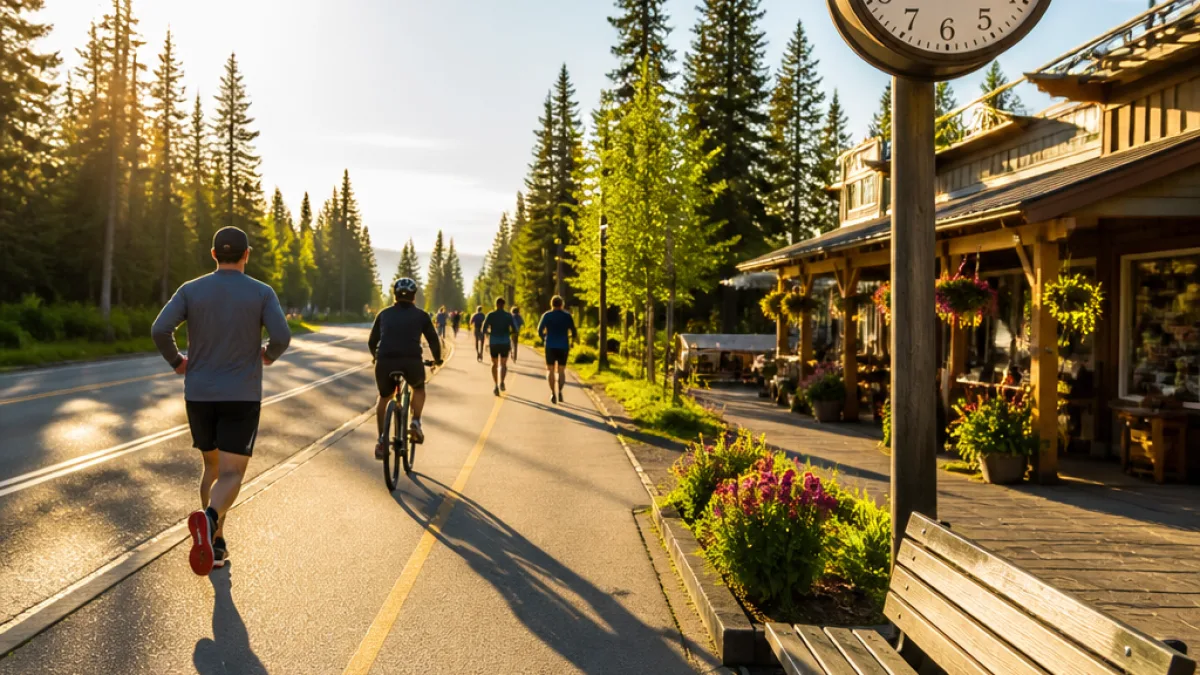
More than a month beyond the summer solstice, Fairbanks remains bathed in near-constant daylight. Joggers keep late hours along Farmers Loop and evening errands at local businesses feel like daytime. That persistent light does more than change our schedules — it also interacts with the internal timing systems of humans and wildlife.
How the sun sets (and doesn’t) our internal clocks
All animals carry an internal biological clock that cycles roughly every 24 hours, commonly called the circadian rhythm. That rhythm is typically synchronized, or “entrained,” by environmental cues, especially the rising and setting of the sun. But in Arctic summers, when dusk becomes a faint notion, the ways animals respond diverge.
“Some animals seem to lose the capacity to keep an entrained circadian clock under those conditions,” said Cory Williams, an associate professor at Colorado State University and a longtime researcher who received his Ph.D. from the University of Alaska Fairbanks. “Humans would fall into that category.”
“There have been a couple of studies on people in the high Arctic and in Antarctica without clocks. Their daily activity period drifts across time as they are unable to maintain a 24-hour rhythm.”
Williams’ observation echoes experiences here in Interior Alaska, where the long daylight stretches leave many residents feeling energized and prone to shifting their sleep and activity into late-night hours.
Varied responses across species
The way an animal sleeps and times activity during the Arctic summer depends on the species. Williams points to contrasts among humans, shorebirds, caribou and arctic ground squirrels. While humans may lose a consistently entrained 24-hour pattern in continuous daylight, other species show different strategies — some maintain daily rhythms, some shift patterns, and some exploit the unending daylight for expanded foraging or breeding activity.
- Humans: Studies indicate a tendency to lose a tightly entrained 24-hour activity cycle in polar environments without strong time cues.
- Other mammals and birds: Responses vary by species and ecological niche; some retain rhythms, others alter timing of activity.
- Local behavior: People in Fairbanks and similar communities often report staying active late into the night and rearranging routines during the long summer.
Local impact and everyday implications
For Fairbanks residents, the shift in routine is familiar: gardeners starting projects after midnight, late-night runs, and social calendars that stretch into the small hours. That pattern is partly cultural — many of us take advantage of the extended daylight — and partly physiological, as the typical day-night cue that helps stabilize sleep timing is weakened.
Williams explained that the human species’ evolutionary history likely factors into how readily our clocks are entrained. For most of human existence, people lived under consistent day-night cycles, and our more recent occupation of extreme latitudes is short on an evolutionary timescale. As a result, humans may be less able than some Arctic-adapted species to use subtler environmental signals to keep a strict 24-hour cycle in continuous daylight.
Summary table: what researchers observe
| Subject | Observed response in continuous daylight |
|---|---|
| Humans | Activity periods can drift; difficulty maintaining a strict 24-hour rhythm |
| Shorebirds, caribou, arctic ground squirrels | Responses vary by species; some maintain rhythms, others adapt timing of activity |
Researchers continue to study how different species interpret environmental cues beyond visible light, such as ultraviolet light or temperature cycles, to regulate their internal clocks. Those mechanisms may explain why animals that evolved in polar regions exhibit flexible or distinct timing strategies compared with humans.
Back in Fairbanks, the practical effects are obvious: late-night traffic on familiar roads, businesses staying open into bright nights, and people rearranging sleep schedules seasonally. Understanding the biological underpinnings clarifies why those patterns feel natural and persistent in summer, and why returning to shortened daylight in autumn often triggers a marked reversion to earlier bedtimes.
As researchers refine knowledge about circadian entrainment in Arctic conditions, residents and visitors can better appreciate that summer stamina here is not simply cultural exuberance — it reflects how life, human and animal alike, responds to an environment where the sun barely sets.
Erik Lindgren is the WE NEWS state correspondent covering Interior Alaska.
















