
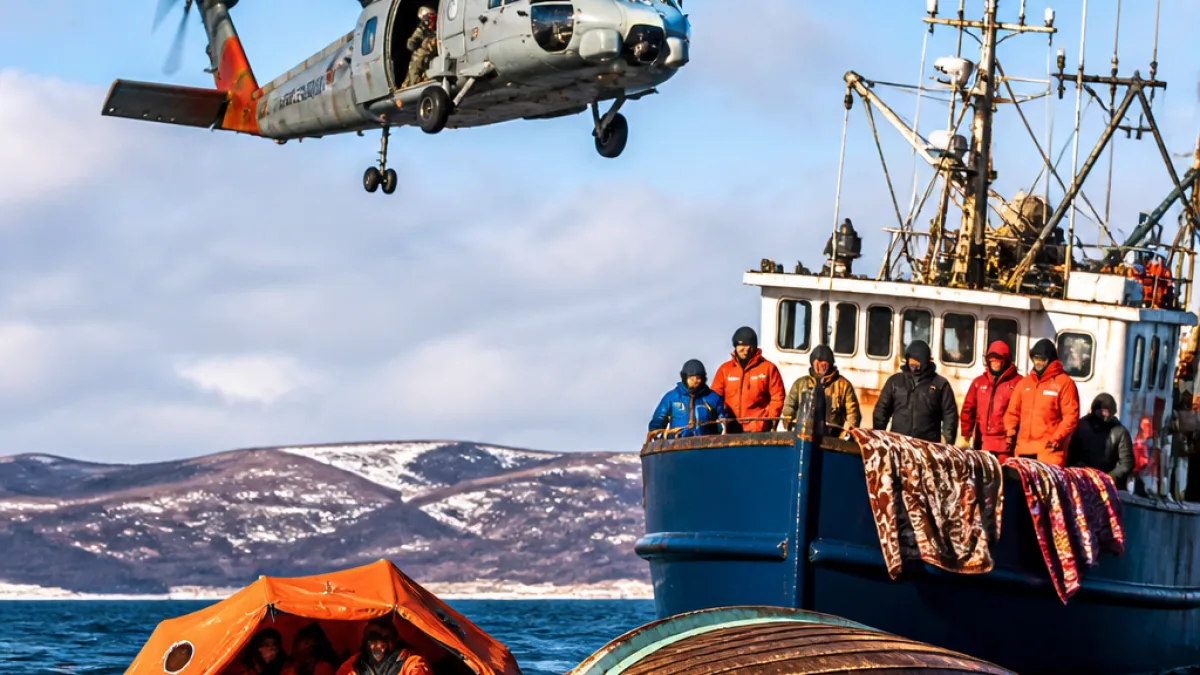
A 15-year-old boy was rescued Monday after spending almost two days atop an overturned skiff in the frigid waters near St. Lawrence Island, Alaska, while the bodies of his 35-year-old brother and a cousin were recovered, authorities and family members said.
Searchers spot survivor atop capsized vessel
Coast Guard aircrews from Kodiak located the teenager about four miles east of St. Lawrence Island and dropped a survival raft and equipment before guiding a nearby fishing vessel to the scene, according to rescue officials and local reporting. Crew aboard the commercial boat Northwest Explorer took the youth aboard and transported him to Nome for medical evaluation after treating him for hypothermia onboard.
The three — the 15-year-old, his brother Sidney Kulowiyi, 35, and a cousin — had departed the remote village of Savoonga on a fishing trip when they were thrown into the Bering Sea and their skiff overturned, relatives said.
Survivor reported brother trapped beneath skiff
According to Adam White, captain of the Northwest Explorer, the rescued teenager told crew members that his brother remained beneath the capsized vessel and that his cousin slipped away during the night before the rescue.
“Through the teeth chattering, he had mentioned that his brother was still under the skiff,”
The Coast Guard and the civilian crew later recovered the bodies of Kulowiyi and the cousin. Family members who set up a GoFundMe page said the teen had tried to hold on to both relatives during the ordeal.
Medical response and condition
Rescue personnel reported the youth was showing signs of hypothermia when he was brought aboard the Northwest Explorer. Crew members wrapped him in blankets and used hot packs to raise his body temperature en route to Nome, where he was taken for further care. Officials have not released his name beyond what family sources provided.
Timeline
| Event | Date/Time (local) |
|---|---|
| Skiff capsized, occupants thrown into water | During fishing trip (family reports) |
| Survivor spotted by Coast Guard HC-130 | Monday morning (Sept. 7) |
| Survivor recovered by Northwest Explorer; bodies recovered | Shortly after aerial sighting |
| Survivor transported to Nome | Monday (Sept. 7) |
Community impact and safety concerns
The incident underscores hazards facing residents of remote Bering Sea communities where subsistence fishing and small-boat travel are a daily reality. Cold water, swift weather changes and isolation complicate rescue efforts. Residents of Savoonga and nearby villages often rely on small skiffs to harvest food and move between islands, making preparedness and quick access to emergency resources critical.
Local leaders and search-and-rescue officials typically urge boaters in the region to carry survival gear, wear personal flotation devices and maintain reliable communications — advice echoed by villagers and mariners across Alaska.
Next steps and ongoing response
The Coast Guard coordinated the aerial spotting and drop of survival gear and worked with the Northwest Explorer to bring the survivor aboard. State or federal investigators customarily follow fatal boating incidents to document circumstances and determine if further safety recommendations are needed. As of Tuesday, no additional agency updates had been released.
- Survivor: 15-year-old boy rescued; treated for hypothermia.
- Fatalities: Brother, Sidney Kulowiyi, 35, and a cousin recovered.
- Location: About four miles east of St. Lawrence Island; departed Savoonga.
The community of Savoonga, on the northeastern side of St. Lawrence Island, is a close-knit Alaska Native village where losses at sea reverberate widely. Family members have organized a fundraising page to assist with expenses related to the deaths, according to relatives.
Search-and-rescue missions in the region rely on a combination of Coast Guard aviation assets, nearby commercial vessels and community responders. The recoveries in this case highlight both the dangers of operating on the Bering Sea and the role of coordinated response in bringing survivors to safety.


















