WASHINGTON — The federal government has released a long-delayed package of grants totaling $410 million for the Alaska Marine Highway System, state and federal officials announced Friday, delivering funding that state leaders say will stabilize ferry service while renewing debate over a controversial terminal project.
Funding fills critical operating gap
The largest portion of the award — $161.2 million — is targeted to cover ferry operations through 2027. Alaska officials said the infusion could account for roughly half of the system’s operating costs in the near term, a relief after a year in which federal ferry grants were frozen and state officials warned of possible schedule reductions and service cuts.
Governor Mike Dunleavy and Transportation Commissioner Ryan Anderson traveled to Washington earlier this year to press administration officials to free the money. Their lobbying came after the Trump administration held up dozens of congressionally approved funding streams, including the ferry grants that support connections between Southeast communities, Prince William Sound, Kodiak and points along the Aleutian chain.
Major projects among awards; Cascade Point draws scrutiny
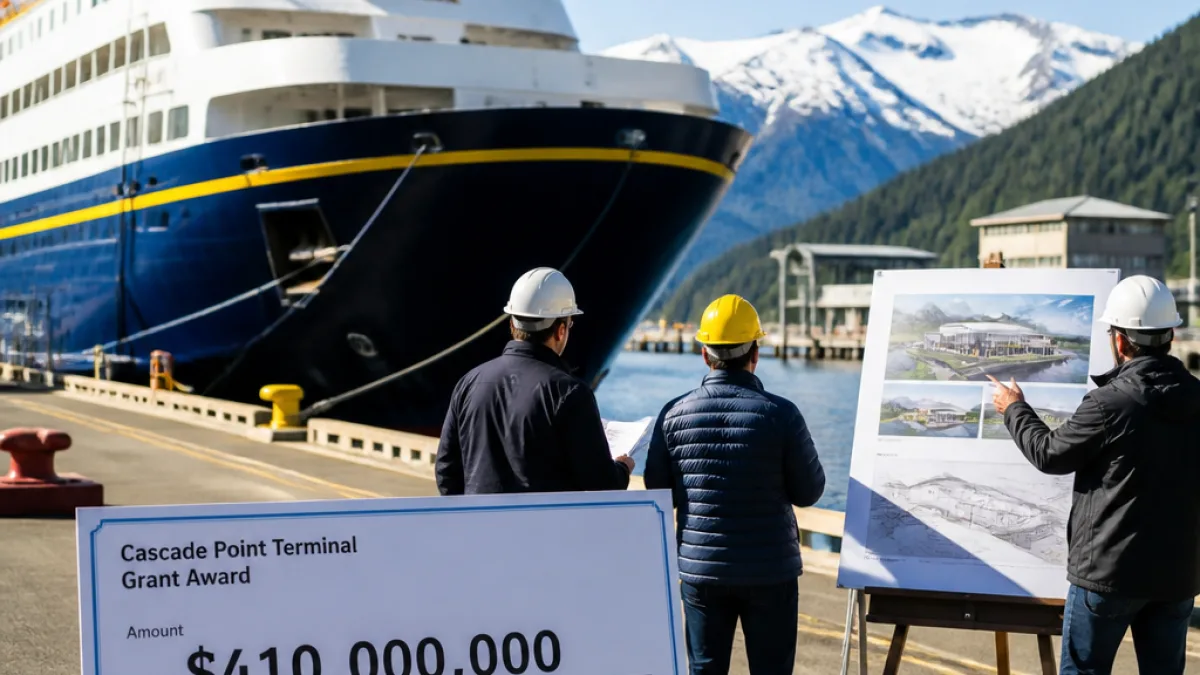
Alongside operational support, the federal awards include money for capital projects. The package contains $37.6 million designated for the Cascade Point terminal — a planned Alaska Marine Highway System facility roughly 28 miles north of Juneau that has prompted opposition from an oversight board and residents of communities expected to use it.
The Dunleavy administration has pushed the Cascade Point terminal, while critics have argued it does not align with the ferry system’s long-range plan. An economic analysis commissioned by the Alaska Department of Transportation found the terminal could benefit a proposed mine in the area, a connection that has added to local skepticism.
Other awards announced this week include $153.4 million to replace the M/V LeConte, a 52-year-old Alaska Marine Highway vessel that has been a workhorse on Southeast routes.
What the money means for communities
Ferry service is a lifeline for many coastal towns, carrying passengers, vehicles, freight and access to medical care. The infusion of federal dollars should reduce the immediacy of proposed schedule cuts and cost-containment measures that state officials warned could affect small communities that lack road connections.
Local leaders and residents in Southeast Alaska have closely watched developments as the state increasingly leaned on federal support to keep the system operating. The relief from the funding release will likely be welcomed by communities that rely on regular ferry sailings for commerce and routine travel.
Remaining questions and oversight concerns
Despite the funding, questions remain about long-term financing and governance of the ferry system. The oversight board that has opposed the Cascade Point project also questioned the administration’s rationale for pursuing it; board members said the project did not align with the marine highway’s long-range plan when they discussed it in October 2025.
Critics have raised concerns about whether some capital investments are being advanced for reasons other than serving the broadest system needs. The link in the analysis between the Cascade Point terminal and a proposed mine near the site has amplified those concerns.
- Total federal award: $410 million
- Operations through 2027: $161.2 million
- Cascade Point terminal: $37.6 million
- M/V LeConte replacement: $153.4 million
| Purpose | Amount |
|---|---|
| Operations through 2027 | $161.2 million |
| Cascade Point terminal | $37.6 million |
| M/V LeConte replacement | $153.4 million |
| Total | $410 million |
State officials have framed the federal release as a necessary step to maintain service levels while longer-term budgeting and capital planning continue. The awards do not, however, resolve debates over project prioritization or the marine highway’s strategy for vessel replacement and terminal siting.
For now, the funding will allow the Alaska Marine Highway System to plan operations with greater certainty through 2027. But community leaders and oversight board members say they will continue pressing for transparency and alignment between investments and the system’s stated long-range goals.
As the system moves into the next operating period, the focus will likely shift from securing emergency federal support to setting a sustainable course for maintenance, vessel renewal and terminal projects that serve the widest range of Alaska’s coastal communities.